Indiana Science HS-PSII-9.5
The Standard
Develop graphical and mathematical representations that describe the relationship between the wavelength of monochromatic light, spacing between slits, distance to screen, and interference pattern produced for a double-slit scenario and apply those representations to qualitatively and quantitatively describe how changing any of the independent variables affects the position of the bright fringes.
Indiana Academic Standards for Science (2023) · Particle and Wave Nature of Light
Teacher's field guide
What This Standard Means
What Students Need to Do
- Students sketch a double-slit pattern and graph each bright fringe’s distance from the center against its fringe number. They use the wavelength, slit spacing, and screen distance to calculate fringe positions and predict how the pattern changes.
What Mastery Looks Like
- Students label the center and first few bright fringes, then plot their positions. They calculate that doubling the wavelength or screen distance doubles fringe spacing, while doubling slit spacing halves it.
Common Misconceptions
- Students may think wider slit spacing spreads the fringes farther apart, or that changing a variable moves the center fringe. They may measure from the edge of the screen instead of the center, or forget to convert nanometers and millimeters to meters.
How to Assess It
- Exit ticket: For 600 nm light, slits 0.30 mm apart, and a screen 2.0 m away, calculate and mark the first bright fringe’s distance from center. Repeat after doubling slit spacing.
Lesson moves
Ways to Teach It
At a fixed low-power laser station, measure fringe spacing with a ruler, then compare two double-slit slides with different spacing.
Draw fringe position versus fringe number for two slit spacings, then explain why one line is steeper.
Give pairs cards showing wavelength, slit spacing, and screen distance; have them calculate fringe spacing and rank three patterns from widest to narrowest.
Give students an optics-lab pattern with a scale bar, slit spacing, and screen distance; have them calculate the unknown laser’s wavelength.
Free download
Printable HS-PSII-9.5 Worksheet
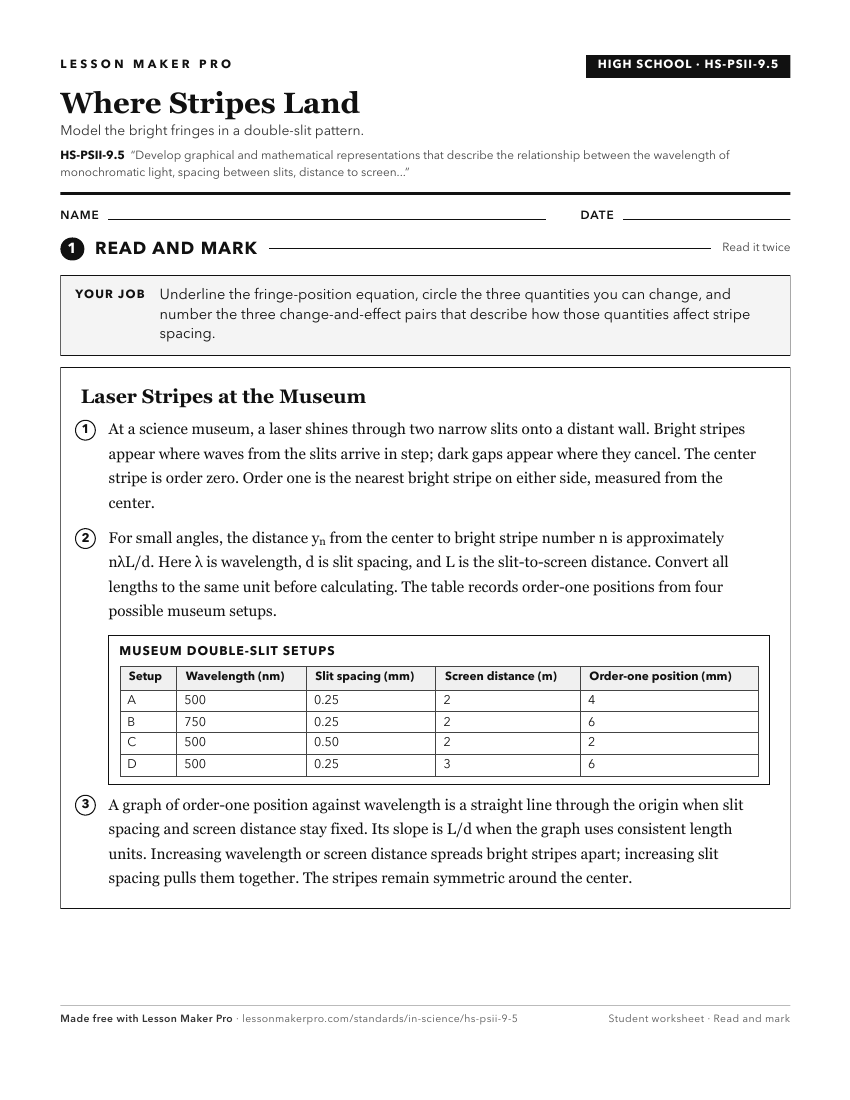
A ready-to-print activity worksheet aligned to HS-PSII-9.5, with an answer key for the teacher on its own page. No account needed.
PDF, US Letter, prints cleanly in black and white.
Download the worksheetKeep exploring
Related Standards
- HS-PSII-9.3
Develop graphical and mathematical representations that describe the relationship between the frequency of a photon and the kinetic energy of an electron emitte...
- HS-PSII-8.2
Develop graphical, mathematical, and pictorial representations (e.g., ray diagrams) that describe the relationship between the angles of incidence and refractio...
- HS-PSII-9.6
Develop graphical and mathematical representations that describe the relationship between the angle between two polarizing filters and the intensity of light pa...
- HS-PSII-8.1
Develop graphical, mathematical, and pictorial representations (e.g., ray diagrams) that describe the relationships between the focal length, the image distance...
Turn this exact standard into a lesson
Grade, subject, topic, and the complete standard are prefilled. Create one free, no account needed.
Also for this standard:Make a WorksheetMake a QuizMake a Sub Lesson