Indiana Science HS-PSII-8.1
The Standard
Develop graphical, mathematical, and pictorial representations (e.g., ray diagrams) that describe the relationships between the focal length, the image distance, and the object distance for planar, converging, and diverging mirrors and apply those representations to qualitatively and quantitatively describe how changing the object distance affects the image distance.
Indiana Academic Standards for Science (2023) · Geometric Optics
Teacher's field guide
What This Standard Means
What Students Need to Do
- Students draw rays for flat, concave, and convex mirrors to locate images. They use focal length and object distance to calculate image distance for curved mirrors. They predict how moving an object shifts its image.
What Mastery Looks Like
- A student draws rays that locate real and virtual images, then checks a curved mirror diagram with 1/f = 1/do + 1/di. They use negative values for virtual image distance and convex focal length. For a flat mirror, they place the image as far behind the mirror as the object is in front.
Common Misconceptions
- Students may draw reflected rays meeting behind a convex mirror instead of extending them backward. They may make every image distance positive or give a flat mirror a focal point. Some assume an image always moves toward the mirror when the object moves toward it.
How to Assess It
- Exit ticket: A concave mirror has a 10 cm focal length. For objects 30 cm and 20 cm from the mirror, calculate each image distance, sketch two rays for each, and say which way the image moved.
Lesson moves
Ways to Teach It
Place a small LED in front of a concave makeup mirror, catch its image on white paper, and measure both distances with a ruler.
Ask, 'Why does your image in a bathroom mirror seem farther away when you step back?' Have students explain with a ray sketch.
Give pairs concave and convex mirror cards with focal lengths and object distances; have them calculate image distances and check with ray sketches.
Sketch a passenger-side car mirror beside a bathroom mirror; explain why cars look smaller in one but not the other.
Free download
Printable HS-PSII-8.1 Worksheet
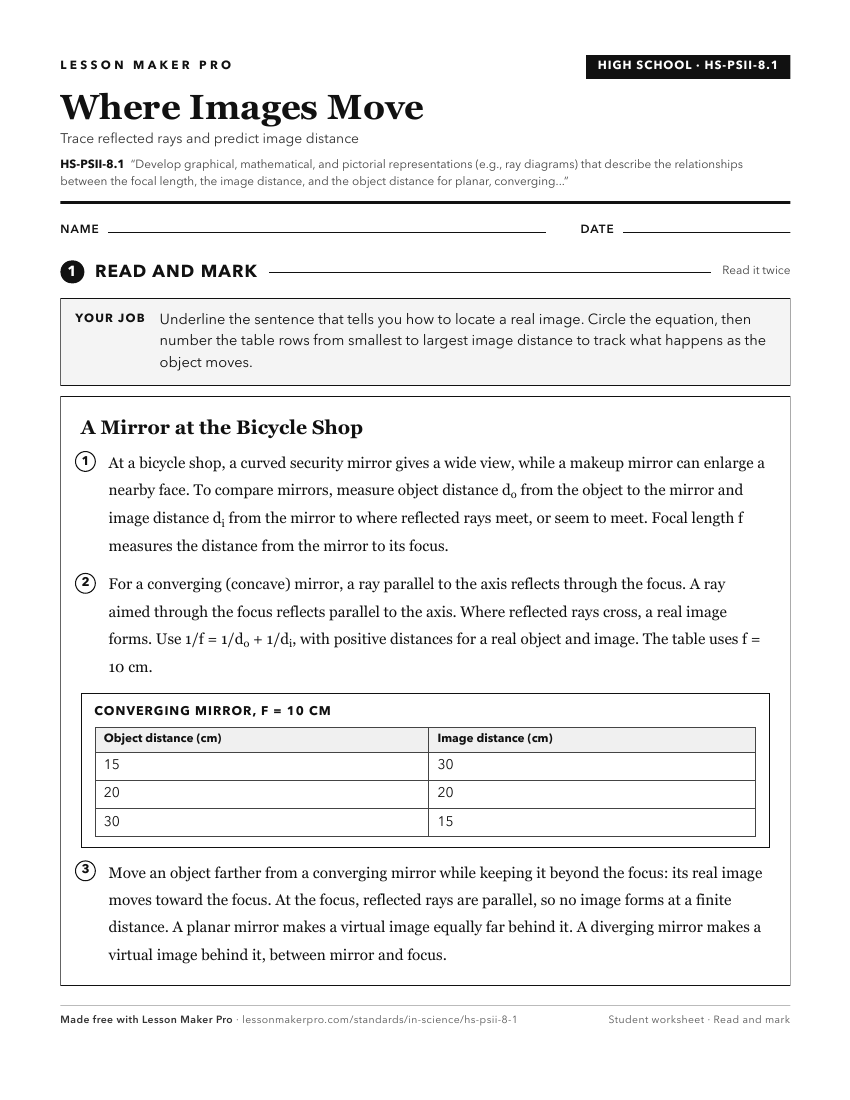
A ready-to-print activity worksheet aligned to HS-PSII-8.1, with an answer key for the teacher on its own page. No account needed.
PDF, US Letter, prints cleanly in black and white.
Download the worksheetKeep exploring
Related Standards
- HS-PSII-8.2
Develop graphical, mathematical, and pictorial representations (e.g., ray diagrams) that describe the relationship between the angles of incidence and refractio...
- HS-PSII-8.3
Develop graphical, mathematical, and pictorial representations (e.g., ray diagrams) that describe the relationships between the focal length, the image distance...
- HS-PSII-9.5
Develop graphical and mathematical representations that describe the relationship between the wavelength of monochromatic light, spacing between slits, distance...
- HS-PSII-8.4
Describe an image as real or virtual for both a curved mirror and lens system based on the position of the image relative to the optical device.
Turn this exact standard into a lesson
Grade, subject, topic, and the complete standard are prefilled. Create one free, no account needed.
Also for this standard:Make a WorksheetMake a QuizMake a Sub Lesson