Indiana Science HS-PSII-5.2
The Standard
Develop graphical and mathematical representations that describe the relationship between the between the amount of current passing through an ohmic device and the amount of voltage (i.e., EMF) applied across the device according to Ohm’s Law. Apply those representations to qualitatively and quantitatively describe how changing the current affects the voltage and vice versa for an ohmic device of known resistance.
Indiana Academic Standards for Science (2023) · Simple and Complex Circuits
Teacher's field guide
What This Standard Means
What Students Need to Do
- Students measure or calculate current through a fixed resistor at several voltages. They graph voltage against current, write V = IR, and use both to predict how one changes when the other changes.
What Mastery Looks Like
- Their voltage-versus-current graph is a straight line through the origin, with a slope equal to resistance. For a 100-ohm resistor, they can predict that raising voltage from 2 V to 3 V raises current from 20 mA to 30 mA.
Common Misconceptions
- Students may switch the graph axes but still call the slope resistance. They may think doubling voltage doubles resistance, or put milliamps into V = IR without converting to amps.
How to Assess It
- On an exit ticket, ask students to graph voltage against current for a 100-ohm resistor at 0, 10, and 20 mA, then predict the voltage at 30 mA.
Lesson moves
Ways to Teach It
Pairs use a DC supply and meters to record voltage across and current through a 100-ohm resistor at three settings, then graph.
Ask: A 100-ohm resistor carries 20 mA at 2 V. What happens to current at 4 V? Explain.
Hand out cards with 50-ohm and 100-ohm resistors, 1 V and 2 V supplies, and current values; pairs race to match them.
Compare a 220-ohm resistor powered by a 5 V USB supply and a 3 V battery; calculate current in each setup.
Free download
Printable HS-PSII-5.2 Worksheet
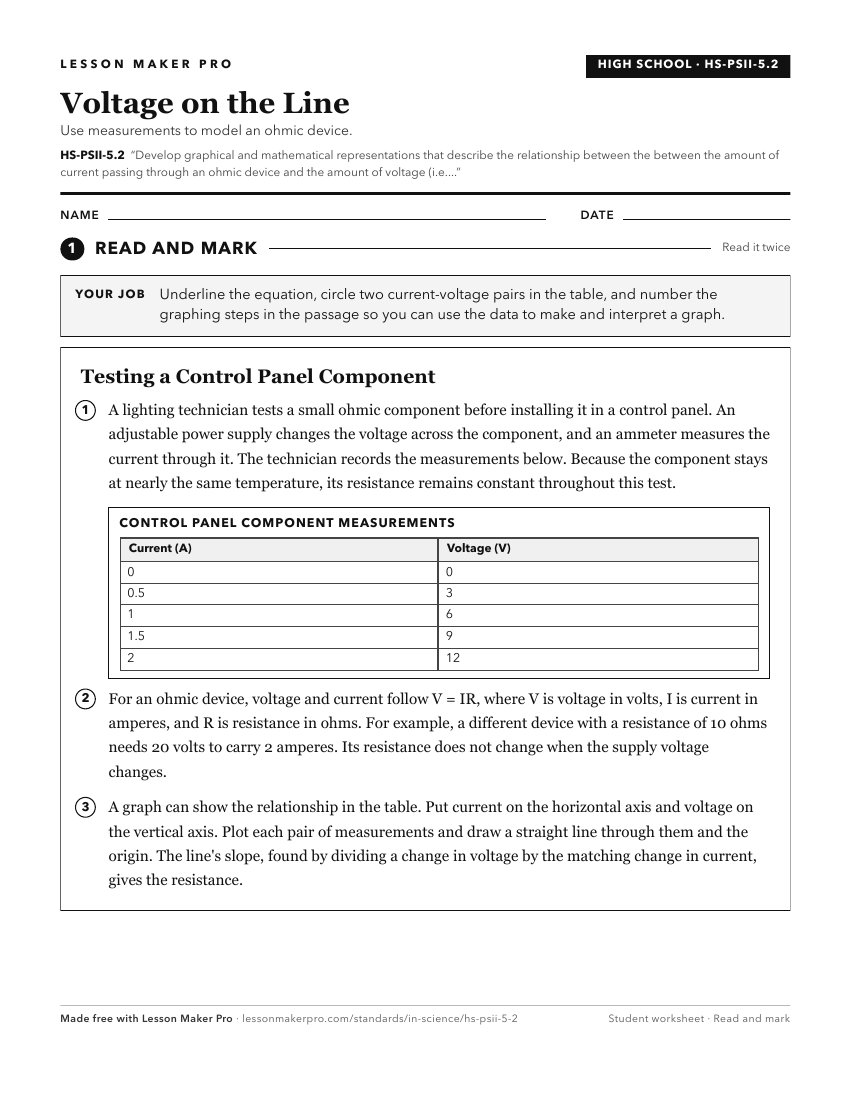
A ready-to-print activity worksheet aligned to HS-PSII-5.2, with an answer key for the teacher on its own page. No account needed.
PDF, US Letter, prints cleanly in black and white.
Download the worksheetKeep exploring
Related Standards
- HS-PSII-9.3
Develop graphical and mathematical representations that describe the relationship between the frequency of a photon and the kinetic energy of an electron emitte...
- HS-PSII-5.4
Define and describe a device as ohmic or non-ohmic based on the relationship between the current passing through the device and the voltage across the device ba...
- HS-PSII-7.2
Develop graphical and mathematical representations that describe the relationship between the rate of change of magnetic flux and the amount of voltage induced ...
- HS-PSII-6.2
Develop and apply a mathematical representation that describes the relationship between the magnetic field created by a long straight wire carrying an electric ...
Turn this exact standard into a lesson
Grade, subject, topic, and the complete standard are prefilled. Create one free, no account needed.
Also for this standard:Make a WorksheetMake a QuizMake a Sub Lesson