Indiana Science HS-PSII-5.4
The Standard
Define and describe a device as ohmic or non-ohmic based on the relationship between the current passing through the device and the voltage across the device based on the shape of the curve of a current vs. voltage or voltage vs. current graphical representation.
Indiana Academic Standards for Science (2023) · Simple and Complex Circuits
Teacher's field guide
What This Standard Means
What Students Need to Do
- Students use voltage and current graphs to tell whether a device's resistance stays the same as voltage changes. They make that call whether voltage or current is on the horizontal axis.
What Mastery Looks Like
- A student identifies a straight line through the origin as ohmic and a curved line as non-ohmic. They explain that voltage divided by current stays the same for the straight line but changes for the curved one.
Common Misconceptions
- Students may call any rising graph ohmic, even if it curves or misses the origin. They may also think the slope always gives resistance, even when current is on the vertical axis.
How to Assess It
- Give students two current-versus-voltage graphs, one straight through the origin and one curved. Ask them to label each device and explain which has constant resistance.
Lesson moves
Ways to Teach It
Connect a 6 V bulb and a 220 Ω resistor separately to a variable supply; measure voltage and current at five settings.
Show a straight graph and a curved graph, then ask, “How can you tell which device has constant resistance?”
Give pairs graph cards with both axis orders; have students sort them as ohmic or non-ohmic and explain each choice.
Show an LED current-voltage graph; ask students why a simple battery-powered LED circuit includes a current-limiting resistor.
Free download
Printable HS-PSII-5.4 Worksheet
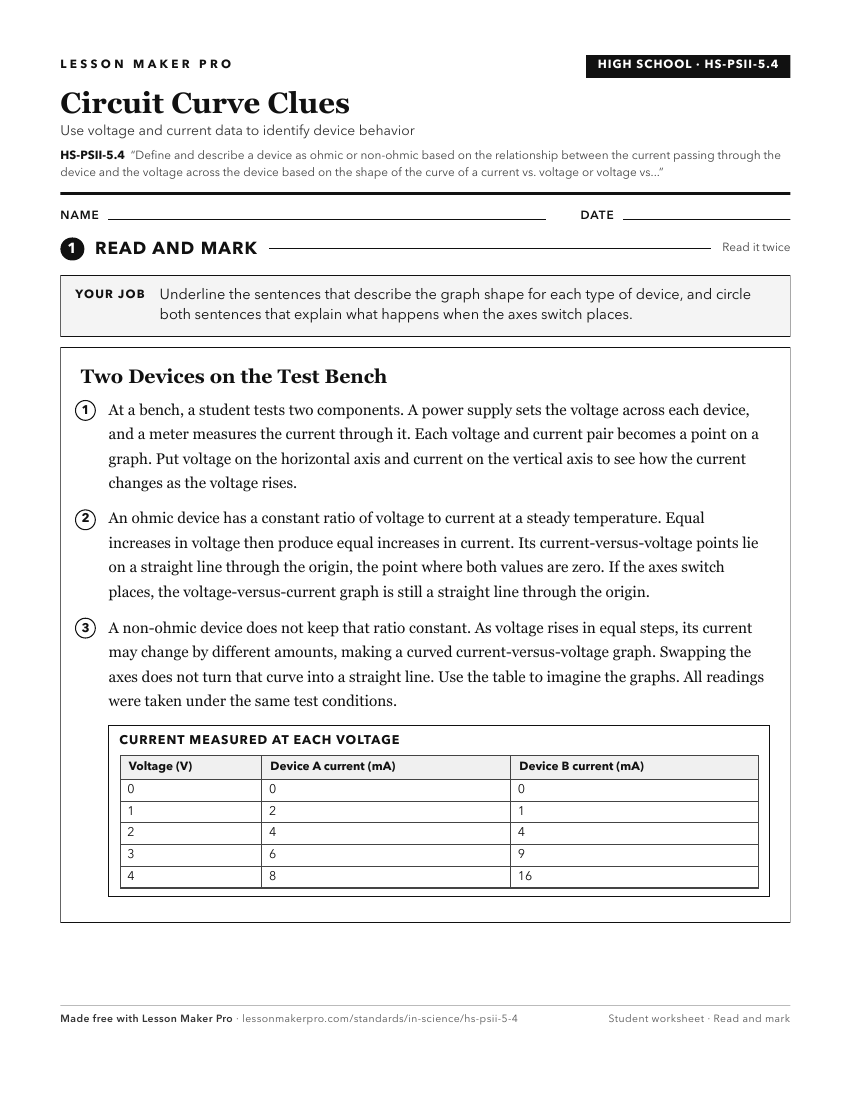
A ready-to-print activity worksheet aligned to HS-PSII-5.4, with an answer key for the teacher on its own page. No account needed.
PDF, US Letter, prints cleanly in black and white.
Download the worksheetKeep exploring
Related Standards
- HS-PSII-5.2
Develop graphical and mathematical representations that describe the relationship between the between the amount of current passing through an ohmic device and ...
- HS-PSII-7.2
Develop graphical and mathematical representations that describe the relationship between the rate of change of magnetic flux and the amount of voltage induced ...
- HS-PSII-5.3
Describe the slope of the graphical representation of current vs. voltage or voltage vs. current in terms of the resistance of the device.
- HS-PSII-6.2
Develop and apply a mathematical representation that describes the relationship between the magnetic field created by a long straight wire carrying an electric ...
Turn this exact standard into a lesson
Grade, subject, topic, and the complete standard are prefilled. Create one free, no account needed.
Also for this standard:Make a WorksheetMake a QuizMake a Sub Lesson