Georgia SS7H3
Georgia Standard (Element Cluster)
Analyze continuity and change in Southern and Eastern Asia.
Georgia Standards of Excellence for Social Studies
Cluster contents
Elements in This Standard
SS7H3 is a Georgia social studies standard. These are the elements under it.
- SS7H3.a
Describe how nationalism led to independence in India.
- SS7H3.b
Describe the impact of Mohandas Gandhi's belief in non-violent protest.
- SS7H3.c
Explain the role of the United States in the rebuilding of Japan after WWII.
- SS7H3.d
Describe the impact of communism in China in terms of Mao Zedong, the Great Leap Forward, the Cultural Revolution, and Tiananmen Square.
- SS7H3.e
Explain the reasons for foreign involvement in Korea and Vietnam in terms of containment of communism.
Teacher's field guide
What This Cluster Means
What Students Need to Do
- Students build cause-and-effect accounts of Indian independence, Japan’s postwar rebuilding, Communist China, and wars in Korea and Vietnam. They identify what changed, what continued, and how nationalism, nonviolent protest, communism, and containment shaped events. They use leaders, policies, events, and outcomes as evidence.
What Mastery Looks Like
- A student can explain how nationalism and Gandhi’s nonviolent methods helped India gain independence. They can describe U.S. actions in Japan and distinguish the Great Leap Forward, Cultural Revolution, and Tiananmen Square protests. They can explain containment as a reason foreign powers entered Korea and Vietnam.
Common Misconceptions
- Students often treat Indian independence as Gandhi’s work alone and confuse nonviolent resistance with passivity. They may assume the United States rebuilt Japan only with money. They also mix up Chinese events and describe Korea and Vietnam as only civil wars, missing Cold War containment.
How to Assess It
- Give students this exit prompt: “Choose India, Japan, China, Korea, or Vietnam. Name one major change, one continuity, and two facts that support your choices.”
Lesson moves
Ways to Teach It
Give pairs event cards from India, Japan, China, Korea, and Vietnam to place on a timeline and connect with cause-and-effect arrows.
Ask students: Which changed daily life more, Indian independence, Japan’s rebuilding, or Mao’s campaigns, and what evidence supports your claim?
Run a containment match game where teams pair Korea and Vietnam event cards with the foreign power, motive, and outcome.
Compare a current map with a 1945 map, then label borders and governments shaped by independence, occupation, communism, and Cold War conflict.
Free download
Printable SS7H3 Worksheet
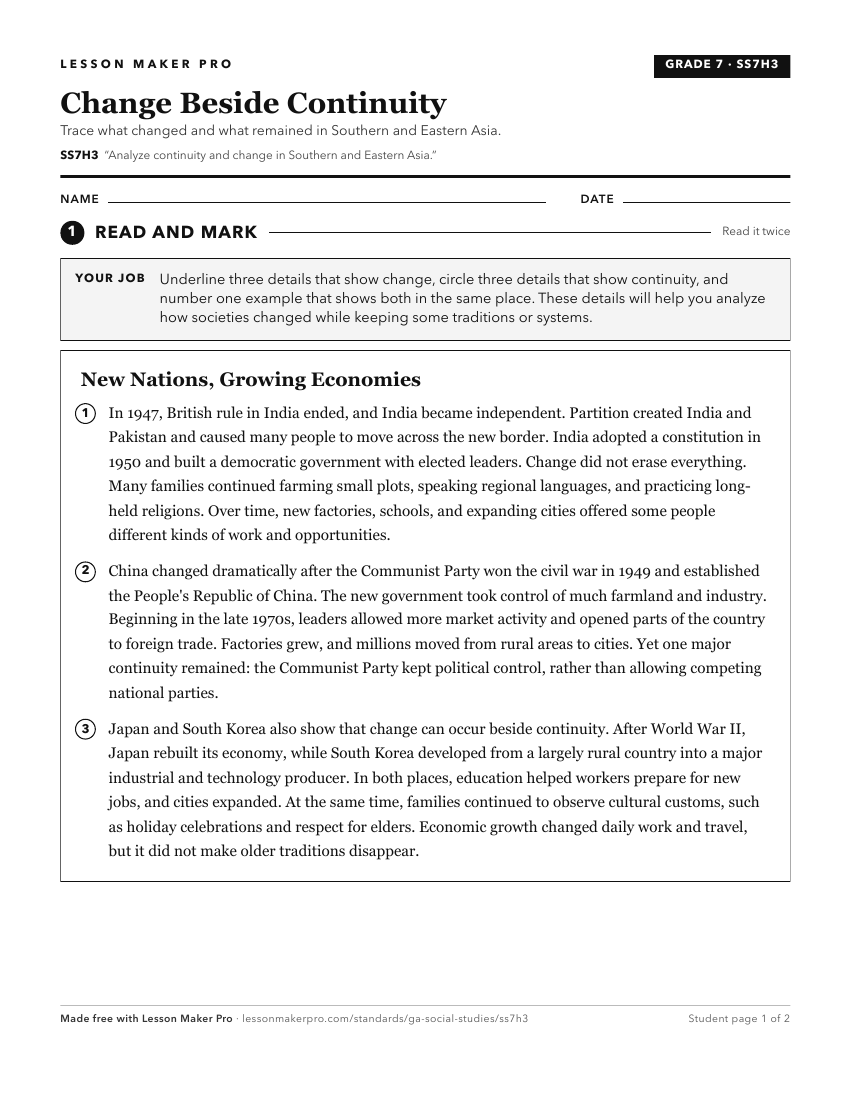
A ready-to-print activity worksheet aligned to SS7H3, with an answer key for the teacher on its own page. No account needed.
PDF, US Letter, prints cleanly in black and white.
Download the worksheetKeep exploring
Related Standards
Turn this cluster into a lesson
Grade, subject, topic, and the complete cluster are prefilled. Create one free, no account needed.
Also for this cluster:Make a WorksheetMake a QuizMake a Sub Lesson