Georgia SS7H3.b
The Standard
- SS7H3
- Analyze continuity and change in Southern and Eastern Asia.
Describe the impact of Mohandas Gandhi's belief in non-violent protest.
Georgia Standards of Excellence for Social Studies · Analyze continuity and change in Southern and Eastern Asia.
Teacher's field guide
What This Standard Means
What Students Need to Do
- Students explain how marches, boycotts, and civil disobedience drew people into India's independence movement. They connect these methods to British pressure, Indian independence, and later civil rights movements.
What Mastery Looks Like
- Students can trace a clear chain from a peaceful protest method to public participation, British response, and political change. They support the chain with examples such as the Salt March.
Common Misconceptions
- Students may think Gandhi won independence alone or that every protest stayed peaceful. They may also confuse nonviolence with passivity or assume Britain left India immediately after one protest.
How to Assess It
- Give students this exit prompt: Explain one way Gandhi's nonviolent methods helped India move toward independence. Include one named action and one result.
Lesson moves
Ways to Teach It
Give pairs cards on the Salt March, boycotts, arrests, and independence, then have them build and explain a cause-and-effect chain.
Ask students to write: How can refusing to cooperate weaken a government, and what risks did Gandhi's followers face?
Play Impact Match, where teams pair protest methods with outcomes, then defend each match using evidence from a short source set.
Present a school issue, such as cafeteria waste, and have students plan a peaceful campaign using petitions, boycotts, or public messages.
Free download
Printable SS7H3.b Worksheet
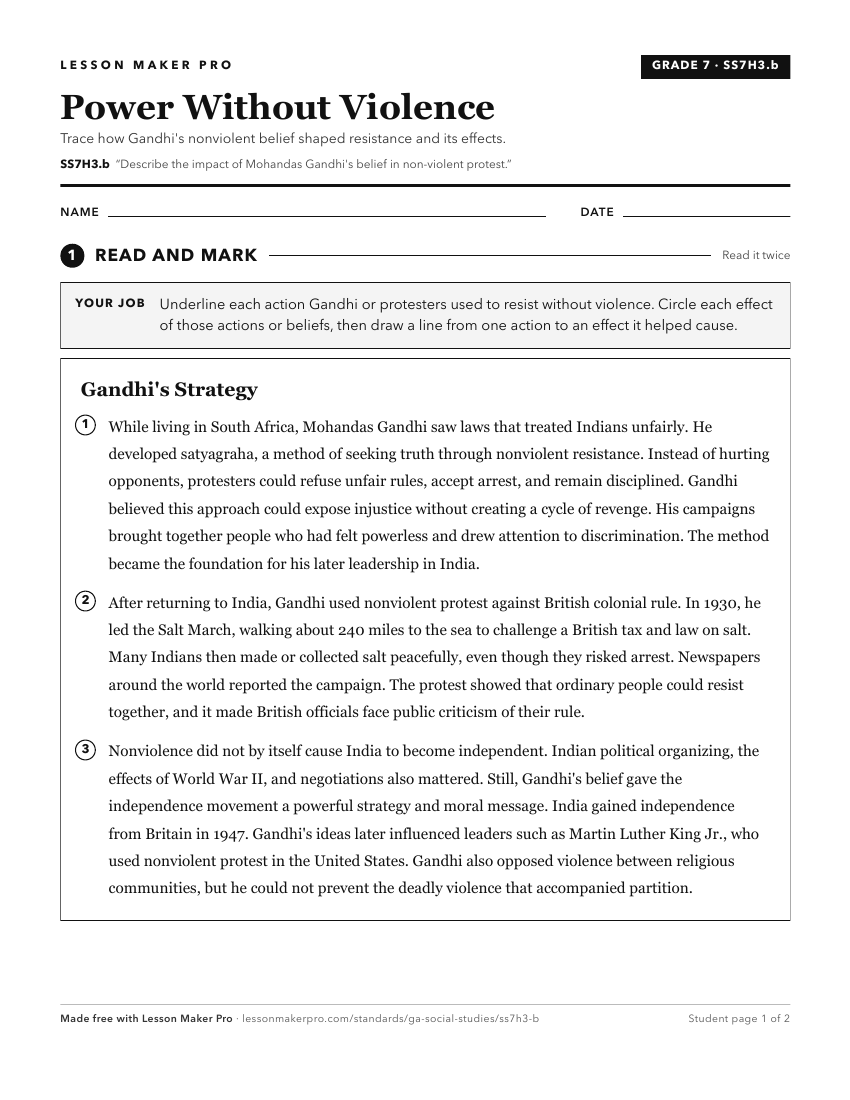
A ready-to-print activity worksheet aligned to SS7H3.b, with an answer key for the teacher on its own page. No account needed.
PDF, US Letter, prints cleanly in black and white.
Download the worksheetKeep exploring
Related Standards
- SS5H6.c
Describe the impact on American society of the assassinations of President John F. Kennedy, Robert F. Kennedy, and Martin Luther King, Jr.
- SS7H3.d
Describe the impact of communism in China in terms of Mao Zedong, the Great Leap Forward, the Cultural Revolution, and Tiananmen Square.
- SS8H11.b
Describe the role of individuals (Martin Luther King, Jr. and John Lewis), groups (SNCC and SCLC) and events (Albany Movement and March on Washington) in the Ci...
- SS7H3.a
Describe how nationalism led to independence in India.
Turn this exact standard into a lesson
Grade, subject, topic, and the complete standard are prefilled. Create one free, no account needed.
Also for this standard:Make a WorksheetMake a QuizMake a Sub Lesson