Georgia L6-8RHSS8
The Standard
Distinguish among fact, opinion, and reasoned judgment in a text.
Georgia Standards of Excellence for Social Studies
Teacher's field guide
What This Standard Means
What Students Need to Do
- Students decide whether a statement can be verified, expresses a personal belief, or reaches a conclusion supported by evidence. They identify words and details that support each classification.
What Mastery Looks Like
- Students accurately classify statements in a history or social studies source and explain their choices. They recognize that a reasoned judgment interprets evidence rather than simply stating a preference.
Common Misconceptions
- Students may treat any confident statement as a fact or any evaluative statement as an unsupported opinion. They may also confuse an evidence-based conclusion with a directly verifiable detail.
How to Assess It
- Give students these three statements: “Atlanta is Georgia’s capital,” “Savannah is Georgia’s best city,” and “Atlanta’s rail connections made it a practical capital.” Ask them to label each and explain why.
Lesson moves
Ways to Teach It
Give groups nine claim cards from a textbook passage to sort into three labeled folders, then require evidence for each placement.
Ask students to explain in writing how a reasoned judgment differs from a personal preference.
Run a three-corner game where students move to fact, opinion, or reasoned judgment after hearing each historical claim.
Have students annotate a local news article by labeling one verifiable detail, one personal view, and one evidence-based conclusion.
Free download
Printable L6-8RHSS8 Worksheet
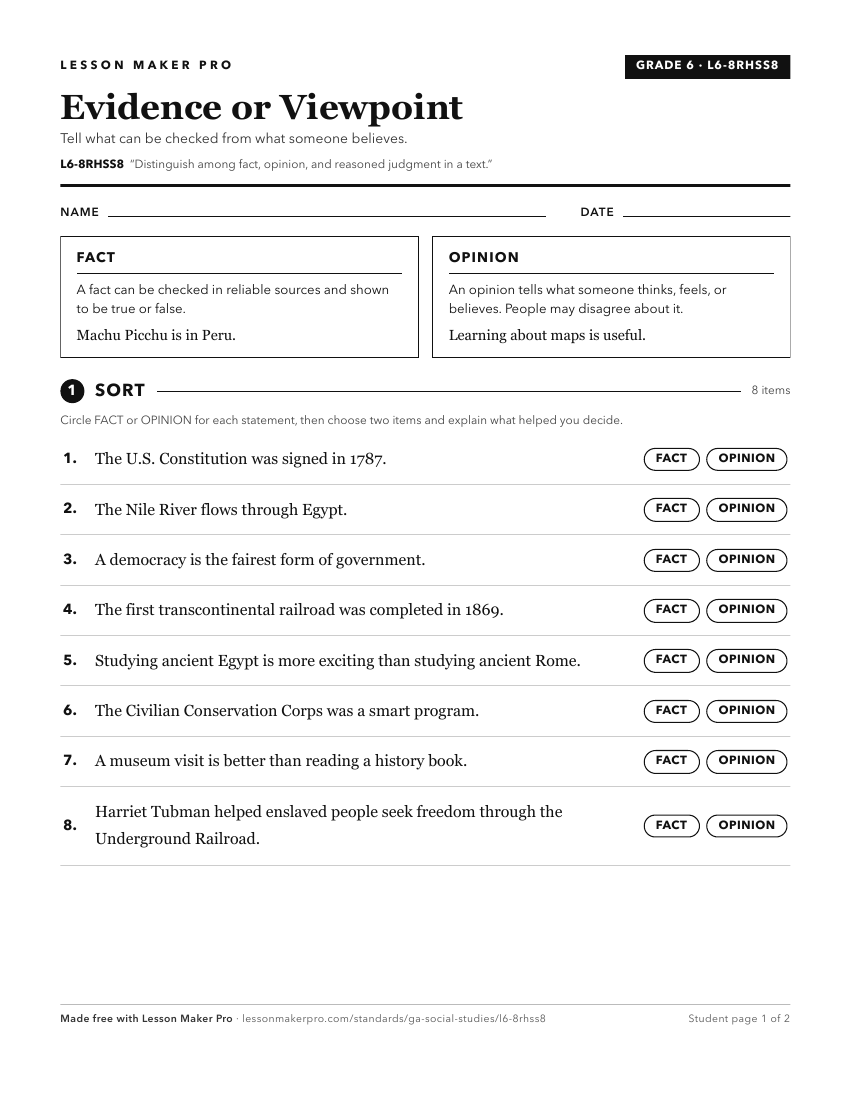
A ready-to-print activity worksheet aligned to L6-8RHSS8, with an answer key for the teacher on its own page. No account needed.
PDF, US Letter, prints cleanly in black and white.
Download the worksheetKeep exploring
Related Standards
- L6-8WHST9
Draw evidence from informational texts to support analysis reflection, and research.
- L6-8WHST1.b
Support claim(s) with logical reasoning and relevant, accurate data and evidence that demonstrate an understanding of the topic or text, using credible sources.
- L6-8RHSS5
Describe how a text presents information (e.g., sequentially, comparatively, causally).
- L6-8RHSS6
Identify aspects of a text that reveal an author’s point of view or purpose (e.g., loaded language, inclusion or avoidance of particular facts).
Turn this exact standard into a lesson
Grade, subject, topic, and the complete standard are prefilled. Create one free, no account needed.
Also for this standard:Make a WorksheetMake a QuizMake a Sub Lesson