Georgia 6.NR.4
Georgia Standard (Expectation Cluster)
Solve a variety of contextual problems involving ratios, unit rates, equivalent ratios, percentages, and conversions within measurement systems using proportional reasoning.
Georgia's K-12 Mathematics Standards
Cluster contents
Expectations in This Standard
6.NR.4 is a Georgia mathematics standard. These are the expectations under it.
- 6.NR.4.1
Explain the concept of a ratio, represent ratios, and use ratio language to describe a relationship between two quantities.
- 6.NR.4.2
Make tables of equivalent ratios relating quantities with whole-number measurements, find missing values in the tables, and plot the pairs of values on the coor...
- 6.NR.4.3
Solve problems involving proportions using a variety of student-selected strategies.
- 6.NR.4.4
Describe the concept of rates and unit rate in the context of a ratio relationship.
- 6.NR.4.5
Solve unit rate problems including those involving unit pricing and constant speed.
- 6.NR.4.6
Calculate a percent of a quantity as a rate per 100 and solve everyday problems given a percent.
- 6.NR.4.7
Use ratios to convert within measurement systems (customary and metric) to solve authentic problems that exist in everyday life.
Teacher's field guide
What This Cluster Means
What Students Need to Do
- Students solve real situations by comparing quantities, finding unit rates, building equivalent ratios, and calculating percentages. They convert measurements within one system and explain their reasoning with tables, diagrams, equations, or words.
What Mastery Looks Like
- Students choose a ratio table, double number line, equation, or unit rate and label units throughout. They find reasonable answers and explain how the quantities scale together.
Common Misconceptions
- Students may add the same amount to both quantities instead of multiplying by the same factor. They may reverse a unit rate, treat a percent as a whole number, or mix units before calculating.
How to Assess It
- Give this exit ticket: “A 12-ounce drink costs $1.80. Find the cost per ounce and the cost of 20 ounces at the same rate.”
Lesson moves
Ways to Teach It
Give pairs measuring cups and colored water to create and compare drink mixtures with equivalent ratios.
Ask students to write which is the better buy, 8 notebooks for $10 or 12 for $14, and justify with unit rates.
Play Ratio Match with cards showing tables, diagrams, fractions, decimals, and percentages that represent equivalent relationships.
Use grocery ads to calculate sale prices, compare package costs, and convert ounces to pounds before choosing the better deal.
Free download
Printable 6.NR.4 Worksheet
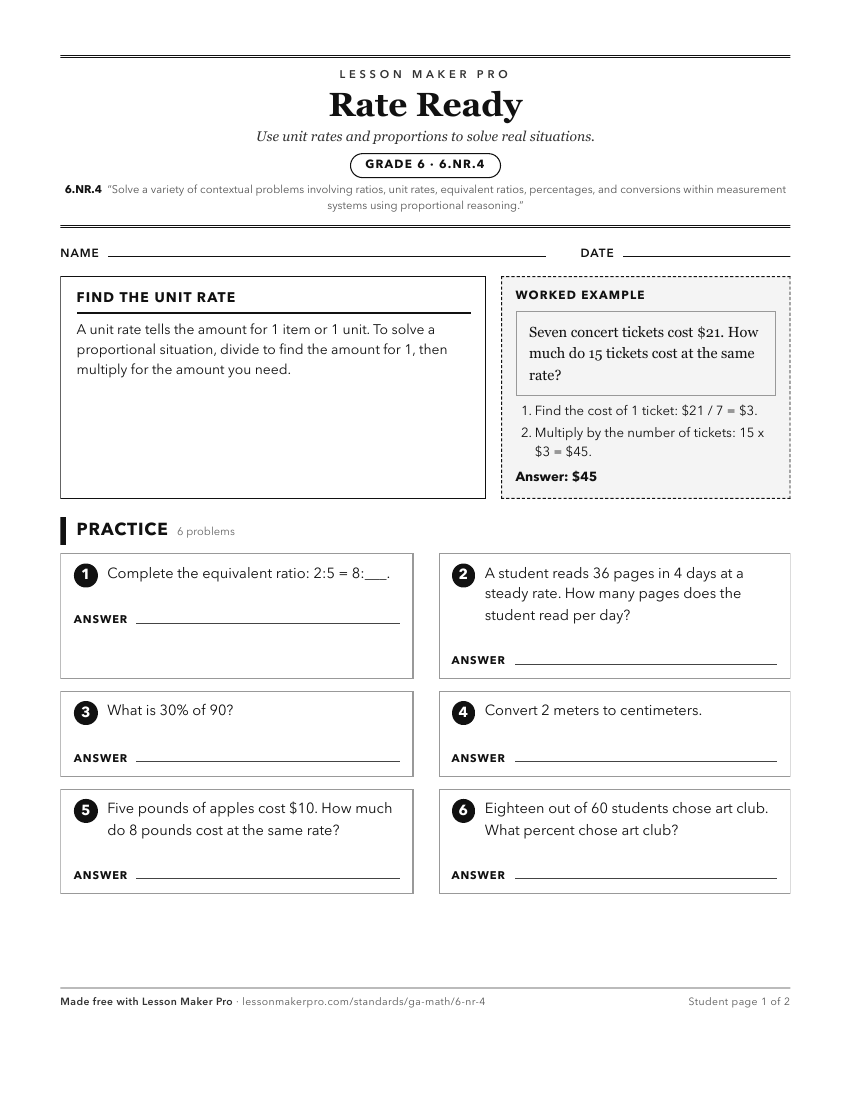
A ready-to-print activity worksheet aligned to 6.NR.4, with an answer key for the teacher on its own page. No account needed.
PDF, US Letter, prints cleanly in black and white.
Download the worksheetKeep exploring
Related Standards
- 7.PAR.4.9
Use proportional relationships to solve multi-step ratio and percent problems presented in applicable situations.
- 7.PAR.4
Recognize proportional relationships in relevant, mathematical problems; represent, solve, and explain these relationships with tables, graphs, and equations.
- 7.NR.1.11
Solve multi-step, contextual problems involving rational numbers, converting between forms as appropriate, and assessing the reasonableness of answers using men...
Turn this cluster into a lesson
Grade, subject, topic, and the complete cluster are prefilled. Create one free, no account needed.
Also for this cluster:Make a WorksheetMake a QuizMake a Sub Lesson