Georgia 5.GSR.8
Georgia Standard (Expectation Cluster)
Examine properties of polygons and rectangular prisms, classify polygons by their properties, and discover volume of right rectangular prisms.
Georgia's K-12 Mathematics Standards
Cluster contents
Expectations in This Standard
5.GSR.8 is a Georgia mathematics standard. These are the expectations under it.
- 5.GSR.8.1
Classify, compare, and contrast polygons based on properties.
- 5.GSR.8.2
Determine, through exploration and investigation, that attributes belonging to a category of two-dimensional figures also belong to all subcategories of that ca...
- 5.GSR.8.3
Investigate volume of right rectangular prisms by packing them with unit cubes without gaps or overlaps. Then, determine the total volume to solve problems.
- 5.GSR.8.4
Discover and explain how the volume of a right rectangular prism can be found by multiplying the area of the base times the height to solve authentic, mathemati...
Teacher's field guide
What This Cluster Means
What Students Need to Do
- Students identify sides, angles, parallel lines, and perpendicular lines, then use those features to classify polygons. They describe rectangular prisms by their faces, edges, vertices, and dimensions. They find volume by connecting unit-cube layers to multiplication.
What Mastery Looks Like
- Students classify a polygon into every group it belongs to and support each choice with named properties. They describe a rectangular prism and calculate its volume from a cube model or dimensions, using cubic units.
Common Misconceptions
- Students often think a square is not a rectangle or that a polygon can have only one name. They may confuse volume with surface area, add dimensions instead of multiplying, or label volume with square units.
How to Assess It
- Give students a square and a 3 by 4 by 5 prism. Ask them to name every valid polygon category for the square and find the prism's volume by describing its layers.
Lesson moves
Ways to Teach It
Build rectangular prisms with unit cubes, record each prism's dimensions and layers, then write a multiplication equation for its volume.
Ask, “Can one polygon have several names?” Students choose an example and defend each name using sides, angles, or parallel lines.
Play a card sort where students place polygon cards into overlapping groups, then challenge a partner to explain any disputed placement.
Measure a cereal box, predict how many cubic units it holds, then calculate its volume and compare the results.
Free download
Printable 5.GSR.8 Worksheet
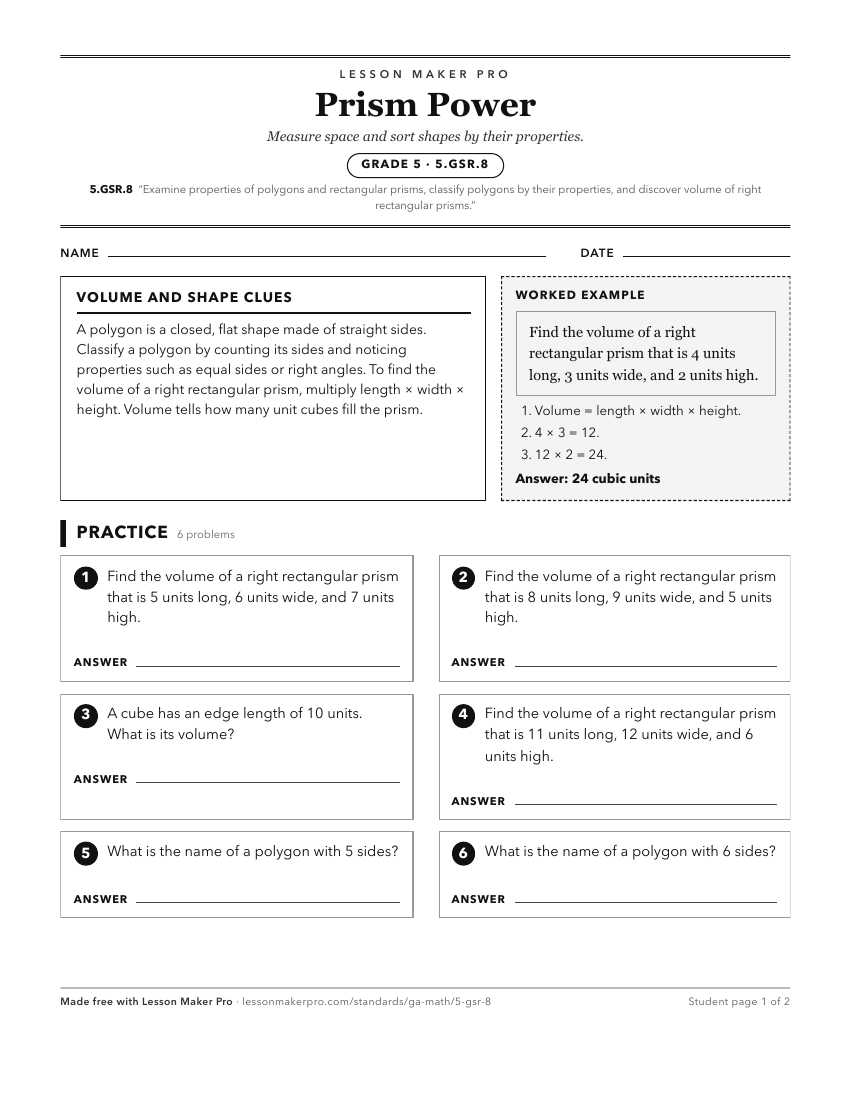
A ready-to-print activity worksheet aligned to 5.GSR.8, with an answer key for the teacher on its own page. No account needed.
PDF, US Letter, prints cleanly in black and white.
Download the worksheetKeep exploring
Related Standards
- 4.GSR.8
Identify and draw geometric objects, classify polygons based on properties, and solve problems involving area and perimeter of rectangular figures.
- 3.GSR.6.2
Classify, compare, and contrast polygons, with a focus on quadrilaterals, based on properties. Analyze specific 3-dimensional figures to identify and describe q...
- 7.GSR.5.8
Explore volume as a measurable attribute of cylinders and right prisms. Find the volume of these geometric figures using concrete problems.
Turn this cluster into a lesson
Grade, subject, topic, and the complete cluster are prefilled. Create one free, no account needed.
Also for this cluster:Make a WorksheetMake a QuizMake a Sub Lesson