Georgia 2.MDR.5
Georgia Standard (Expectation Cluster)
Estimate and measure the lengths of objects and distance to solve problems found in real-life using standard units of measurement, including inches, feet, and yards and analyze graphical displays of data to answer relevant questions.
Georgia's K-12 Mathematics Standards
Cluster contents
Expectations in This Standard
2.MDR.5 is a Georgia mathematics standard. These are the expectations under it.
- 2.MDR.5.1
Construct simple measuring instruments using unit models. Compare unit models to rulers.
- 2.MDR.5.2
Estimate and measure the length of an object or distance to the nearest whole unit using appropriate units and standard measuring tools.
- 2.MDR.5.3
Measure to determine how much longer one object is than another and express the length difference in terms of a standard-length unit.
- 2.MDR.5.4
Ask questions and answer them based on gathered information, observations, and appropriate graphical displays to solve problems relevant to everyday life.
- 2.MDR.5.5
Represent whole-number sums and differences within a standard unit of measurement on a number line diagram.
Teacher's field guide
What This Cluster Means
What Students Need to Do
- Students estimate and measure objects or distances using inches, feet, and yards. They solve measurement problems and read graphs to compare values, find totals, and answer questions.
What Mastery Looks Like
- Students choose inches, feet, or yards to fit the object or distance. They make a reasonable estimate, measure from zero accurately, and use graph labels and values to answer questions.
Common Misconceptions
- Students may start measuring above zero, leave gaps between repeated units, or mix inches, feet, and yards. They may also read a graph’s tallest bar without checking its labels or scale.
How to Assess It
- Give students a ruler, a pencil, and a three-bar measurement graph. Ask them to estimate and measure the pencil in inches, then answer which object on the graph is longest.
Lesson moves
Ways to Teach It
Set up stations with rulers, yardsticks, and classroom objects so students estimate, measure, record, and compare lengths.
Ask students to explain in writing why they would measure a desk in feet but a crayon in inches.
Play Measurement Match by pairing object cards with reasonable estimates and unit cards for inches, feet, or yards.
Plan a classroom rug purchase by measuring the floor in feet, then graph group results and compare proposed rug sizes.
Free download
Printable 2.MDR.5 Worksheet
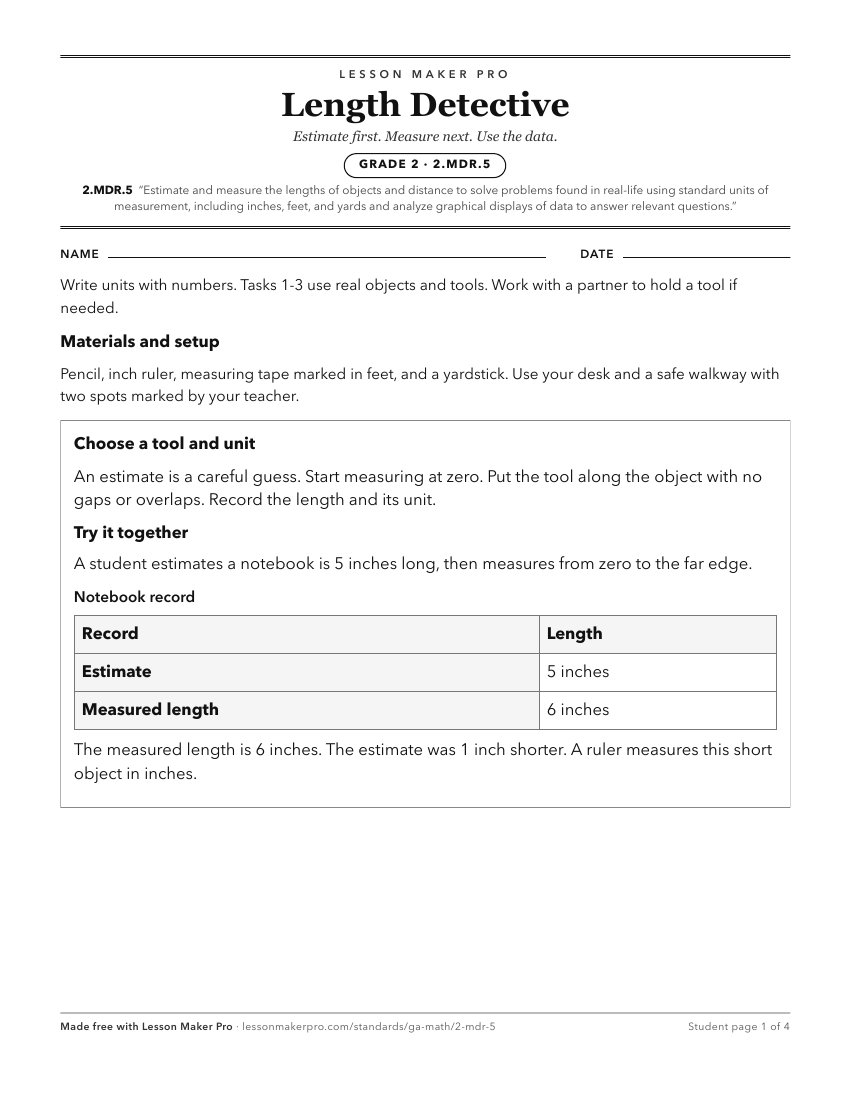
A ready-to-print activity worksheet aligned to 2.MDR.5, with an answer key for the teacher on its own page. No account needed.
PDF, US Letter, prints cleanly in black and white.
Download the worksheetKeep exploring
Related Standards
- 4.MDR.6
Measure time and objects that exist in the world to solve real-life, mathematical problems and analyze graphical displays of data to answer relevant questions.
- 5.MDR.7
Solve problems involving customary measurements, metric measurements, and time and analyze graphical displays of data to answer relevant questions.
- 3.MDR.5.5
Estimate and measure liquid volumes, lengths and masses of objects using customary units. Solve problems involving mass, length, and volume given in the same un...
Turn this cluster into a lesson
Grade, subject, topic, and the complete cluster are prefilled. Create one free, no account needed.
Also for this cluster:Make a WorksheetMake a QuizMake a Sub Lesson