Georgia 2.MDR.5.5
The Standard
Represent whole-number sums and differences within a standard unit of measurement on a number line diagram.
Georgia's K-12 Mathematics Standards · Estimate and measure the lengths of objects and distance to solve problems found in real-life using standard units of measurement, including inches, feet, and yards and analyze graphical displays of data to answer relevant questions.
Teacher's field guide
What This Standard Means
What Students Need to Do
- Students label a number line with equal intervals that represent one measurement unit each. They use jumps to join or separate measured lengths, then write the matching equation and answer.
What Mastery Looks Like
- A student draws equal intervals, labels the unit, and starts at the correct value. The jumps move in the correct direction and end at the answer named in the equation.
Common Misconceptions
- Students may count tick marks instead of the spaces between them. They may draw unequal intervals, leave off units, or move right when subtracting.
How to Assess It
- Ask: “On one number line, show 9 cm + 4 cm, then show 13 cm minus 4 cm. Label each endpoint and unit.”
Lesson moves
Ways to Teach It
Tape a floor number line in inches, then have students walk right for addition and left for subtraction using labeled measurement cards.
Show two diagrams for 11 centimeters minus 4 centimeters, one correct and one with unequal intervals, and ask students to defend their choice.
Play Measurement Jump Cards: students draw a unit card and two number cards, model the equation, and earn a point for accurate labels.
Measure two classroom objects in centimeters, then draw a number line showing their combined length or the difference between their lengths.
Free download
Printable 2.MDR.5.5 Worksheet
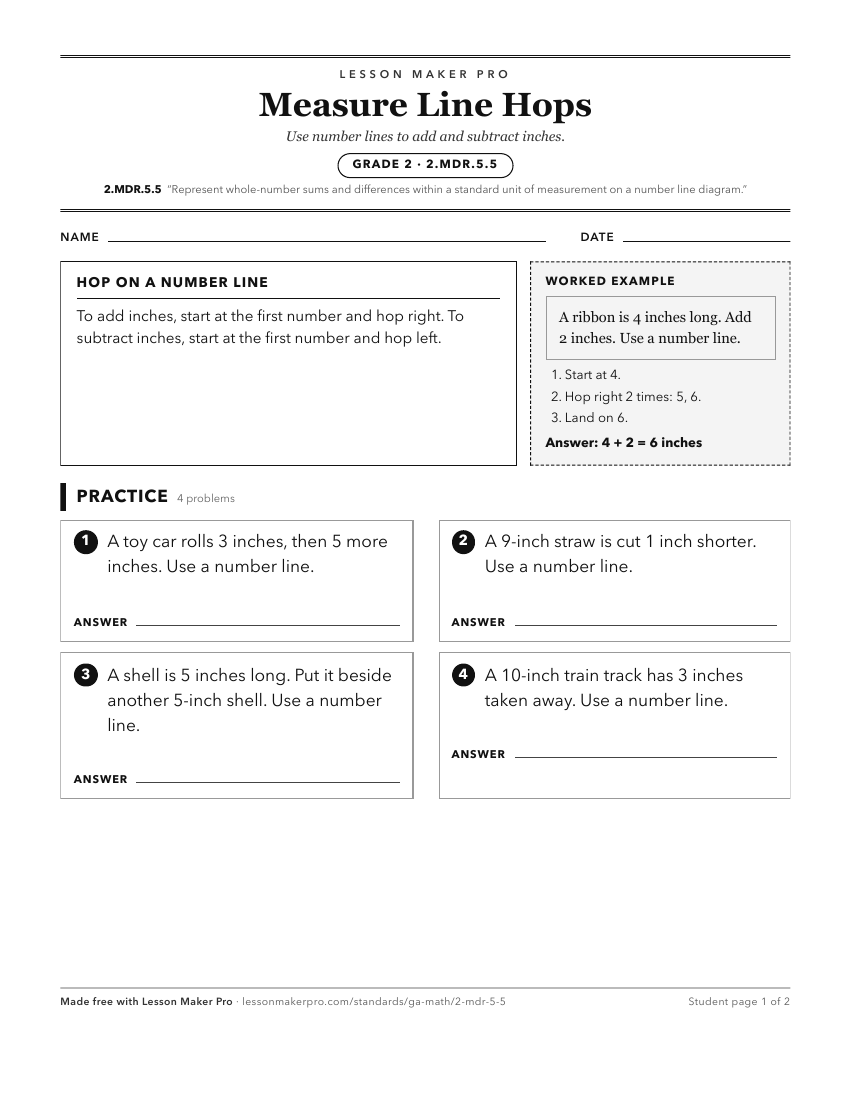
A ready-to-print activity worksheet aligned to 2.MDR.5.5, with an answer key for the teacher on its own page. No account needed.
PDF, US Letter, prints cleanly in black and white.
Download the worksheetKeep exploring
Related Standards
- 7.NR.1.3
Represent addition and subtraction with rational numbers on a horizontal or a vertical number line diagram to solve authentic problems.
- 4.NR.4.4
Represent whole numbers and fractions as the sum of unit fractions.
- 2.NR.1.3
Represent, compare, and order whole numbers to 1000 with an emphasis on place value and equality. Use >, =, and < symbols to record the results of comparisons.
- 1.NR.1.3
Compare and order whole numbers up to 100 using concrete models, drawings, and the symbols >, =, and <.
Turn this exact standard into a lesson
Grade, subject, topic, and the complete standard are prefilled. Create one free, no account needed.
Also for this standard:Make a WorksheetMake a QuizMake a Sub Lesson