Georgia 7.L.V.3
Georgia Standard (Expectation Cluster)
Meaning & Purpose Analyze the denotative and connotative meanings of words and phrases and strategically apply those understandings when interpreting and constructing texts.
Georgia's K-12 English Language Arts Standards · Language (L)
Cluster contents
Expectations in This Standard
7.L.V.3 is a Georgia English Language Arts standard. These are the expectations under it.
- 7.L.V.3.a
This progression transitions to 6-8.L.V.3.b.
- 7.L.V.3.b
Analyze relationships between words, phrases, and/or clauses (e.g., synonyms, antonyms, analogies, contextual clues) to determine, distinguish, or clarify the m...
- 7.L.V.3.c
Distinguish between the connotations of words that share a similar denotation (e.g., confident, assertive, egotistic, pompous, smug). (I)
- 7.L.V.3.d
Use available print and/or digital resources, including reference materials and digital tools (e.g., online search, embedded word processing features), to deter...
- 7.L.V.3.e
Determine or clarify the nuanced meanings of closely related words or phrases using available print and/or digital resources to make strategic decisions when sp...
Teacher's field guide
What This Cluster Means
What Students Need to Do
- Students separate a word’s literal meaning from the feelings and associations it carries. They explain how those associations affect tone and meaning, then choose words that fit their own purpose.
What Mastery Looks Like
- Students can compare words such as “stubborn” and “determined,” stating their shared literal meaning and different associations. They can explain how word choice shapes tone and revise wording for a purpose.
Common Misconceptions
- Students may treat connotation as simply positive or negative, missing subtler feelings or associations. They may assume synonyms are interchangeable or confuse personal associations with context clues.
How to Assess It
- Give this exit ticket: “The reporter described the crowd as a mob.” Define “mob,” name its connotation, and replace it with a neutral word.
Lesson moves
Ways to Teach It
Sort word cards such as “slim,” “skinny,” “scrawny,” and “slender” on a favorable-to-unfavorable line, then identify their shared literal meaning.
Discuss this prompt: How would calling a character “confident” instead of “arrogant” change a reader’s view?
Play a word-swap challenge where teams replace a highlighted word to make the same sentence sound admiring, critical, or neutral.
Compare two headlines about the same event and underline words that reveal each writer’s attitude toward the people involved.
Free download
Printable 7.L.V.3 Worksheet
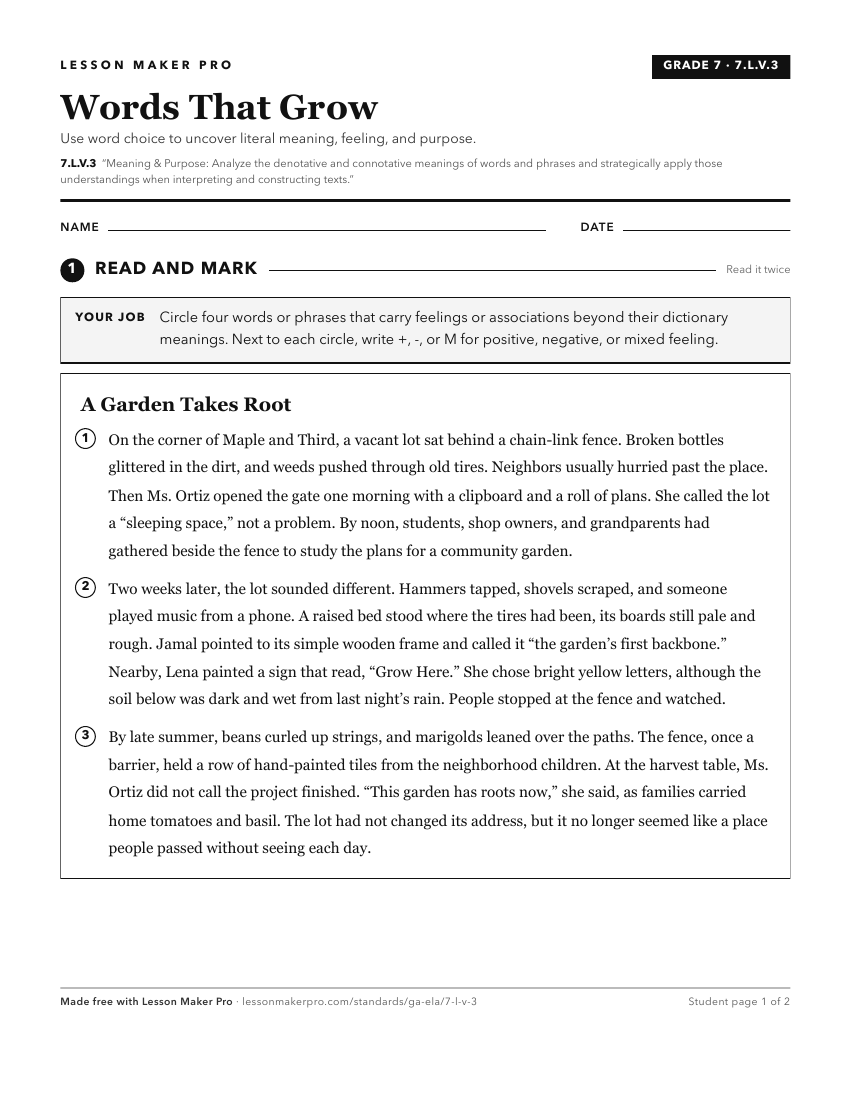
A ready-to-print activity worksheet aligned to 7.L.V.3, with an answer key for the teacher on its own page. No account needed.
PDF, US Letter, prints cleanly in black and white.
Download the worksheetKeep exploring
Related Standards
- 9.L.V.3
Meaning & Purpose Analyze and craft nuanced words and phrases in a variety of texts and for a variety of purposes.
- 10.L.V.3
Meaning & Purpose Analyze and craft nuanced words and phrases in a variety of texts and for a variety of purposes.
- 6.L.V.3
The 6th Grade version of this standard.
- 8.L.V.3
The 8th Grade version of this standard.
Turn this cluster into a lesson
Grade, subject, topic, and the complete cluster are prefilled. Create one free, no account needed.
Also for this cluster:Make a WorksheetMake a QuizMake a Sub Lesson