Georgia 7.L.GC.1
Georgia Standard (Expectation Cluster)
Grammar, Usage, & Mechanics: Draw from knowledge of the conventions of Standard English grammar, usage, and mechanics when analyzing and constructing texts.
Georgia's K-12 English Language Arts Standards · Language (L)
Cluster contents
Expectations in This Standard
7.L.GC.1 is a Georgia English Language Arts standard. These are the expectations under it.
- 7.L.GC.1.49
Mechanics: Use commas, parentheses, and dashes to set off nonessential words, phrases, or clauses. (Master)
- 7.L.GC.1.50
Mechanics: Use ellipses appropriately. (Continue)
- 7.L.GC.1.51
Mechanics: Use hyphens with appropriate affixes and compound words. (Continue)
- 7.L.GC.1.52
Mechanics: Use semicolons, with or without a conjunctive adverb, to form compound and compound-complex sentences. (Continue)
- 7.L.GC.1.53
Grammar, Mechanics Use parts of speech and their associated phrases or clauses to perform indicated sentence functions (e.g., subject, direct object, predicate ...
- 7.L.GC.1.54
Mechanics: Use conventional capitalization, quotation marks, commas, end punctuation, and parentheses (citations) when incorporating textual evidence. (Continue...
- 7.L.GC.1.55
Grammar: Use demonstrative pronouns. (Introduce, Master)
- 7.L.GC.1.56
Mechanics: Use colons to introduce lists, examples, and explanations. (Introduce)
- 7.L.GC.1.57
Usage: Form and use verbals and verbal phrases (participles/participials, gerunds, and infinitives) based on function. (Introduce)
Teacher's field guide
What This Cluster Means
What Students Need to Do
- Students identify grammar, usage, punctuation, capitalization, and spelling choices that affect clarity. They apply standard conventions while drafting and revising, then explain how specific choices shape meaning and tone.
What Mastery Looks Like
- Students can edit a paragraph for sentence boundaries, agreement, pronoun use, punctuation, capitalization, and spelling. They can explain their changes and preserve the writer’s intended meaning and tone.
Common Misconceptions
- Students may add commas wherever they hear a pause, creating comma splices. They may miss agreement errors in long sentences or assume conversational wording always fits formal writing. They may correct grammar without checking whether the change alters the writer’s meaning.
How to Assess It
- Give this exit ticket: “Neither of the players were ready, they had forgot their permission slips.” Ask students to correct it and explain each change.
Lesson moves
Ways to Teach It
Give pairs sentence strips containing fragments, run-ons, and complete sentences, then have them sort and revise each one.
Compare two versions of a paragraph and discuss how punctuation, word choice, and sentence structure change clarity and tone.
Run an editing relay where teams correct one marked error at a time and name the rule used.
Have students proofread a mock school announcement for grammar, punctuation, capitalization, and spelling before posting it.
Free download
Printable 7.L.GC.1 Worksheet
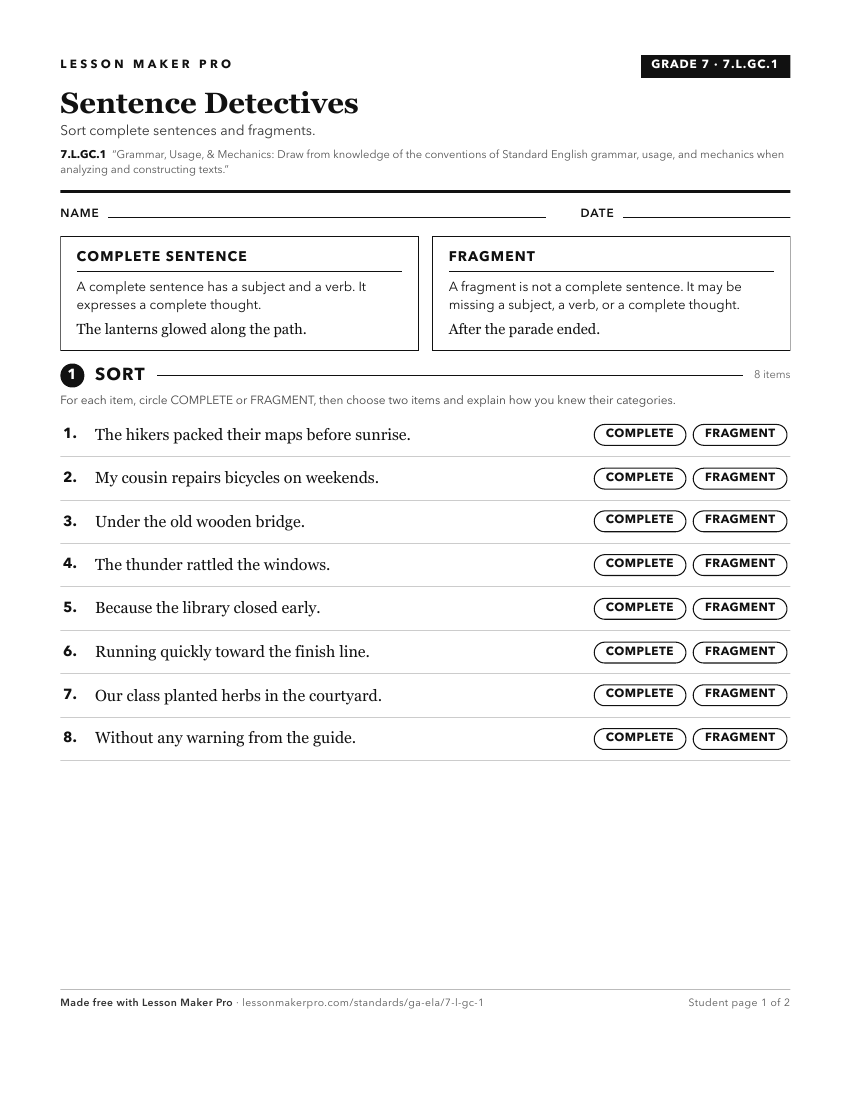
A ready-to-print activity worksheet aligned to 7.L.GC.1, with an answer key for the teacher on its own page. No account needed.
PDF, US Letter, prints cleanly in black and white.
Download the worksheetKeep exploring
Related Standards
- 8.L.GC.1
Grammar, Usage, & Mechanics Draw from knowledge of the conventions of Standard English grammar, usage, and mechanics when analyzing and constructing texts.
- 10.L.GC.1
Grammar, Usage, & Mechanics Draw from knowledge of the conventions of Standard English grammar, usage, and mechanics when analyzing, evaluating, and constructin...
- 9.L.GC.1
Grammar, Usage, & Mechanics Draw from knowledge of the conventions of Standard English grammar, usage, and mechanics when analyzing, evaluating, and constructin...
- 6.L.GC.1
Grammar, Usage, & Mechanics Draw from knowledge of the conventions of Standard English grammar, usage, and mechanics when analyzing and constructing texts.
Turn this cluster into a lesson
Grade, subject, topic, and the complete cluster are prefilled. Create one free, no account needed.
Also for this cluster:Make a WorksheetMake a QuizMake a Sub Lesson