Georgia 2.L.GC.2.a
The Standard
Distinguish between simple and compound sentences, and identify the sentence type (i.e., declarative, imperative, interrogative, and exclamatory). (I)
Georgia's K-12 English Language Arts Standards · Language (L) · Grammar Conventions
Teacher's field guide
What This Standard Means
What Students Need to Do
- Students sort sentences by whether they contain one complete idea or two complete ideas joined by words such as "and," "but," or "so." They also identify statements, commands, questions, and exclamations and use matching punctuation.
What Mastery Looks Like
- Students correctly label mixed examples by structure and purpose. They can explain their choices using complete ideas, joining words, meaning, and punctuation as evidence.
Common Misconceptions
- Students may think any long sentence is compound or that every sentence with "and" is compound. They may label sentences by punctuation alone or miss the understood subject "you" in a command.
How to Assess It
- Give students these four sentences: "The bell rang." "Wash your hands." "Did Mia call, or did she text?" "The puppy is so tiny!" Have them label each by structure and purpose.
Lesson moves
Ways to Teach It
Give pairs sentence strips and conjunction cards, then have students join complete ideas and label each new sentence.
Ask students to write a statement, command, question, and exclamation, then explain which examples contain one or two complete ideas.
Play a sentence sort relay where teams place cards under simple or compound, then add a purpose label.
Collect school signs or announcements, rewrite any fragments as complete sentences, and label each sentence by structure and purpose.
Free download
Printable 2.L.GC.2.a Worksheet
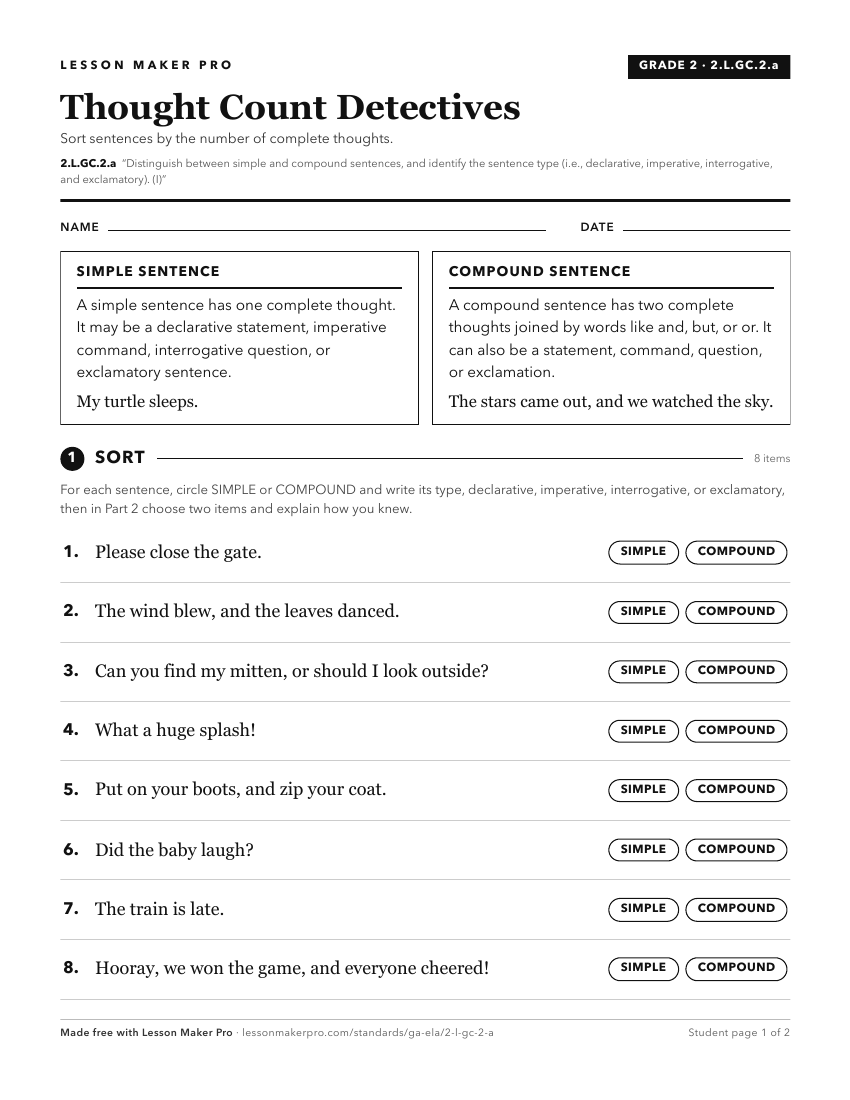
A ready-to-print activity worksheet aligned to 2.L.GC.2.a, with an answer key for the teacher on its own page. No account needed.
PDF, US Letter, prints cleanly in black and white.
Download the worksheetKeep exploring
Related Standards
- 1.L.GC.2.a
Distinguish between complete and incomplete simple sentences, and identify sentence type (i.e., declarative, imperative, interrogative, and exclamatory). (I)
- 3.L.GC.2.b
Use a variety of simple, compound, and complex sentences to strengthen clarity and coherence, establishing consistent verb tense within and between sentences. (...
- 3.L.GC.2.a
Distinguish between correctly structured simple, compound, and complex sentences. (I)
- K.L.GC.2.a
Recognize that conventional sentences always include a subject and a predicate. (I)
Turn this exact standard into a lesson
Grade, subject, topic, and the complete standard are prefilled. Create one free, no account needed.
Also for this standard:Make a WorksheetMake a QuizMake a Sub Lesson