Georgia 1.L.GC.2.a
The Standard
Distinguish between complete and incomplete simple sentences, and identify sentence type (i.e., declarative, imperative, interrogative, and exclamatory). (I)
Georgia's K-12 English Language Arts Standards · Language (L) · Grammar Conventions
Teacher's field guide
What This Standard Means
What Students Need to Do
- Students decide whether a group of words tells a whole idea or leaves something missing. They sort sentences by purpose: telling, asking, directing, or showing strong feeling.
What Mastery Looks Like
- A student can explain what is missing from a fragment and revise it into a whole thought. The student can name each sentence type and choose a fitting end mark.
Common Misconceptions
- Students may think any words with a capital letter and end mark form a complete sentence. They often classify sentences by punctuation alone. Commands can confuse them because the subject “you” is understood but not written.
How to Assess It
- Give students these items: “The dog barked.” “Under the table.” “Can I help?” “Please sit down.” “What a huge pumpkin!” Ask them to circle the incomplete item and label each complete sentence by type.
Lesson moves
Ways to Teach It
Build sentences with word cards, then remove the naming or action part and have students explain what is missing.
Read “Please close the door.” Ask, “Is it telling, asking, directing, or exclaiming? What clues prove your answer?”
Play Sentence Sort: teams place cards under declarative, imperative, interrogative, or exclamatory, then repair any incomplete cards.
Examine classroom signs and notes, then label each sentence’s purpose and explain why that type fits the real situation.
Free download
Printable 1.L.GC.2.a Worksheet
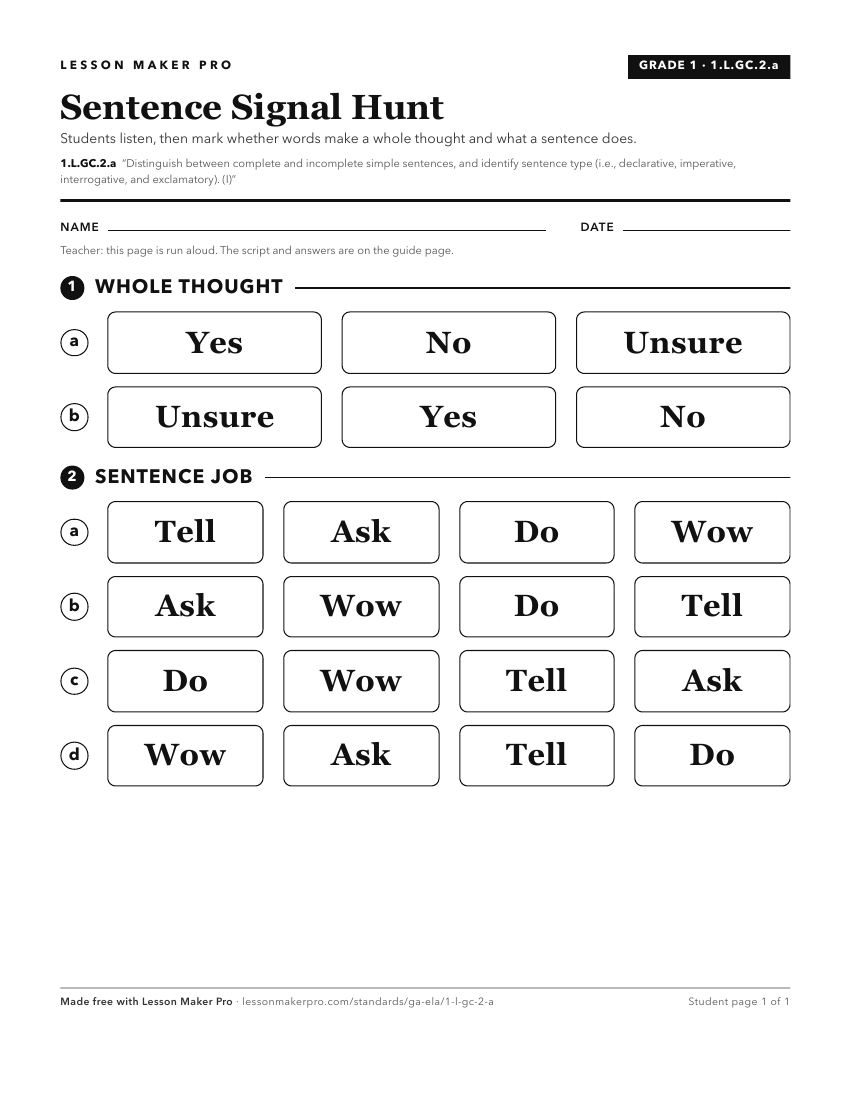
A ready-to-print activity worksheet aligned to 1.L.GC.2.a, with an answer key for the teacher on its own page. No account needed.
PDF, US Letter, prints cleanly in black and white.
Download the worksheetKeep exploring
Related Standards
- 1.L.GC.2.b
Use a variety of simple sentences (including a variety of sentence types) to develop clarity in written texts. (C)
- 3.L.GC.2.a
Distinguish between correctly structured simple, compound, and complex sentences. (I)
- K.L.GC.2.a
Recognize that conventional sentences always include a subject and a predicate. (I)
- 2.L.GC.2.a
Distinguish between simple and compound sentences, and identify the sentence type (i.e., declarative, imperative, interrogative, and exclamatory). (I)
Turn this exact standard into a lesson
Grade, subject, topic, and the complete standard are prefilled. Create one free, no account needed.
Also for this standard:Make a WorksheetMake a QuizMake a Sub Lesson