Georgia 3.L.GC.2.a
The Standard
Distinguish between correctly structured simple, compound, and complex sentences. (I)
Georgia's K-12 English Language Arts Standards · Language (L) · Grammar Conventions
Teacher's field guide
What This Standard Means
What Students Need to Do
- Students identify complete thoughts, clauses, and connecting words in sentences. They use those parts to tell whether a sentence is simple, compound, or complex and whether it is formed correctly.
What Mastery Looks Like
- Students accurately label simple, compound, and complex sentences. They point to the clauses and connecting words that support each choice, and they recognize incorrectly joined or incomplete clauses.
Common Misconceptions
- Students may call any sentence with “and” compound, even when “and” joins only words or phrases. They may treat a dependent clause as a complete sentence or join two complete thoughts with only a comma.
How to Assess It
- Use this exit ticket: Label the first three sentences, then correct the fourth: “Birds sang.” “Birds sang, and squirrels ran.” “When rain began, we went inside.” “We went inside, the rain began.”
Lesson moves
Ways to Teach It
Give pairs sentence strips with clauses and conjunctions, then have students build and label one simple, one compound, and one complex sentence.
Ask students to compare “Maya packed lunch” and “Maya packed lunch because the cafeteria was closed,” then explain what changed.
Play a sentence sort relay using cards labeled simple, compound, complex, fragment, and run-on.
Have students rewrite a classroom announcement using one simple, one compound, and one complex sentence.
Free download
Printable 3.L.GC.2.a Worksheet
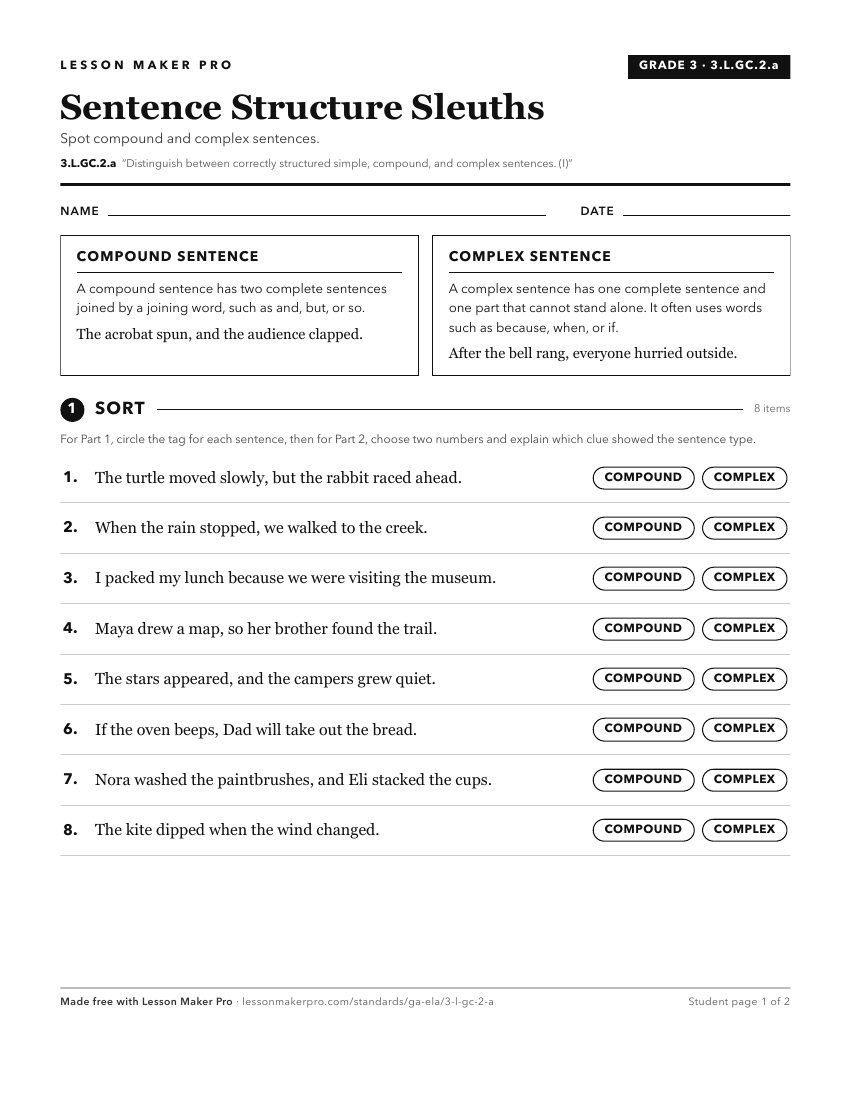
A ready-to-print activity worksheet aligned to 3.L.GC.2.a, with an answer key for the teacher on its own page. No account needed.
PDF, US Letter, prints cleanly in black and white.
Download the worksheetKeep exploring
Related Standards
- 1.L.GC.2.a
Distinguish between complete and incomplete simple sentences, and identify sentence type (i.e., declarative, imperative, interrogative, and exclamatory). (I)
- 3.L.GC.2.b
Use a variety of simple, compound, and complex sentences to strengthen clarity and coherence, establishing consistent verb tense within and between sentences. (...
- 4.L.GC.2.b
Use a variety of simple, compound, and complex sentences to strengthen clarity and coherence, maintaining consistent verb tense within and between paragraphs. (...
- 2.L.GC.2.a
Distinguish between simple and compound sentences, and identify the sentence type (i.e., declarative, imperative, interrogative, and exclamatory). (I)
Turn this exact standard into a lesson
Grade, subject, topic, and the complete standard are prefilled. Create one free, no account needed.
Also for this standard:Make a WorksheetMake a QuizMake a Sub Lesson