Georgia K.L.GC.2.a
The Standard
Recognize that conventional sentences always include a subject and a predicate. (I)
Georgia's K-12 English Language Arts Standards · Language (L) · Grammar Conventions
Teacher's field guide
What This Standard Means
What Students Need to Do
- Students identify the subject, who or what a sentence names, and the predicate, what that subject does or is. They notice when either part is missing.
What Mastery Looks Like
- Given a short sentence, students can point to and name the subject and predicate. They can complete a fragment by adding the missing naming or telling part.
Common Misconceptions
- Students may call any word group a sentence because it begins with a capital or ends with a period. They may treat “The red dog” or “ran fast” as a whole sentence.
How to Assess It
- Exit ticket: Show “The rabbit hops” and “Hops quickly.” Ask students to circle the subject, underline the predicate, and fix the incomplete example.
Lesson moves
Ways to Teach It
Give pairs picture and word cards, then have them build sentences by matching a naming card with an action card.
Show “The puppy” and ask, “What could we add to make a complete thought?” Record and compare three student endings.
Play Sentence or Not: read short word groups, and students hold up green for complete or red for missing a part.
During morning routines, students describe a classmate’s action, such as “Maya hangs her backpack,” then identify the naming and telling parts.
Free download
Printable K.L.GC.2.a Worksheet
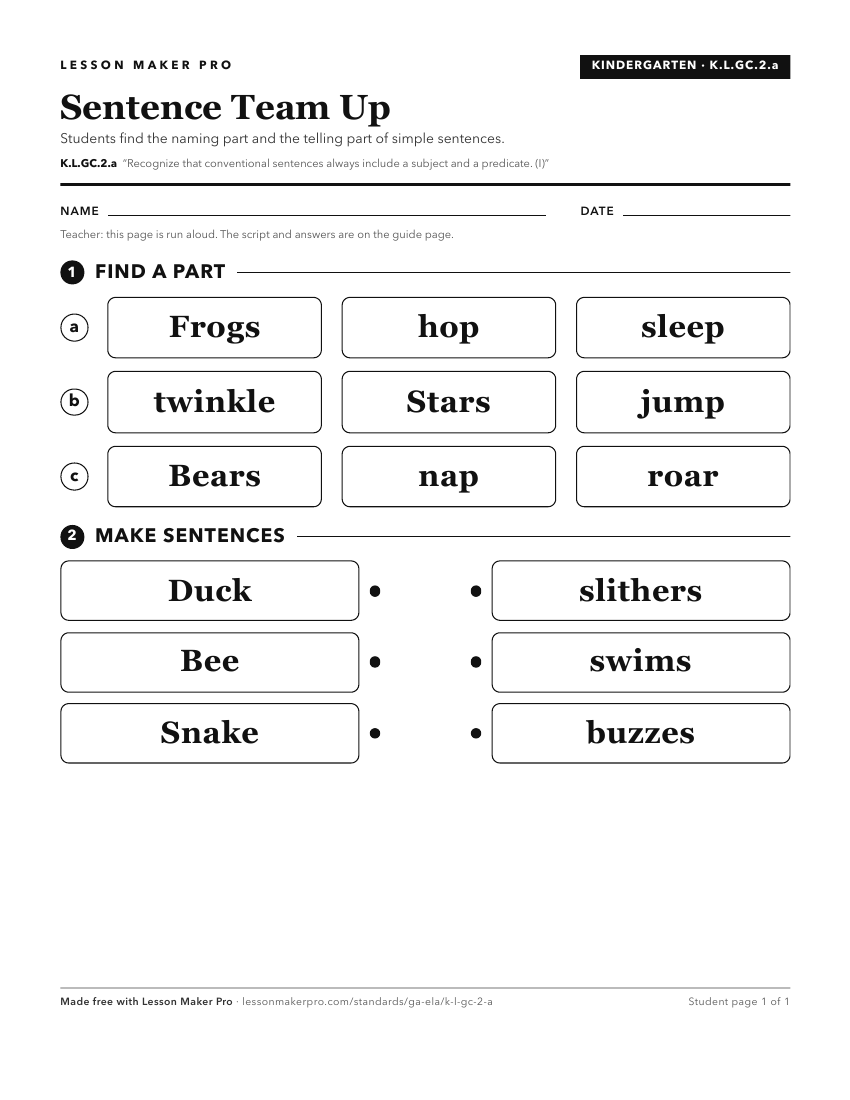
A ready-to-print activity worksheet aligned to K.L.GC.2.a, with an answer key for the teacher on its own page. No account needed.
PDF, US Letter, prints cleanly in black and white.
Download the worksheetKeep exploring
Related Standards
- 1.L.GC.2.a
Distinguish between complete and incomplete simple sentences, and identify sentence type (i.e., declarative, imperative, interrogative, and exclamatory). (I)
- 3.L.GC.2.c
Use correct subject-verb agreement in a variety of sentences. (C)
- 3.L.GC.2.a
Distinguish between correctly structured simple, compound, and complex sentences. (I)
- 2.L.GC.2.a
Distinguish between simple and compound sentences, and identify the sentence type (i.e., declarative, imperative, interrogative, and exclamatory). (I)
Turn this exact standard into a lesson
Grade, subject, topic, and the complete standard are prefilled. Create one free, no account needed.
Also for this standard:Make a WorksheetMake a QuizMake a Sub Lesson