Florida SS.K.E.1.2
The Standard
- SS.K.E.1
- Beginning Economics
Recognize that United States currency comes in different forms.
Florida Next Generation Sunshine State Standards for Social Studies · Economics
Teacher's field guide
What This Standard Means
What Students Need to Do
- Students identify coins and paper bills as forms of U.S. money. They sort examples by form and describe visible differences, such as shape, material, and size.
What Mastery Looks Like
- A student can point to a coin and a bill and explain that both are money. The student can separate pictures of U.S. money from cards, coupons, and toy tokens.
Common Misconceptions
- Students may think only coins or only bills count as money. They may confuse credit cards, gift cards, coupons, or arcade tokens with U.S. currency.
How to Assess It
- Show pictures of a penny, dollar bill, credit card, and toy token. Ask students to circle the U.S. money and name each form.
Lesson moves
Ways to Teach It
Give pairs a tray of play coins and replica bills to sort into two labeled hoops: coins and bills.
Ask, “How are coins and bills alike, and how are they different?” Record student answers on a class chart.
Play Money Match by having students match picture cards showing coins and bills to the labels coin or bill.
Set up a classroom store where students choose either a play coin or replica bill to pay for an item.
Free download
Printable SS.K.E.1.2 Worksheet
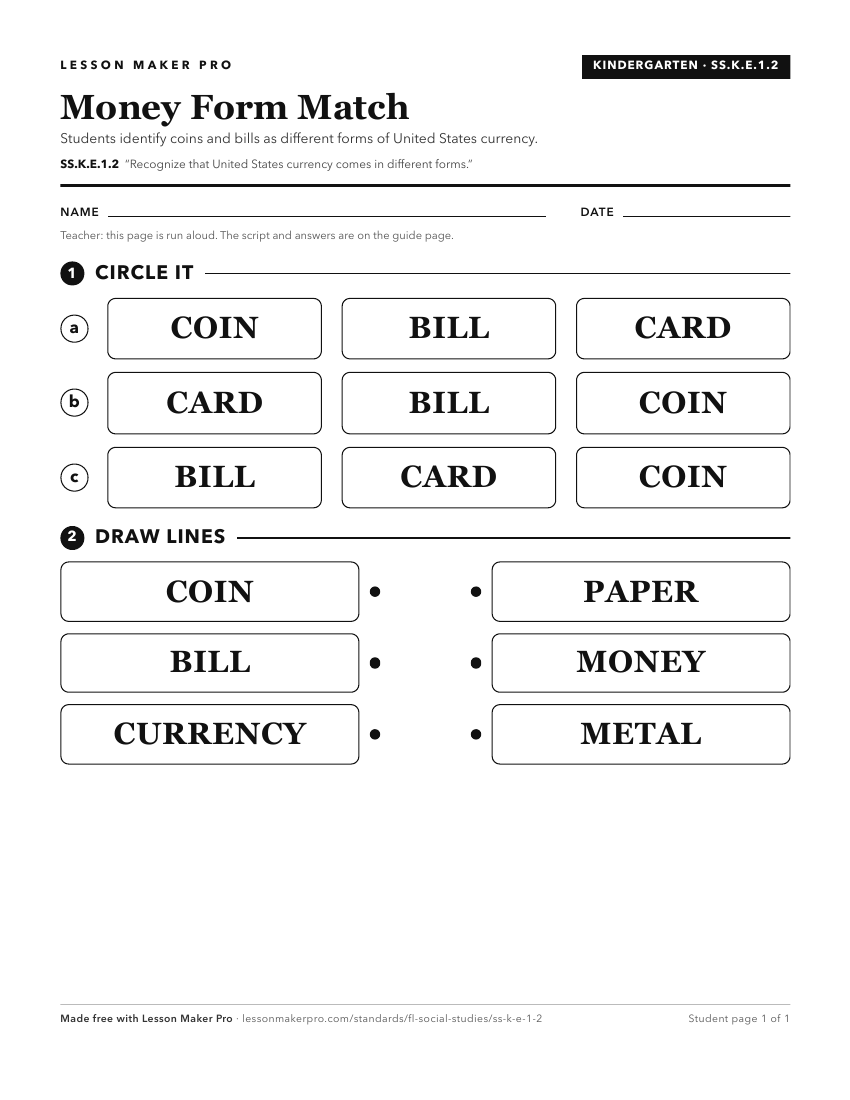
A ready-to-print activity worksheet aligned to SS.K.E.1.2, with an answer key for the teacher on its own page. No account needed.
PDF, US Letter, prints cleanly in black and white.
Download the worksheetKeep exploring
Related Standards
- SS.K.CG.2.4
Recognize symbols that represent the United States.
- SS.3.E.1.4
Distinguish between currencies used in the United States, Canada, Mexico, and the Caribbean.
- SS.1.E.1.1
Recognize that money is used in the exchange of goods and services.
- SS.2.CG.2.4
Recognize symbols, individuals, and documents that represent the United States.
Turn this exact standard into a lesson
Grade, subject, topic, and the complete standard are prefilled. Create one free, no account needed.
Also for this standard:Make a WorksheetMake a QuizMake a Sub Lesson