Florida SS.8.A.4.2
The Standard
- SS.8.A.4
- Demonstrate an understanding of the domestic and international causes, course, and consequences of westward expansion.
Describe the debate surrounding the spread of slavery into western territories and Florida.
Florida Next Generation Sunshine State Standards for Social Studies
Teacher's field guide
What This Standard Means
What Students Need to Do
- Students explain why adding new slave or free states threatened the balance of power in Congress. They compare arguments about property rights, abolition, states’ rights, and popular sovereignty, including Florida’s admission as a slave state.
What Mastery Looks Like
- Students use a map or primary source to identify competing views and explain the reasons behind them. They connect measures such as the Missouri Compromise and Kansas-Nebraska Act to growing sectional conflict.
Common Misconceptions
- Students may assume every western territory was automatically free or that popular sovereignty ended slavery. They may also overlook Florida’s slave-based economy and its 1845 admission as a slave state.
How to Assess It
- Give students a map of free and slave states in 1845. Ask them to explain in three sentences why Florida’s admission concerned both sides.
Lesson moves
Ways to Teach It
Have pairs place labeled state and territory cards on a map, then track the changing balance between free and slave states.
Ask students to write: Should Congress, territorial voters, or individual states decide whether slavery is allowed, and why?
Run a timeline relay using event cards for the Missouri Compromise, Florida statehood, Compromise of 1850, and Kansas-Nebraska Act.
Use an 1845 Florida census table to examine how enslaved labor shaped political arguments about Florida’s statehood.
Free download
Printable SS.8.A.4.2 Worksheet
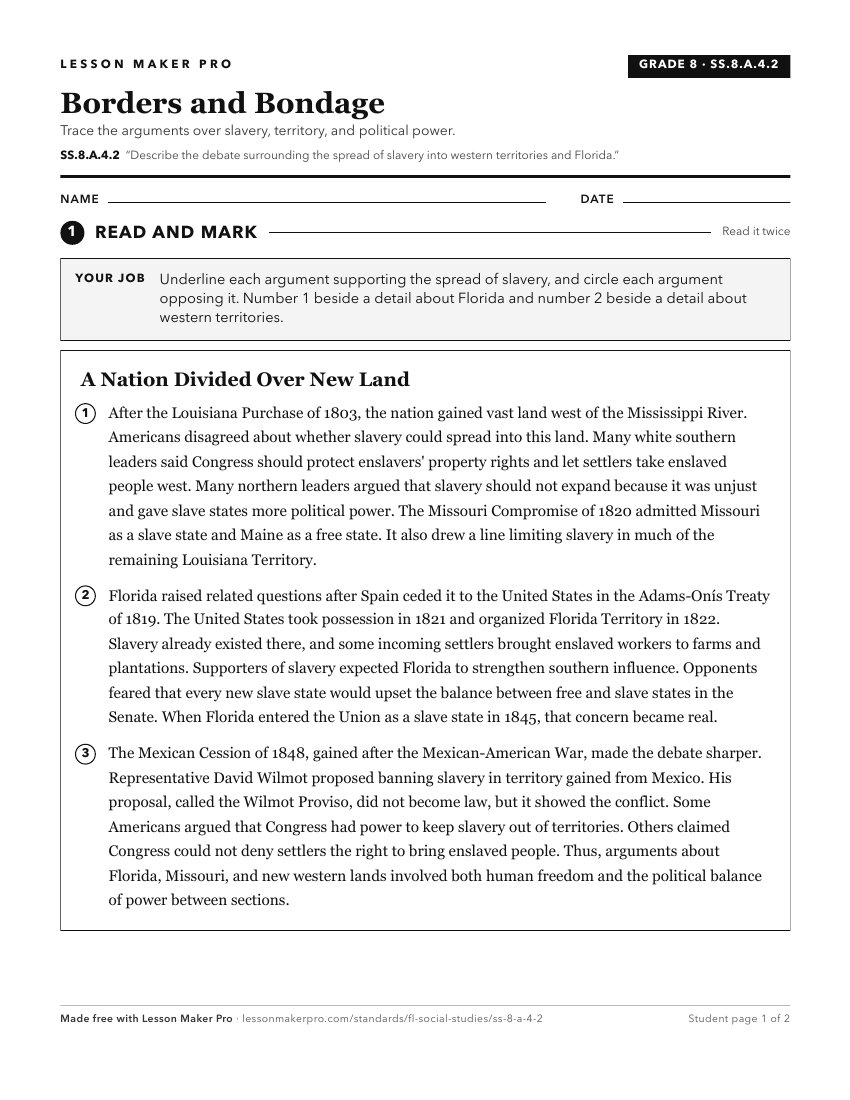
A ready-to-print activity worksheet aligned to SS.8.A.4.2, with an answer key for the teacher on its own page. No account needed.
PDF, US Letter, prints cleanly in black and white.
Download the worksheetKeep exploring
Related Standards
- SS.8.A.5.2
Analyze the role of slavery in the development of sectional conflict.
- SS.4.A.6.4
Describe effects of the Spanish American War on Florida.
- SS.4.A.3.6
Identify the effects of Spanish rule in Florida.
- SS.4.A.3.2
Describe causes and effects of European colonization on the Native American tribes of Florida.
Turn this exact standard into a lesson
Grade, subject, topic, and the complete standard are prefilled. Create one free, no account needed.
Also for this standard:Make a WorksheetMake a QuizMake a Sub Lesson