Florida SS.8.A.5.2
The Standard
- SS.8.A.5
- Examine the causes, course, and consequences of the Civil War and Reconstruction including its effects on American peoples.
Analyze the role of slavery in the development of sectional conflict.
Florida Next Generation Sunshine State Standards for Social Studies
Teacher's field guide
What This Standard Means
What Students Need to Do
- Students trace how disputes over slavery shaped politics, western expansion, court cases, and violence between regions. They use events and sources to explain how these disputes deepened mistrust and made compromise harder.
What Mastery Looks Like
- A student can build a cause-and-effect chain from the Missouri Compromise through Bleeding Kansas, Dred Scott, and the election of 1860. They use evidence to show why compromises delayed conflict without settling whether slavery would expand.
Common Misconceptions
- Students may name tariffs or states' rights without explaining that the main regional dispute centered on protecting or limiting slavery. They may assume every Northerner was an abolitionist or every white Southerner enslaved people. They may also treat Fort Sumter as a sudden beginning rather than the result of decades of conflict.
How to Assess It
- Exit ticket: Choose two events from the Missouri Compromise, Compromise of 1850, Kansas-Nebraska Act, or Dred Scott. Explain how slavery shaped each event and increased regional conflict.
Lesson moves
Ways to Teach It
Give pairs event cards for the Missouri Compromise, Dred Scott, Kansas-Nebraska Act, and Bleeding Kansas to sequence and connect with yarn.
Write a CER paragraph answering, "Why did each major compromise over slavery produce another conflict instead of a lasting settlement?"
Run a timeline relay where teams place event cards in order and earn points by explaining each event's link to slavery.
Compare an 1860 election map with a recent election map, then discuss how regional interests can shape conflict without equating the issues.
Free download
Printable SS.8.A.5.2 Worksheet
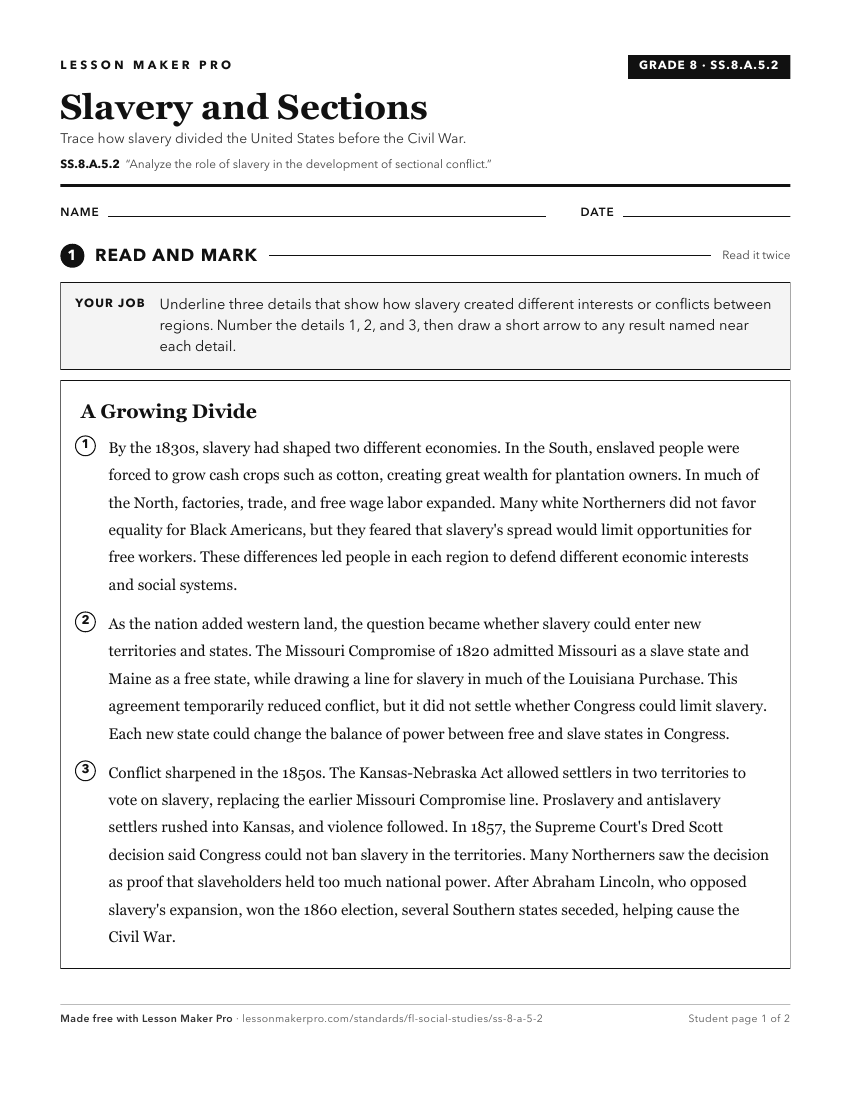
A ready-to-print activity worksheet aligned to SS.8.A.5.2, with an answer key for the teacher on its own page. No account needed.
PDF, US Letter, prints cleanly in black and white.
Download the worksheetKeep exploring
Related Standards
- SS.68.AA.2.7
Examine how the status of slaves, those who had escaped slavery and free blacks, affected their contributions to the Civil War effort.
- SS.8.A.4.2
Describe the debate surrounding the spread of slavery into western territories and Florida.
- SS.68.AA.2
Analyze events that involved or affected Africans from the founding of the nation through Reconstruction.
- SS.8.A.5.1
Explain the causes, course, and consequences of the Civil War (e.g., sectionalism, slavery, states' rights, balance of power in the Senate).
Turn this exact standard into a lesson
Grade, subject, topic, and the complete standard are prefilled. Create one free, no account needed.
Also for this standard:Make a WorksheetMake a QuizMake a Sub Lesson