Florida SS.8.A.5.1
The Standard
- SS.8.A.5
- Examine the causes, course, and consequences of the Civil War and Reconstruction including its effects on American peoples.
Explain the causes, course, and consequences of the Civil War (e.g., sectionalism, slavery, states' rights, balance of power in the Senate).
Florida Next Generation Sunshine State Standards for Social Studies
Teacher's field guide
What This Standard Means
What Students Need to Do
- Students connect disputes over slavery’s expansion, regional economies, federal and state authority, and political power to secession and war. They trace major turning points, then explain political, social, and economic results, including emancipation and expanded federal power.
What Mastery Looks Like
- A student can separate long-term conditions from immediate triggers, place key events in sequence, and explain why each changed the conflict. The student supports claims about outcomes with evidence from maps, speeches, laws, or casualty and census data.
Common Misconceptions
- Students often name states’ rights without identifying the right Southern leaders were defending, especially slavery and its expansion. They may treat the Emancipation Proclamation as ending slavery everywhere immediately, or assume all Northerners supported racial equality. Some confuse a chronology of battles with an explanation of how turning points changed the war.
How to Assess It
- Exit ticket prompt: Name one long-term cause, one event that shifted the war, and one consequence. For each, write one sentence explaining the causal link.
Lesson moves
Ways to Teach It
Give pairs printed cause, event, and consequence cards; students sort them, build a timeline, and draw arrows showing causal links.
Ask students to write: Which issue most directly drove secession, and what two pieces of evidence support your claim?
Play Cause, Turning Point, or Consequence: read twelve clues aloud, and teams hold up labeled cards before defending one disputed answer.
Use Florida census data from 1860 and 1870 to calculate population changes, then connect those changes to emancipation.
Free download
Printable SS.8.A.5.1 Worksheet
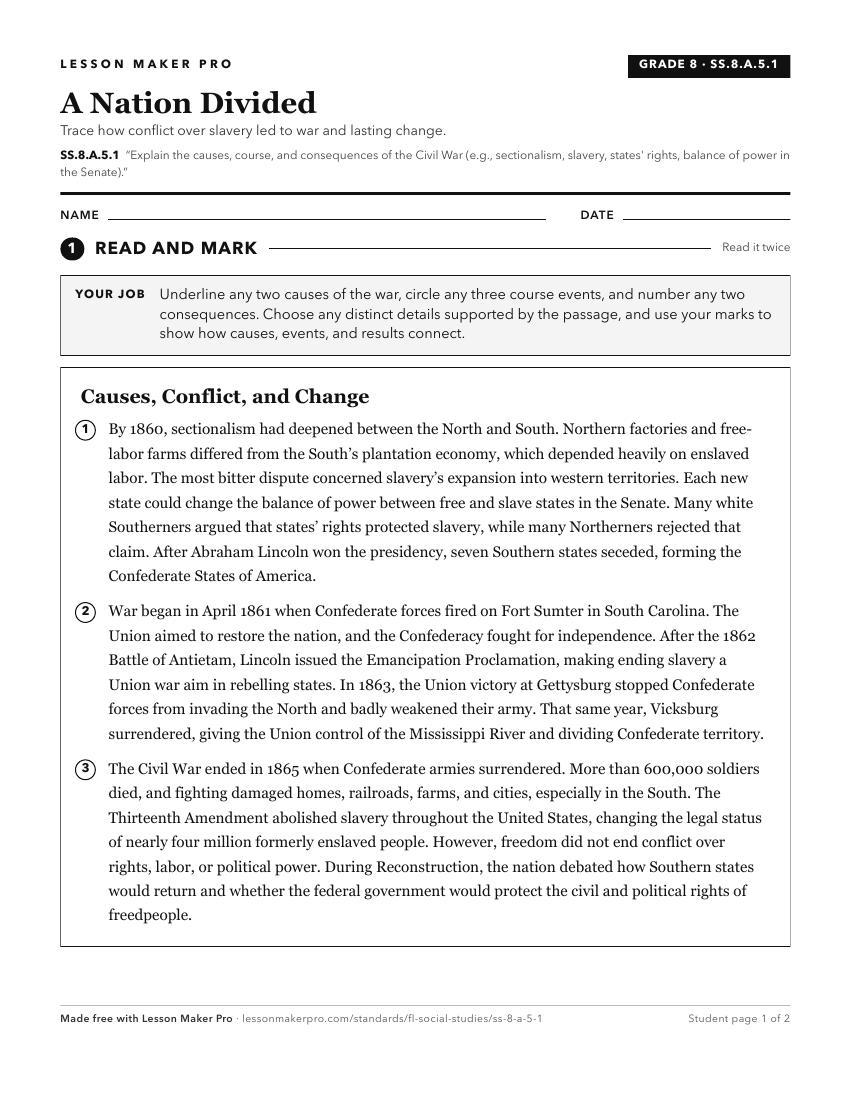
A ready-to-print activity worksheet aligned to SS.8.A.5.1, with an answer key for the teacher on its own page. No account needed.
PDF, US Letter, prints cleanly in black and white.
Download the worksheetKeep exploring
Related Standards
- SS.5.A.6.5
Identify the causes and effects of the War of 1812.
- SS.8.A.5.2
Analyze the role of slavery in the development of sectional conflict.
- SS.8.A.3.6
Examine the causes, course, and consequences of the American Revolution.
- SS.8.A.5
Examine the causes, course, and consequences of the Civil War and Reconstruction including its effects on American peoples.
Turn this exact standard into a lesson
Grade, subject, topic, and the complete standard are prefilled. Create one free, no account needed.
Also for this standard:Make a WorksheetMake a QuizMake a Sub Lesson