Florida SS.8.A.2
Florida Standard (Benchmark Cluster)
Examine the causes, course, and consequences of British settlement in the American colonies.
Florida Next Generation Sunshine State Standards for Social Studies
Cluster contents
Benchmarks in This Standard
SS.8.A.2 is a Florida social studies standard. These are the benchmarks under it.
- SS.8.A.2.1
Compare the relationships among the British, French, Spanish, and Dutch in their struggle for colonization of North America.
- SS.8.A.2.2
Compare the characteristics of the New England, Middle, and Southern colonies.
- SS.8.A.2.3
Differentiate economic systems of New England, Middle, and Southern colonies including indentured servants and slaves as labor sources.
- SS.8.A.2.4
Identify the impact of key colonial figures on the economic, political, and social development of the colonies.
- SS.8.A.2.5
Discuss the impact of colonial settlement on Native American populations.
- SS.8.A.2.6
Examine the causes, course, and consequences of the French and Indian War.
- SS.8.A.2.7
Describe the contributions of key groups (e.g., Africans, Native Americans, women, and children) to the society and culture of colonial America.
Teacher's field guide
What This Cluster Means
What Students Need to Do
- Students trace why English migrants established colonies and how settlements changed over time. They connect geography, labor, trade, religion, and government to colonial growth. They explain effects on Native nations, Africans, settlers, and Britain.
What Mastery Looks Like
- Students can place major settlements and turning points in order, then build accurate cause-and-effect chains. They compare colonial regions and support claims with details from maps, laws, letters, or records.
Common Misconceptions
- Students often assume every colony began for religious freedom and that settlers entered empty land. They may treat the colonies as alike, overlook Native resistance and exchange, or place plantation slavery only after independence.
How to Assess It
- Exit ticket: Choose Jamestown, Plymouth, or Georgia. Name one motive for settlement, one event that shaped its development, and one consequence for a named group.
Lesson moves
Ways to Teach It
Give groups settlement, geography, labor, and consequence cards to place on a map and connect with yarn into cause-and-effect chains.
Students argue whether geography or human decisions mattered more in colonial growth, using two specific examples.
Run a cause, event, consequence relay in which teams correctly match cards for Jamestown, Plymouth, Massachusetts Bay, and Georgia.
Compare a colonial Boston port map with a current map, then identify one settlement pattern that still shapes the city.
Free download
Printable SS.8.A.2 Worksheet
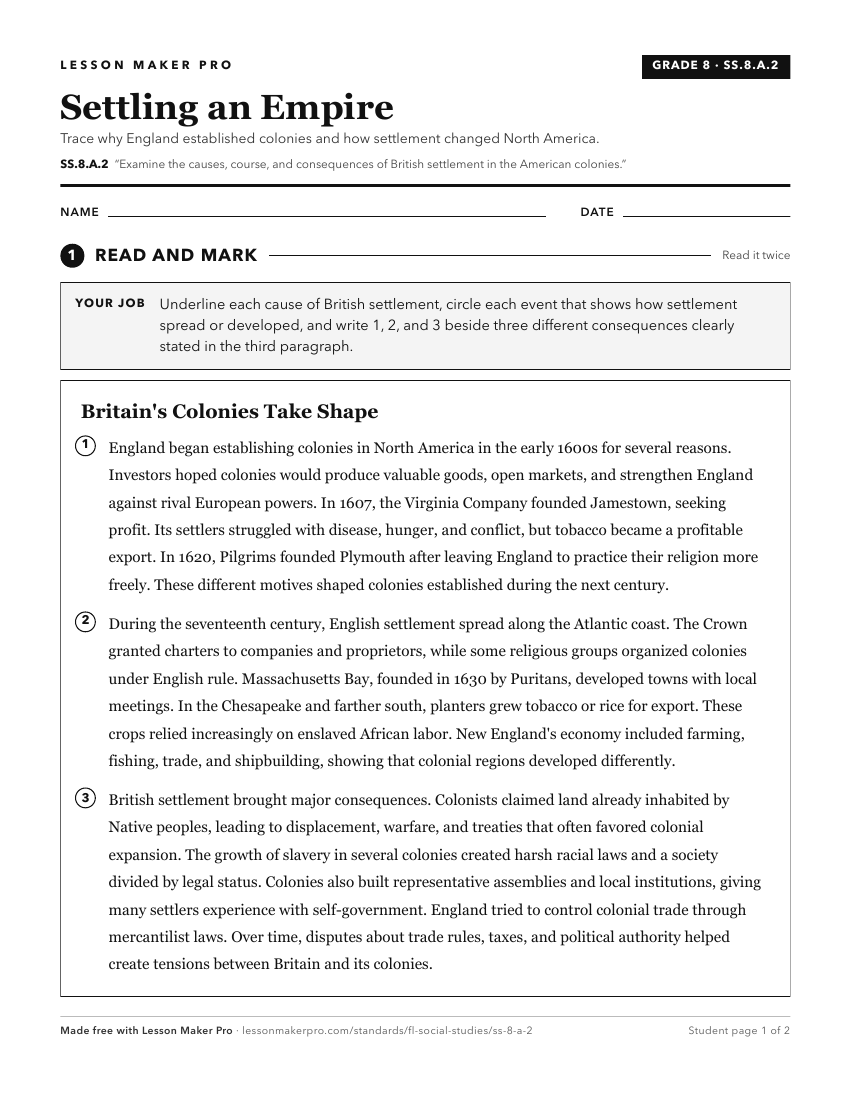
A ready-to-print activity worksheet aligned to SS.8.A.2, with an answer key for the teacher on its own page. No account needed.
PDF, US Letter, prints cleanly in black and white.
Download the worksheetKeep exploring
Related Standards
Turn this cluster into a lesson
Grade, subject, topic, and the complete cluster are prefilled. Create one free, no account needed.
Also for this cluster:Make a WorksheetMake a QuizMake a Sub Lesson