Florida SS.8.A.2.2
The Standard
- SS.8.A.2
- Examine the causes, course, and consequences of British settlement in the American colonies.
Compare the characteristics of the New England, Middle, and Southern colonies.
Florida Next Generation Sunshine State Standards for Social Studies
Teacher's field guide
What This Standard Means
What Students Need to Do
- Students compare the geography, climate, economies, labor systems, religions, and settlement patterns of the three colonial regions. They explain how local conditions shaped daily life and work.
What Mastery Looks Like
- Students correctly sort examples such as shipbuilding, grain farming, and plantation agriculture by region. They support each choice with a geographic, economic, or social reason and name similarities between regions.
Common Misconceptions
- Students often treat every colony within a region as identical or assume all colonists shared one religion. They may also place slavery only in the South, overlooking enslaved labor in every region.
How to Assess It
- Give students a three-column chart labeled New England, Middle, and Southern. Ask them to place six provided traits and justify two placements in writing.
Lesson moves
Ways to Teach It
Give pairs a colonial map and trait cards to sort by region, then require evidence for each placement.
Ask students to write which region offered the best life for a farmer, merchant, or artisan and defend their choice.
Play a region riddle game using clues about climate, crops, labor, religion, ports, and settlement patterns.
Have students compare each colonial region with a present-day state economy shaped by geography, such as fishing, farming, or shipping.
Free download
Printable SS.8.A.2.2 Worksheet
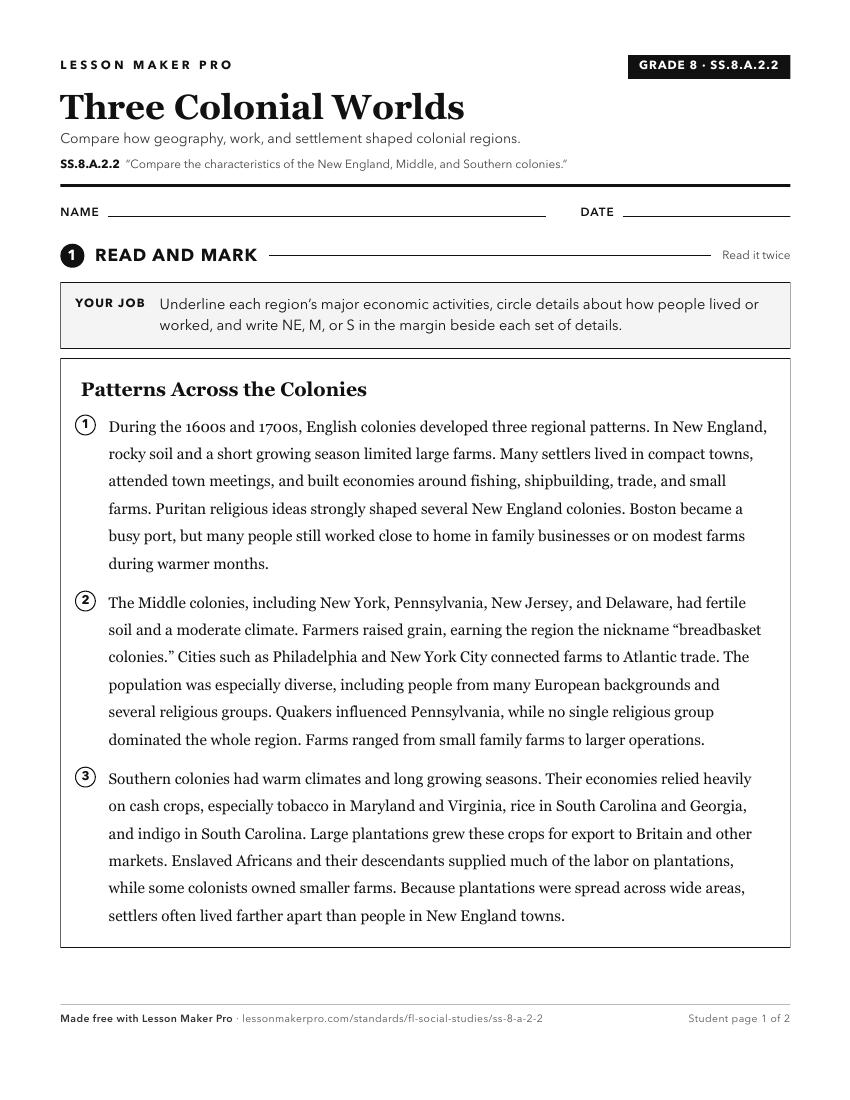
A ready-to-print activity worksheet aligned to SS.8.A.2.2, with an answer key for the teacher on its own page. No account needed.
PDF, US Letter, prints cleanly in black and white.
Download the worksheetKeep exploring
Related Standards
- SS.5.A.4.3
Identify significant individuals responsible for the development of the New England, Middle, and Southern colonies.
- SS.8.A.2.3
Differentiate economic systems of New England, Middle, and Southern colonies including indentured servants and slaves as labor sources.
- SS.8.A.2.1
Compare the relationships among the British, French, Spanish, and Dutch in their struggle for colonization of North America.
- SS.5.A.4.2
Compare characteristics of New England, Middle, and Southern colonies.
Turn this exact standard into a lesson
Grade, subject, topic, and the complete standard are prefilled. Create one free, no account needed.
Also for this standard:Make a WorksheetMake a QuizMake a Sub Lesson