Florida SS.8.A.2.1
The Standard
- SS.8.A.2
- Examine the causes, course, and consequences of British settlement in the American colonies.
Compare the relationships among the British, French, Spanish, and Dutch in their struggle for colonization of North America.
Florida Next Generation Sunshine State Standards for Social Studies
Teacher's field guide
What This Standard Means
What Students Need to Do
- Students identify where Britain, France, Spain, and the Netherlands claimed land and why their interests collided. They use maps and events to explain competition, trade, alliances, and armed conflict.
What Mastery Looks Like
- A student can accurately match each power to its main regions, goals, rivals, and major conflicts. They can use evidence to explain how trade and territorial disputes changed control of land.
Common Misconceptions
- Students often treat colonial borders as fixed and assume Britain controlled most of North America from the beginning. They may confuse New Netherland with New France or overlook Native nations as allies and trading partners.
How to Assess It
- Exit ticket: Name two colonial powers that competed for land or trade, describe the conflict, and give one event that changed their relationship.
Lesson moves
Ways to Teach It
Give groups a blank map and color-coded claim cards to place British, French, Spanish, and Dutch settlements in the correct regions.
Ask students to write which two powers were the strongest rivals and support their choice with two facts.
Play a matching game connecting each colonial power with regions, trade goods, allies, rivals, and major conflicts.
Have students compare control of ports and trade routes to competition among modern companies for customers and shipping access.
Free download
Printable SS.8.A.2.1 Worksheet
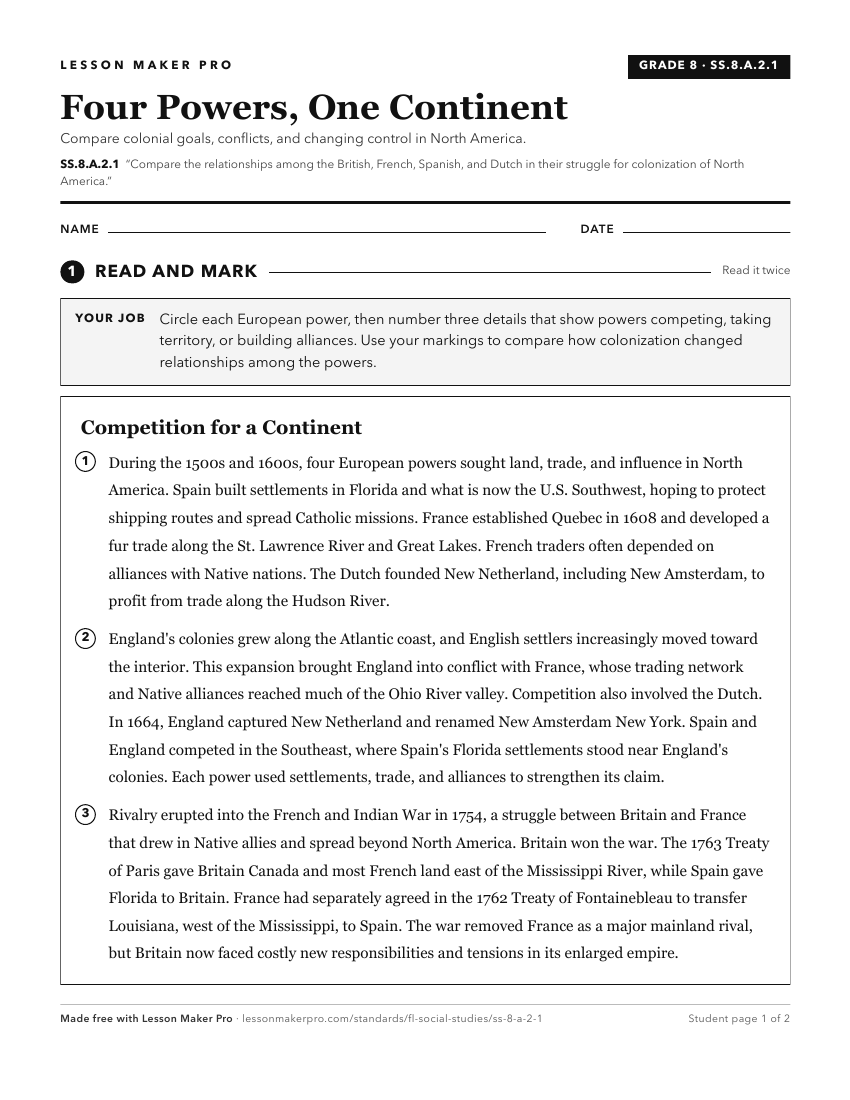
A ready-to-print activity worksheet aligned to SS.8.A.2.1, with an answer key for the teacher on its own page. No account needed.
PDF, US Letter, prints cleanly in black and white.
Download the worksheetKeep exploring
Related Standards
- SS.8.A.2
Examine the causes, course, and consequences of British settlement in the American colonies.
- SS.5.A.4
Colonization of North America
- SS.5.A.3.3
Describe interactions among Native Americans, Africans, English, French, Dutch, and Spanish for control of North America.
- SS.8.A.2.2
Compare the characteristics of the New England, Middle, and Southern colonies.
Turn this exact standard into a lesson
Grade, subject, topic, and the complete standard are prefilled. Create one free, no account needed.
Also for this standard:Make a WorksheetMake a QuizMake a Sub Lesson