Florida SS.7.G.2.4
The Standard
- SS.7.G.2
- Understand physical and cultural characteristics of places.
Describe current major cultural regions of North America.
Florida Next Generation Sunshine State Standards for Social Studies
Teacher's field guide
What This Standard Means
What Students Need to Do
- Students locate major cultural regions, including the United States and Canada, Latin America, and the Caribbean. They describe each using language, religion, traditions, and settlement patterns.
What Mastery Looks Like
- Students label the regions on a map and support each label with two accurate cultural traits. They explain that cultural boundaries can overlap and differ from national borders.
Common Misconceptions
- Students may treat cultural regions as fixed political divisions or assume everyone in a region shares one culture. They may also overlook Indigenous cultures, migration, and multilingual communities.
How to Assess It
- Give students a blank map of North America. Ask them to outline three major cultural regions and write two cultural traits for each.
Lesson moves
Ways to Teach It
Give groups outline maps, language data, religion data, and migration maps, then have them draw and defend cultural region boundaries.
Ask students to write: Why might two people living in the same country belong to different cultural regions?
Read clue cards about language, traditions, and settlement history, then have teams match each card to a region and explain their choice.
Compare local food labels, radio stations, or festival calendars to trace cultural connections between your community and North American regions.
Free download
Printable SS.7.G.2.4 Worksheet
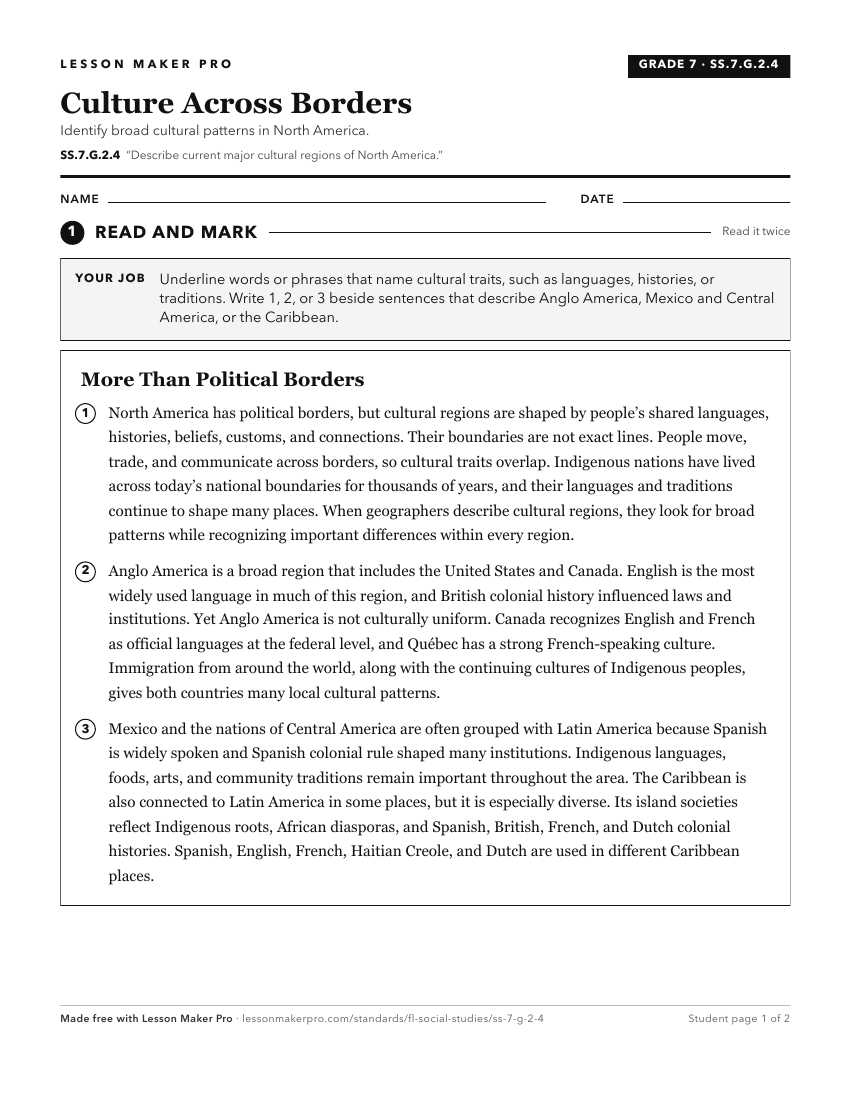
A ready-to-print activity worksheet aligned to SS.7.G.2.4, with an answer key for the teacher on its own page. No account needed.
PDF, US Letter, prints cleanly in black and white.
Download the worksheetKeep exploring
Related Standards
- SS.7.G.2.3
Explain how major physical characteristics, natural resources, climate, and absolute and relative location have influenced settlement, economies, and inter-gove...
- SS.3.G.4.2
Identify the cultures that have settled the United States, Canada, Mexico, and the Caribbean.
- SS.2.A.2.2
Compare the cultures of Native American tribes from various geographic regions of the United States.
- SS.3.G.4.3
Compare the cultural characteristics of diverse populations in one of the five regions of the United States with Canada, Mexico, or the Caribbean.
Turn this exact standard into a lesson
Grade, subject, topic, and the complete standard are prefilled. Create one free, no account needed.
Also for this standard:Make a WorksheetMake a QuizMake a Sub Lesson