Florida SS.5.G.2.1
The Standard
- SS.5.G.2
- Places and Regions
Describe the push-pull factors (e.g., economy, natural hazards, tourism, climate, physical features) that influenced boundary changes within the United States.
Florida Next Generation Sunshine State Standards for Social Studies
Teacher's field guide
What This Standard Means
What Students Need to Do
- Students compare historical maps to locate changes in national or regional borders. They connect economic opportunities, hazards, climate, tourism, and landforms to why people or governments wanted, left, or reorganized land.
What Mastery Looks Like
- Given before-and-after maps, a student identifies the land affected and names a relevant push or pull factor. The student uses map or source evidence to explain how that factor contributed to the change.
Common Misconceptions
- Students may reverse push and pull, or assume every factor affects people in the same way. They may think rivers or mountains changed borders by themselves, rather than leaders choosing those features as boundary lines.
How to Assess It
- Exit ticket: Show before-and-after maps of the Louisiana Purchase. Ask, “What land changed hands, and which pull factor helped drive the change? Cite one map clue.”
Lesson moves
Ways to Teach It
Students place factor cards on a floor map beside Louisiana Purchase, Texas, Oregon, and Mexican Cession regions, then explain each placement.
Write: Which mattered more in westward boundary change, economic opportunity or physical geography? Use evidence from two maps.
Play a push, pull, or neither card sort using examples such as drought, gold, warm climate, ports, mountains, and beaches.
Compare local population and city-limit maps, then identify economic or physical factors that may explain annexation or boundary growth.
Free download
Printable SS.5.G.2.1 Worksheet
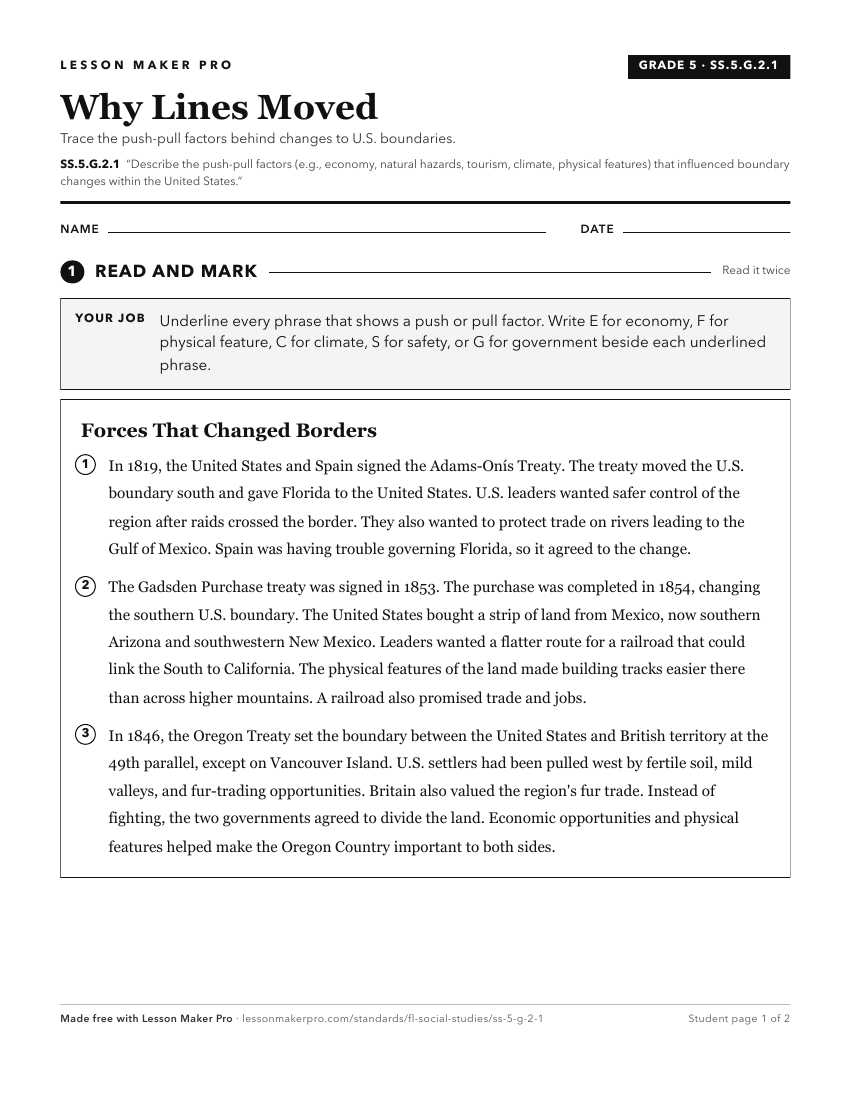
A ready-to-print activity worksheet aligned to SS.5.G.2.1, with an answer key for the teacher on its own page. No account needed.
PDF, US Letter, prints cleanly in black and white.
Download the worksheetKeep exploring
Related Standards
- SS.7.G.2.3
Explain how major physical characteristics, natural resources, climate, and absolute and relative location have influenced settlement, economies, and inter-gove...
- SS.3.G.4.1
Explain how the environment influences settlement patterns in the United States, Canada, Mexico, and the Caribbean.
- SS.5.G.3.1
Describe the impact that past natural events have had on human and physical environments in the United States through 1850.
- SS.8.G.5.2
Describe the impact of human modifications on the physical environment and ecosystems of the United States throughout history.
Turn this exact standard into a lesson
Grade, subject, topic, and the complete standard are prefilled. Create one free, no account needed.
Also for this standard:Make a WorksheetMake a QuizMake a Sub Lesson