Florida B.E.S.T. MA.912.GR.2
B.E.S.T. Standard (Benchmark Cluster)
Apply properties of transformations to describe congruence or similarity.
Florida B.E.S.T. Standards for Mathematics
Cluster contents
Benchmarks in This Standard
MA.912.GR.2 is a B.E.S.T. standard. These are the benchmarks under it.
- MA.912.GR.2.1
Given a preimage and image, describe the transformation and represent the transformation algebraically using coordinates.
- MA.912.GR.2.2
Identify transformations that do or do not preserve distance.
- MA.912.GR.2.3
Identify a sequence of transformations that will map a given figure onto itself or onto another congruent or similar figure.
- MA.912.GR.2.4
Determine symmetries of reflection, symmetries of rotation and symmetries of translation of a geometric figure.
- MA.912.GR.2.5
Given a geometric figure and a sequence of transformations, draw the transformed figure on a coordinate plane.
- MA.912.GR.2.6
Apply rigid transformations to map one figure onto another to justify that the two figures are congruent.
- MA.912.GR.2.7
Justify the criteria for triangle congruence using the definition of congruence in terms of rigid transformations.
- MA.912.GR.2.8
Apply an appropriate transformation to map one figure onto another to justify that the two figures are similar.
- MA.912.GR.2.9
Justify the criteria for triangle similarity using the definition of similarity in terms of non-rigid transformations.
Teacher's field guide
What This Cluster Means
What Students Need to Do
- Students decide whether two figures are congruent or similar by examining the transformations that connect them. They describe what happens to side lengths, angle measures, orientation, and scale.
What Mastery Looks Like
- Students can describe a sequence of translations, rotations, reflections, and dilations that maps one figure onto another. They justify congruence using preserved lengths and angles, or similarity using equal angles and proportional side lengths.
Common Misconceptions
- Students may think figures are congruent whenever they have the same shape, even when their sizes differ. They may assume a dilation preserves side lengths or that every transformation changes orientation. They may also match the wrong corresponding vertices.
How to Assess It
- Give triangle A(0,0), B(2,0), C(0,3) and image A′(1,1), B′(5,1), C′(1,7); ask students to name a transformation sequence and justify whether the triangles are congruent or similar.
Lesson moves
Ways to Teach It
Use tracing paper to translate, rotate, and reflect a polygon, then measure corresponding sides and angles to identify what stays unchanged.
Ask students to explain why a dilation can preserve angle measures without preserving side lengths.
Run a card sort matching transformation sequences with labels of congruent, similar, or neither, and require one written justification per match.
Compare a classroom floor plan with room measurements, then calculate the scale factor and identify corresponding lengths and angles.
Free download
Printable MA.912.GR.2 Worksheet
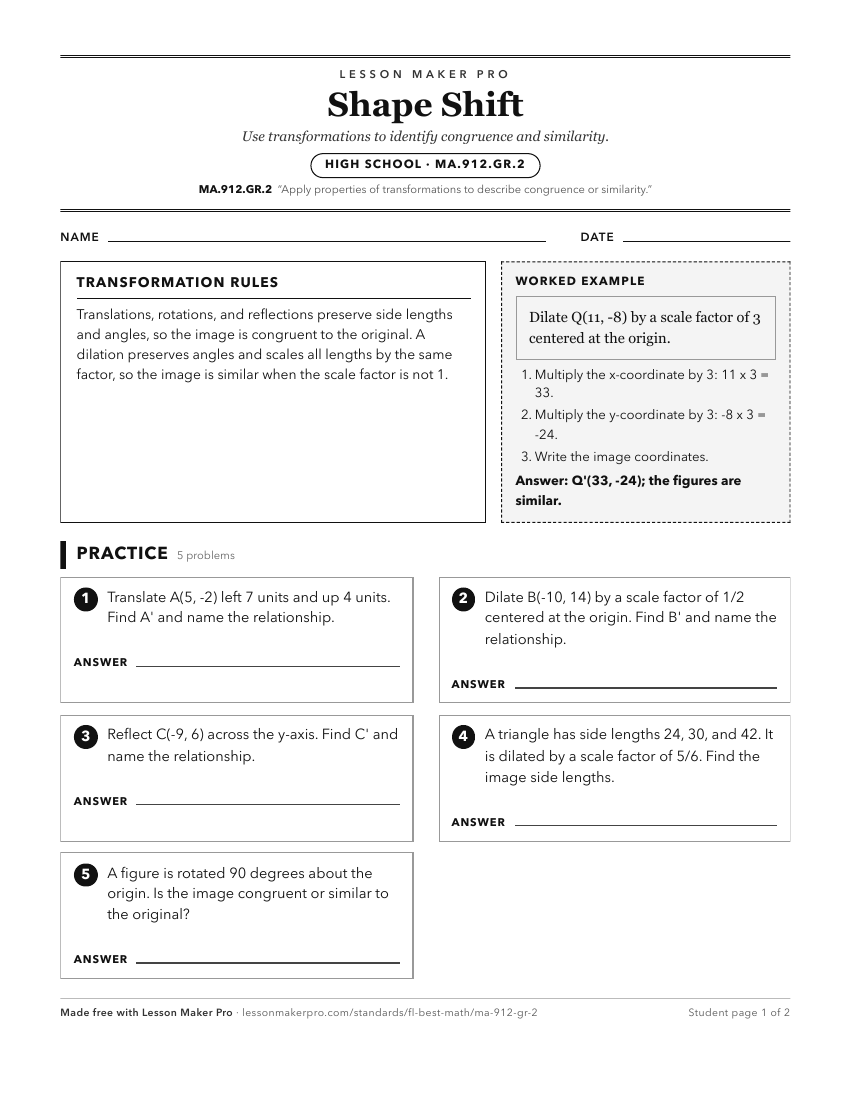
A ready-to-print activity worksheet aligned to MA.912.GR.2, with an answer key for the teacher on its own page. No account needed.
PDF, US Letter, prints cleanly in black and white.
Download the worksheetKeep exploring
Related Standards
Turn this cluster into a lesson
Grade, subject, topic, and the complete cluster are prefilled. Create one free, no account needed.
Also for this cluster:Make a WorksheetMake a QuizMake a Sub Lesson