Florida B.E.S.T. MA.912.GR.2.9
The Standard
Justify the criteria for triangle similarity using the definition of similarity in terms of non-rigid transformations.
Florida B.E.S.T. Standards for Mathematics
Teacher's field guide
What This Standard Means
What Students Need to Do
- Students explain why AA, two proportional sides with the included angle, and three proportional sides guarantee triangle similarity. They use a dilation to match scale, then rigid motions to align the triangles.
What Mastery Looks Like
- A student can choose a scale factor and explain how a dilation makes corresponding sides match. They use rigid motions and congruence facts to justify AA, SAS, and SSS similarity.
Common Misconceptions
- Students may compare noncorresponding sides or use equal side differences instead of proportional lengths. They may treat SSA as valid or assume one equal angle is enough. Some omit the rigid motions needed after a dilation.
How to Assess It
- Exit ticket: Triangle ABC has sides 4 and 6 around a 50° angle. Triangle DEF has sides 10 and 15 around a 50° angle. Name the criterion and explain how a dilation and rigid motions prove similarity.
Lesson moves
Ways to Teach It
On grid paper, students dilate a cutout triangle, then translate, rotate, or reflect it to match a second triangle.
Ask, "Why do two equal angles force the third angle and matching side lengths to share one scale factor?"
Run a card sort matching triangle pairs with AA, SAS, SSS, or not similar, including a transformation-based reason for each choice.
Measure a pole and its shadow, compare them with a meterstick and its shadow, then justify AA similarity using equal sun angles.
Free download
Printable MA.912.GR.2.9 Worksheet
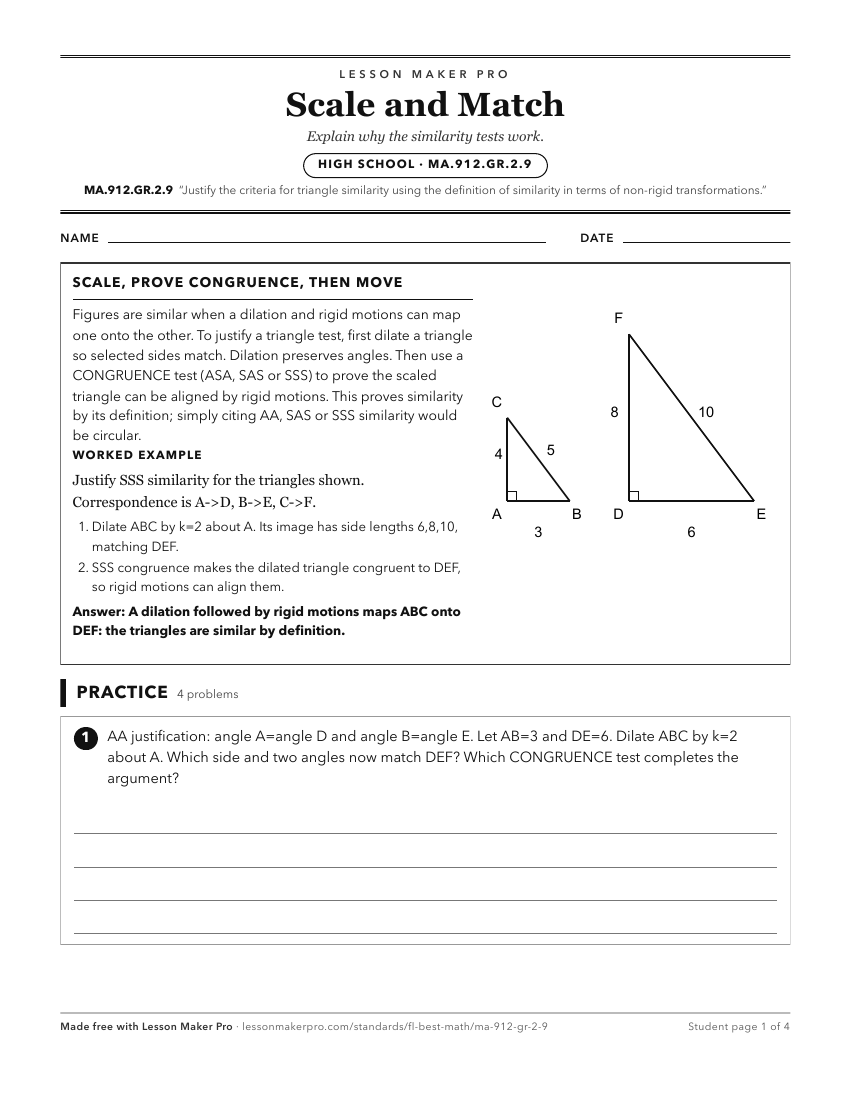
A ready-to-print activity worksheet aligned to MA.912.GR.2.9, with an answer key for the teacher on its own page. No account needed.
PDF, US Letter, prints cleanly in black and white.
Download the worksheetKeep exploring
Related Standards
- MA.8.GR.2
Understand similarity and congruence using models and transformations.
- MA.912.GR.2
Apply properties of transformations to describe congruence or similarity.
- MA.912.GR.6.5
Apply transformations to prove that all circles are similar.
- MA.912.GR.2.7
Justify the criteria for triangle congruence using the definition of congruence in terms of rigid transformations.
Turn this exact standard into a lesson
Grade, subject, topic, and the complete standard are prefilled. Create one free, no account needed.
Also for this standard:Make a WorksheetMake a QuizMake a Sub Lesson