Florida B.E.S.T. MA.912.GR.2.6
The Standard
Apply rigid transformations to map one figure onto another to justify that the two figures are congruent.
Florida B.E.S.T. Standards for Mathematics
Teacher's field guide
What This Standard Means
What Students Need to Do
- Students find a sequence of translations, rotations, or reflections that places one figure exactly over another. They describe each motion precisely and use the completed mapping as evidence of congruence.
What Mastery Looks Like
- Students accurately describe translations, rotations, and reflections using lines, angles, directions, and distances. They verify that all corresponding vertices coincide, then use that mapping to justify congruence.
Common Misconceptions
- Students may treat a dilation as a rigid motion because the shape stays the same. They may also match one vertex correctly but fail to check that every vertex lands on its corresponding point.
How to Assess It
- Give two congruent polygons on a coordinate grid. Ask students to name a sequence of rigid motions that maps the first polygon onto the second and verify each vertex.
Lesson moves
Ways to Teach It
Give pairs tracing paper to slide, turn, or flip one printed polygon until it covers another, then record the exact motions.
Ask students to explain why matching side lengths alone does not show that one figure can be mapped onto another by rigid motions.
Play a transformation relay where teams write one precise motion at a time to map a polygon onto a target on a coordinate grid.
Use two identical floor-plan shapes in different positions and ask students to describe how a contractor could align the plans without resizing them.
Free download
Printable MA.912.GR.2.6 Worksheet
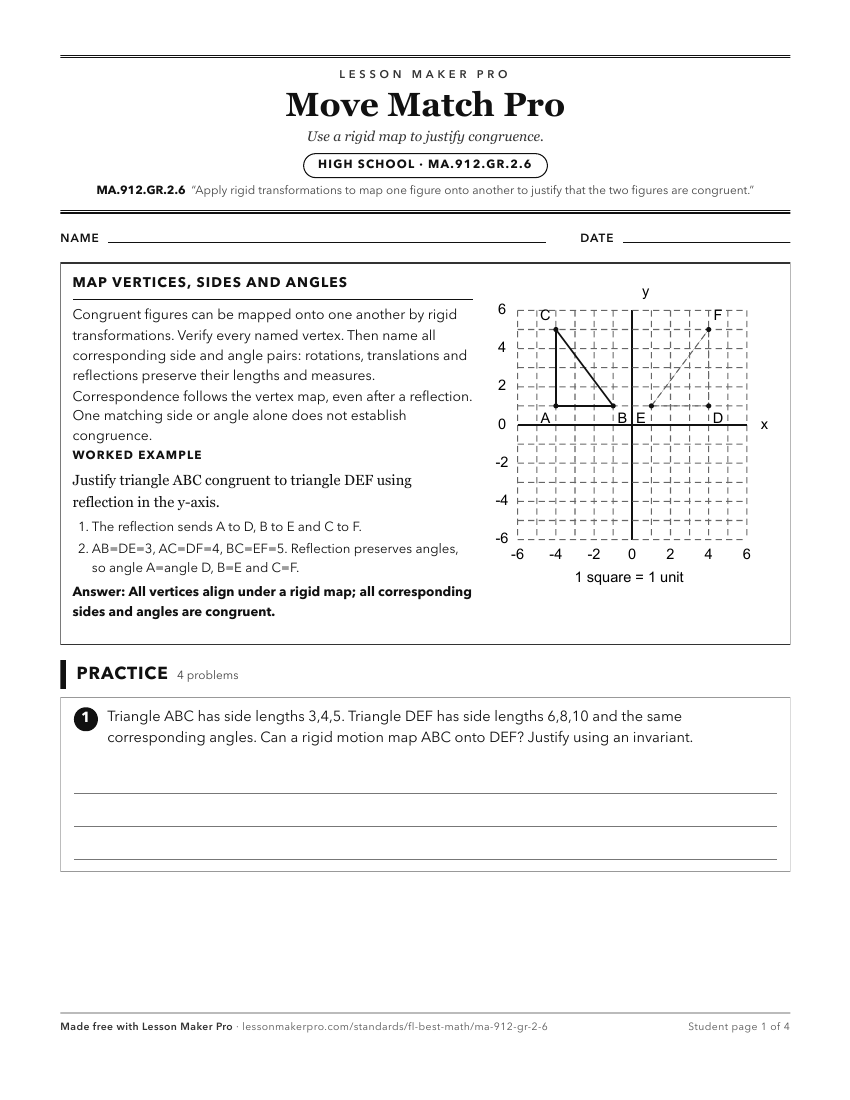
A ready-to-print activity worksheet aligned to MA.912.GR.2.6, with an answer key for the teacher on its own page. No account needed.
PDF, US Letter, prints cleanly in black and white.
Download the worksheetKeep exploring
Related Standards
- MA.912.GR.2.3
Identify a sequence of transformations that will map a given figure onto itself or onto another congruent or similar figure.
- MA.912.GR.2
Apply properties of transformations to describe congruence or similarity.
- MA.912.GR.2.8
Apply an appropriate transformation to map one figure onto another to justify that the two figures are similar.
- MA.912.GR.2.7
Justify the criteria for triangle congruence using the definition of congruence in terms of rigid transformations.
Turn this exact standard into a lesson
Grade, subject, topic, and the complete standard are prefilled. Create one free, no account needed.
Also for this standard:Make a WorksheetMake a QuizMake a Sub Lesson