Florida B.E.S.T. MA.6.NSO.3.4
The Standard
Express composite whole numbers as a product of prime factors with natural number exponents.
Florida B.E.S.T. Standards for Mathematics
Teacher's field guide
What This Standard Means
What Students Need to Do
- Students break a composite whole number into prime factors. They group repeated prime factors and write them with exponents, then multiply to check the original number.
What Mastery Looks Like
- Students can use a factor tree or repeated division and reach the same prime factors. They write repeated factors with exponents, such as 72 = 2^3 × 3^2, and check the product.
Common Misconceptions
- Students may stop a factor tree while a composite factor remains. They may omit repeated primes or read 2^3 as 2 times 3 instead of three factors of 2.
How to Assess It
- Ask students to factor 180, write the result using exponents, and multiply the factors to verify that the product is 180.
Lesson moves
Ways to Teach It
Give students factor cards for 72 and have them split composite factors until only primes remain, then combine repeated primes with exponent cards.
Have students compare two different factor trees for 84 and explain in writing why both produce the same prime factorization.
Play Prime Factorization Bingo by calling composite numbers while students factor each number and cover the matching exponential form.
Use the prime factorization of 360 snack bags to test which group sizes can divide the total evenly.
Free download
Printable MA.6.NSO.3.4 Worksheet
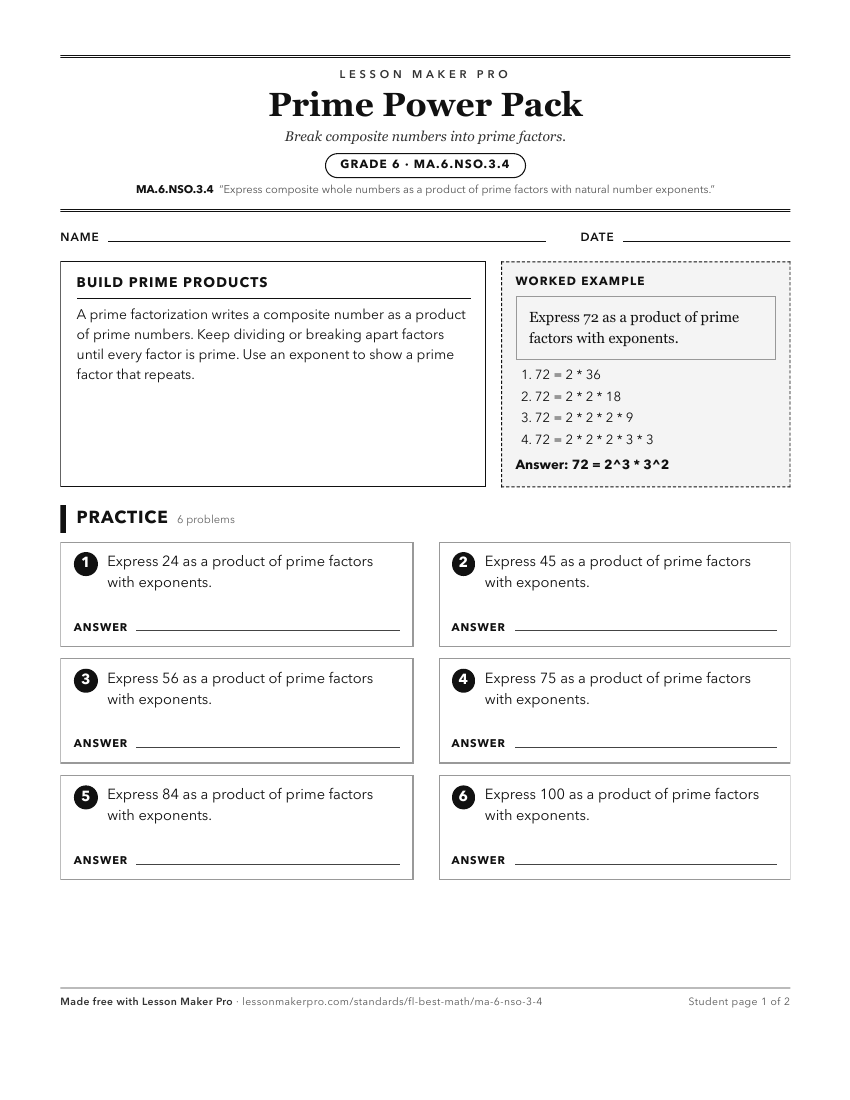
A ready-to-print activity worksheet aligned to MA.6.NSO.3.4, with an answer key for the teacher on its own page. No account needed.
PDF, US Letter, prints cleanly in black and white.
Download the worksheetKeep exploring
Related Standards
- MA.4.AR.3.1
Determine factor pairs for a whole number from 0 to 144. Determine whether a whole number from 0 to 144 is prime, composite or neither.
- MA.6.NSO.3.3
Evaluate positive rational numbers and integers with natural number exponents.
- MA.6.NSO.3.2
Rewrite the sum of two composite whole numbers having a common factor, as a common factor multiplied by the sum of two whole numbers.
- MA.3.NSO.2.2
Explore multiplication of two whole numbers with products from 0 to 144, and related division facts.
Turn this exact standard into a lesson
Grade, subject, topic, and the complete standard are prefilled. Create one free, no account needed.
Also for this standard:Make a WorksheetMake a QuizMake a Sub Lesson