Florida B.E.S.T. MA.4.AR.3.1
The Standard
Determine factor pairs for a whole number from 0 to 144. Determine whether a whole number from 0 to 144 is prime, composite or neither.
Florida B.E.S.T. Standards for Mathematics
Teacher's field guide
What This Standard Means
What Students Need to Do
- Students list positive whole-number pairs whose product equals a given number, using arrays, multiplication, or division. They use the factor pairs to classify numbers as prime, composite, or neither.
What Mastery Looks Like
- A student can list each factor pair once and know when the list is complete. They correctly classify numbers through 144 and explain why 0 and 1 are neither prime nor composite.
Common Misconceptions
- Students often confuse factors with multiples or stop before finding every pair. They may count reversed pairs twice, miss a square pair, call 1 prime, or call 0 composite.
How to Assess It
- Exit ticket: List every positive factor pair of 36. Then classify 36, 37, 1, and 0 as prime, composite, or neither and justify one answer.
Lesson moves
Ways to Teach It
Give pairs of students 36 square tiles and have them build every rectangular array, recording each row-by-column factor pair.
Ask students to write why 1 and 0 are neither prime nor composite, using definitions and one example of each number type.
Play Factor Pair Bingo: call a product, and students cover a factor pair on their boards after verifying the multiplication.
Plan seating for 48 guests by listing every equal-row arrangement, then decide whether 48 is prime or composite.
Free download
Printable MA.4.AR.3.1 Worksheet
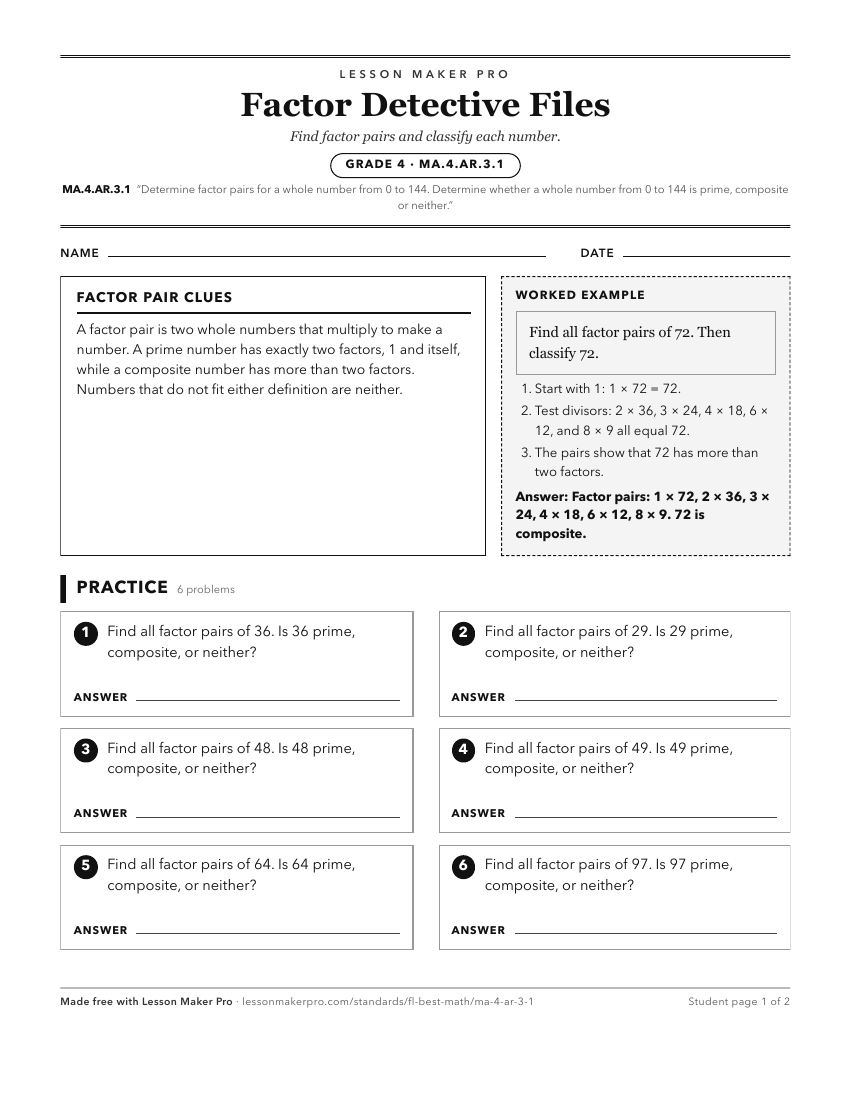
A ready-to-print activity worksheet aligned to MA.4.AR.3.1, with an answer key for the teacher on its own page. No account needed.
PDF, US Letter, prints cleanly in black and white.
Download the worksheetKeep exploring
Related Standards
- MA.3.AR.3.1
Determine and explain whether a whole number from 1 to 1,000 is even or odd.
- MA.3.NSO.2.2
Explore multiplication of two whole numbers with products from 0 to 144, and related division facts.
- MA.6.NSO.3.4
Express composite whole numbers as a product of prime factors with natural number exponents.
- MA.3.AR.3.2
Determine whether a whole number from 1 to 144 is a multiple of a given one-digit number.
Turn this exact standard into a lesson
Grade, subject, topic, and the complete standard are prefilled. Create one free, no account needed.
Also for this standard:Make a WorksheetMake a QuizMake a Sub Lesson