Florida B.E.S.T. MA.3.AR.3.2
The Standard
Determine whether a whole number from 1 to 144 is a multiple of a given one-digit number.
Florida B.E.S.T. Standards for Mathematics
Teacher's field guide
What This Standard Means
What Students Need to Do
- Students decide whether a number can be arranged into equal groups of a stated size with none left over. They show their reasoning with multiplication, division, skip-counting, or an array.
What Mastery Looks Like
- A student can classify numbers accurately and explain each decision. For example, the student knows 72 is a multiple of 8 because 8 × 9 = 72, while 74 is not.
Common Misconceptions
- Students may reverse factor and multiple, saying 8 is a multiple of 72. They may stop at 10 times a number and miss larger products. Some accept a division result with a remainder or rely only on the last digit.
How to Assess It
- Give this exit ticket: Circle every multiple of 6 in 42, 55, 72, 91, and 114. Prove one choice with an equation.
Lesson moves
Ways to Teach It
Give pairs 72 counters and number cards, then have them test whether each number can form equal groups of a chosen size.
Ask students to explain two different ways to prove that 96 is a multiple of 8.
Play Multiple Match by pairing factor cards from 1 to 9 with matching product cards from 1 to 144.
Plan snack bags using 48 crackers, then decide which group sizes from 1 to 9 leave no crackers remaining.
Free download
Printable MA.3.AR.3.2 Worksheet
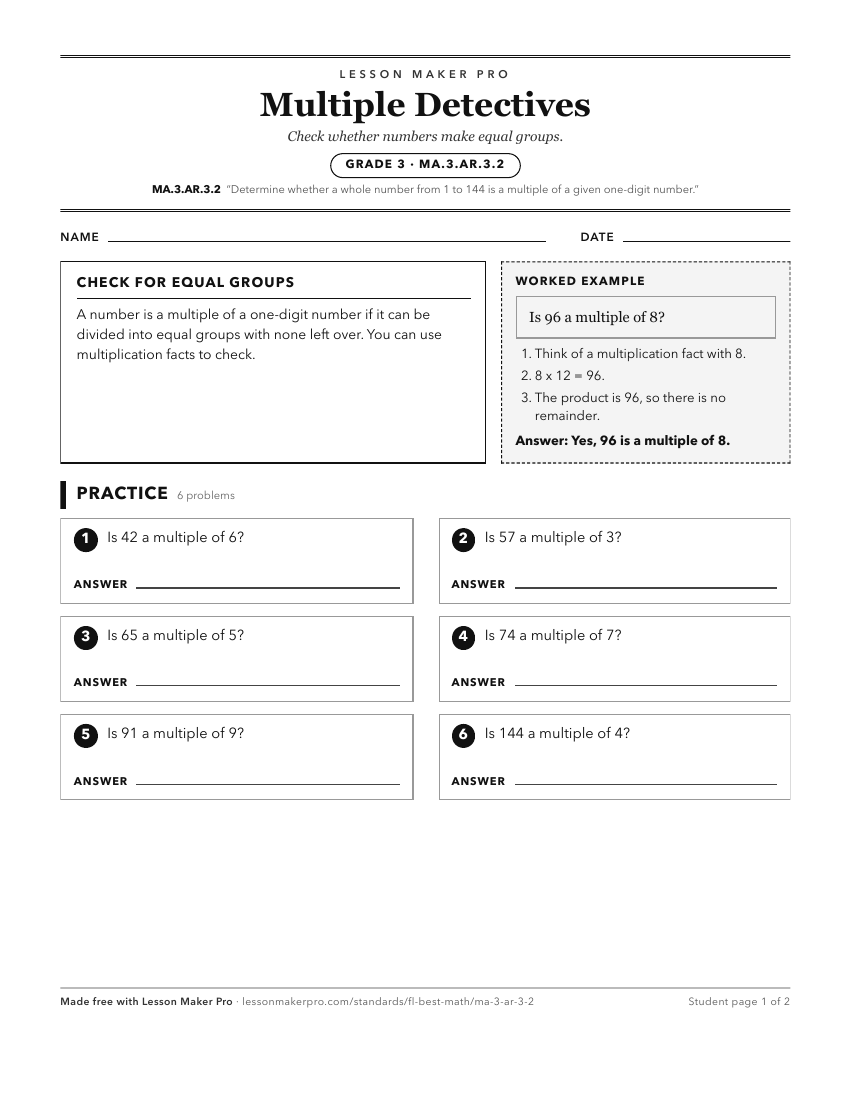
A ready-to-print activity worksheet aligned to MA.3.AR.3.2, with an answer key for the teacher on its own page. No account needed.
PDF, US Letter, prints cleanly in black and white.
Download the worksheetKeep exploring
Related Standards
- MA.3.AR.3.1
Determine and explain whether a whole number from 1 to 1,000 is even or odd.
- MA.4.AR.3.1
Determine factor pairs for a whole number from 0 to 144. Determine whether a whole number from 0 to 144 is prime, composite or neither.
- MA.3.NSO.2.3
Multiply a one-digit whole number by a multiple of 10, up to 90, or a multiple of 100, up to 900, with procedural reliability.
- MA.1.NSO.2.3
Identify the number that is one more, one less, ten more and ten less than a given two-digit number.
Turn this exact standard into a lesson
Grade, subject, topic, and the complete standard are prefilled. Create one free, no account needed.
Also for this standard:Make a WorksheetMake a QuizMake a Sub Lesson