Florida B.E.S.T. MA.1.NSO.2.3
The Standard
Identify the number that is one more, one less, ten more and ten less than a given two-digit number.
Florida B.E.S.T. Standards for Mathematics
Teacher's field guide
What This Standard Means
What Students Need to Do
- Students find nearby values by changing a two-digit number by 1 or 10. They use place value, number lines, or charts to explain which digit changes.
What Mastery Looks Like
- Given 47, a student gives 48, 46, 57, and 37 and labels each relationship correctly. The student also handles decade changes, such as moving from 40 to 39.
Common Misconceptions
- Students may change the wrong digit, saying 48 is ten more than 47. They may struggle across a decade, such as naming 30 instead of 29 as one less than 30.
How to Assess It
- Exit ticket: For 52, write the numbers reached by moving forward 1, back 1, forward 10, and back 10. Circle the digit that changed each time.
Lesson moves
Ways to Teach It
Build 34 with base-ten blocks, then add or remove one cube or one rod and record each new number.
Partners explain why adding a ten usually leaves the ones digit unchanged, using 46 and 56 as evidence.
Play Number Change: students draw a two-digit number card and a move card, then say and record the result.
Use a store count, such as 63 cans, and ask how the total changes after selling or receiving 1 or 10.
Free download
Printable MA.1.NSO.2.3 Worksheet
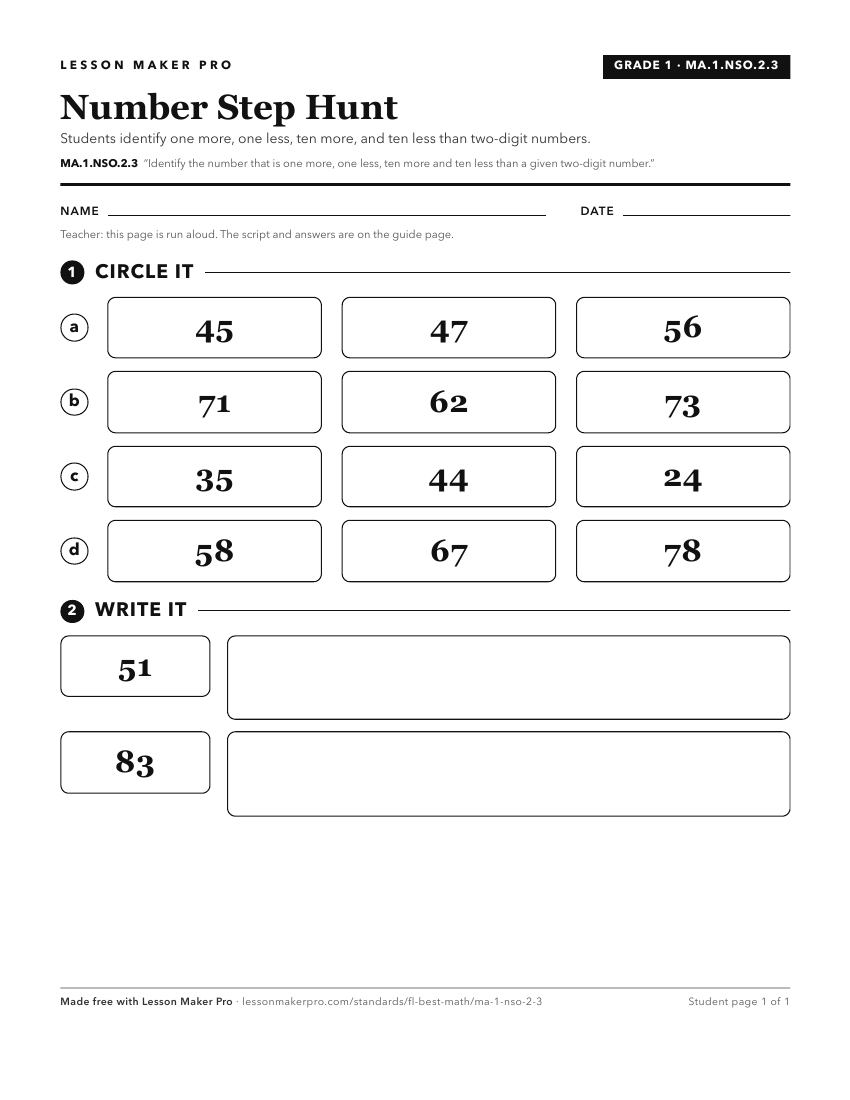
A ready-to-print activity worksheet aligned to MA.1.NSO.2.3, with an answer key for the teacher on its own page. No account needed.
PDF, US Letter, prints cleanly in black and white.
Download the worksheetKeep exploring
Related Standards
- MA.4.NSO.2.6
Identify the number that is one-tenth more, one-tenth less, one-hundredth more and one-hundredth less than a given number.
- MA.1.NSO.2.5
Explore subtraction of a one-digit number from a two-digit number.
- MA.1.NSO.1
Extend counting sequences and understand the place value of two-digit numbers.
- MA.2.NSO.2.2
Identify the number that is ten more, ten less, one hundred more and one hundred less than a given three-digit number.
Turn this exact standard into a lesson
Grade, subject, topic, and the complete standard are prefilled. Create one free, no account needed.
Also for this standard:Make a WorksheetMake a QuizMake a Sub Lesson