Florida B.E.S.T. MA.1.NSO.2.5
The Standard
Explore subtraction of a one-digit number from a two-digit number.
Florida B.E.S.T. Standards for Mathematics
Teacher's field guide
What This Standard Means
What Students Need to Do
- Students subtract a one-digit number from a two-digit number using objects, drawings, or a number line. They try strategies such as counting back, breaking apart, or making a ten.
What Mastery Looks Like
- Students solve problems such as 16 − 7 and 28 − 5 using objects, drawings, or number lines. They explain how counting back or making a ten leads to the answer.
Common Misconceptions
- Students may count the starting number as the first step when counting back. They may subtract the smaller digit from the larger digit, or forget that crossing a ten changes the tens digit.
How to Assess It
- Ask: “Show 24 − 7 with a drawing or number line. Write the answer and explain how you crossed the ten.”
Lesson moves
Ways to Teach It
Build 32 with base-ten blocks, trade one ten for ten ones, remove 6 ones, and record the matching equation.
Ask, “How are 24 − 3 and 24 − 7 alike and different?” Students draw both and explain their thinking.
Play Subtraction Match by drawing a two-digit number card and a one-digit card, solving, then finding the matching answer card.
Give students 26 crayons, remove 8 for another table, and have them model and solve how many remain.
Free download
Printable MA.1.NSO.2.5 Worksheet
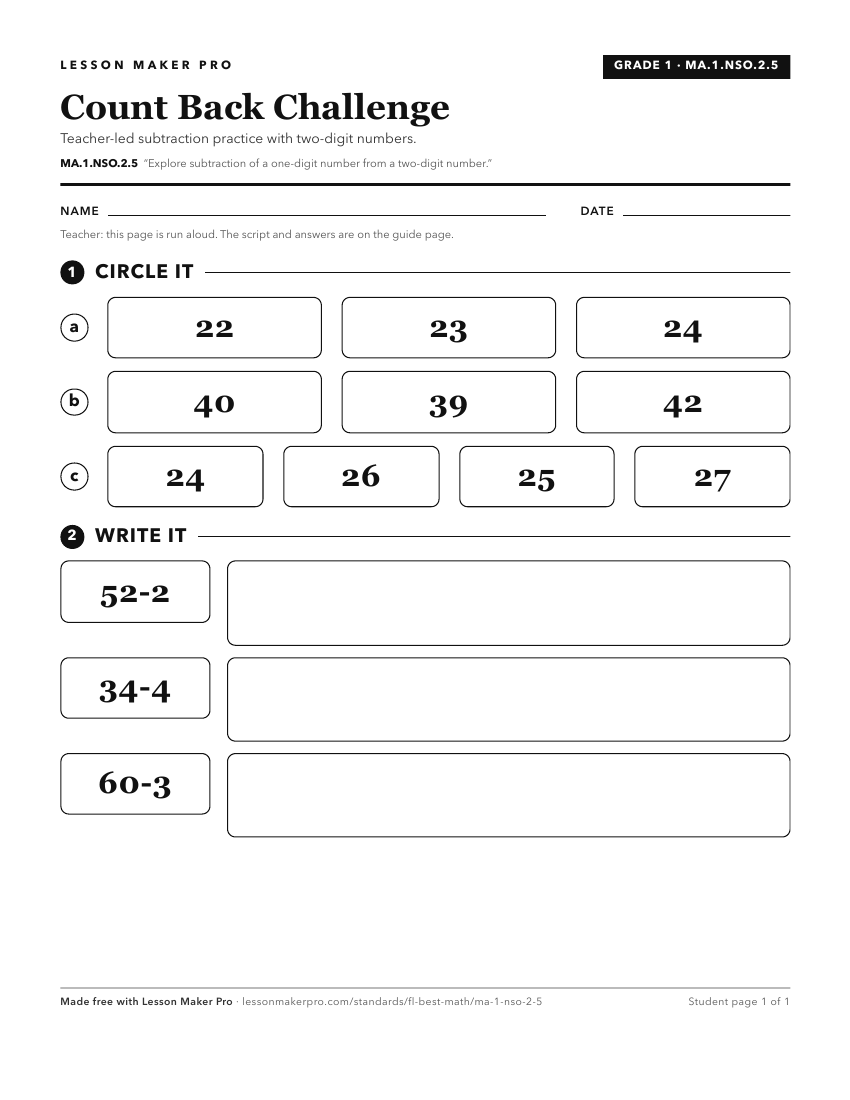
A ready-to-print activity worksheet aligned to MA.1.NSO.2.5, with an answer key for the teacher on its own page. No account needed.
PDF, US Letter, prints cleanly in black and white.
Download the worksheetKeep exploring
Related Standards
- MA.1.NSO.2.3
Identify the number that is one more, one less, ten more and ten less than a given two-digit number.
- MA.1.NSO.2
Develop an understanding of addition and subtraction operations with one- and two-digit numbers.
- MA.1.NSO.2.4
Explore the addition of a two-digit number and a one-digit number with sums to 100.
- MA.2.NSO.2
Add and subtract two- and three-digit whole numbers.
Turn this exact standard into a lesson
Grade, subject, topic, and the complete standard are prefilled. Create one free, no account needed.
Also for this standard:Make a WorksheetMake a QuizMake a Sub Lesson