Florida B.E.S.T. MA.3.AR.3.1
The Standard
Determine and explain whether a whole number from 1 to 1,000 is even or odd.
Florida B.E.S.T. Standards for Mathematics
Teacher's field guide
What This Standard Means
What Students Need to Do
- Students decide whether a number can be split into pairs with none left over. They use the ones digit or a pairing model to classify the number and explain why.
What Mastery Looks Like
- Students correctly classify any given number through 1,000. They point to the ones digit and explain that even numbers form complete pairs while odd numbers leave one unpaired.
Common Misconceptions
- Some students judge by a number’s size instead of its ones digit. Others think every number containing an even digit is even, or that 1,000 must be odd because it is large.
How to Assess It
- Exit ticket: Classify 347, 620, and 1,000 as even or odd, then explain each answer using the ones digit.
Lesson moves
Ways to Teach It
Have students pair counters for 37 and 48, then connect any leftover counter to each number’s ones digit.
Write an explanation proving whether 735 is odd or even without counting from 1.
Play a card sort where partners classify three-digit number cards, then earn a point by naming the deciding ones digit.
Examine numbered lockers or house addresses and predict which numbers could be divided into two equal groups.
Free download
Printable MA.3.AR.3.1 Worksheet
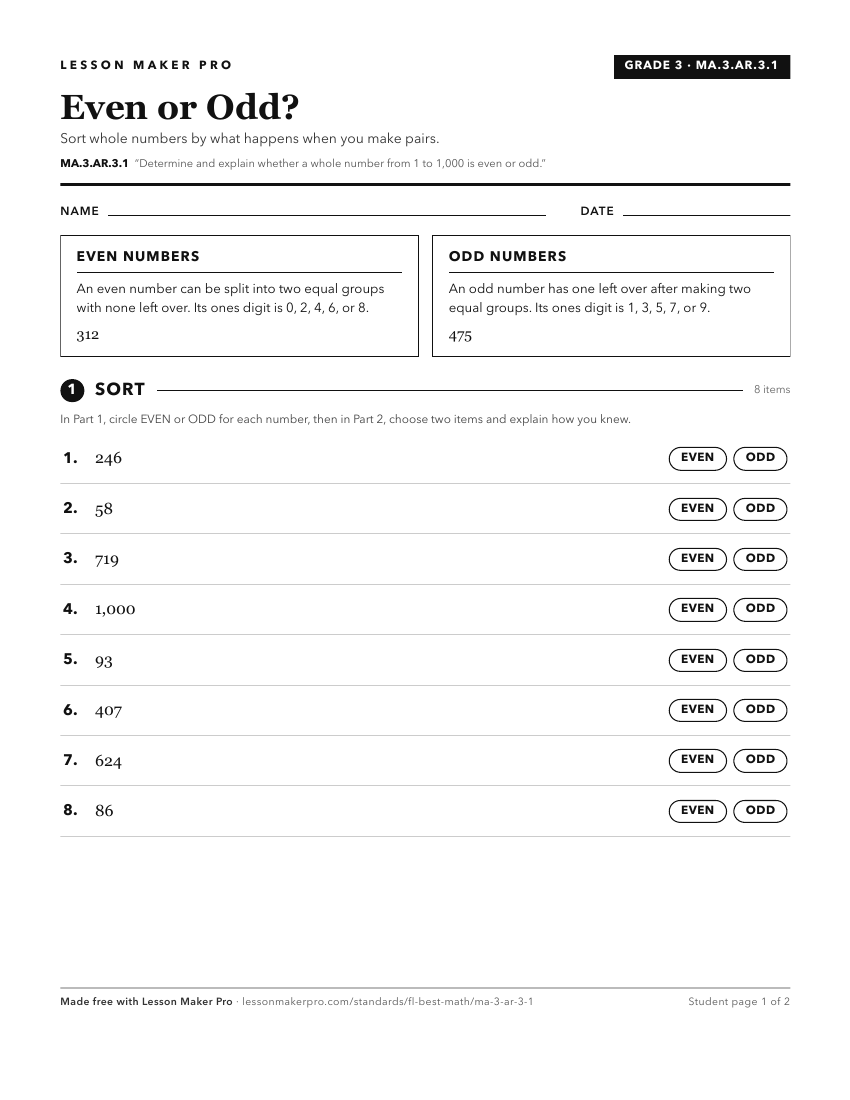
A ready-to-print activity worksheet aligned to MA.3.AR.3.1, with an answer key for the teacher on its own page. No account needed.
PDF, US Letter, prints cleanly in black and white.
Download the worksheetKeep exploring
Related Standards
- MA.2.AR.3.1
Represent an even number using two equal groups or two equal addends. Represent an odd number using two equal groups with one left over or two equal addends plu...
- MA.3.AR.3.2
Determine whether a whole number from 1 to 144 is a multiple of a given one-digit number.
- MA.912.F.1.9
Determine whether a function is even, odd or neither when represented algebraically, graphically or in a table.
- MA.3.NSO.1.4
Round whole numbers from 0 to 1,000 to the nearest 10 or 100.
Turn this exact standard into a lesson
Grade, subject, topic, and the complete standard are prefilled. Create one free, no account needed.
Also for this standard:Make a WorksheetMake a QuizMake a Sub Lesson