CCSS.
Standard Cluster
Build new functions from existing functions
Common Core State Standards for Mathematics · High School — Functions
Cluster contents
Standards in This Cluster
CCSS.Math.Content.HSF-BF.B is a cluster heading. These are the individual standards under it.
- CCSS.Math.Content.HSF-BF.B.3
Identify the effect on the graph of replacing f(x) by f(x) + k, k f(x), f(kx), and f(x + k) for specific values of k (both positive and negative); find the valu...
- CCSS.Math.Content.HSF-BF.B.4
Find inverse functions.
- CCSS.Math.Content.HSF-BF.B.4a
Solve an equation of the form f(x) = c for a simple function f that has an inverse and write an expression for the inverse.
- CCSS.Math.Content.HSF-BF.B.4b
(+) Verify by composition that one function is the inverse of another.
- CCSS.Math.Content.HSF-BF.B.4c
(+) Read values of an inverse function from a graph or a table, given that the function has an inverse.
- CCSS.Math.Content.HSF-BF.B.4d
(+) Produce an invertible function from a non-invertible function by restricting the domain.
- CCSS.Math.Content.HSF-BF.B.5
(+) Understand the inverse relationship between exponents and logarithms and use this relationship to solve problems involving logarithms and exponents.
Teacher's field guide
What This Cluster Means
What Students Need to Do
- Students use a known function to create new functions through shifts, reflections, stretches, compressions, and combinations. They also reverse functions by finding inverses and checking that the inverse works.
What Mastery Looks Like
- Students write equations for shifted, reflected, stretched, and compressed versions of a known function. They find an inverse when it exists and verify it using composition or a graph.
Common Misconceptions
- Students often reverse the direction of horizontal shifts, so they move f(x+3) right instead of left. They may confuse an inverse function with a reciprocal or reflect across the x-axis instead of y=x.
How to Assess It
- Exit ticket: Given f(x)=2x-5, write f(x-3)+4, describe its graph change, find f⁻¹(x), and verify the inverse by composition.
Lesson moves
Ways to Teach It
Overlay transparent graphs of f(x), f(x-2), and 2f(x), then mark how three chosen points move.
Ask students to explain why f(x+3) moves a graph left while f(x)+3 moves it up.
Run a card sort matching parent graphs, transformed equations, transformation descriptions, and inverse pairs.
Use C=5/9(F-32) to build the inverse temperature formula and check both formulas with boiling and freezing points.
Free download
Printable HSF-BF.B Worksheet
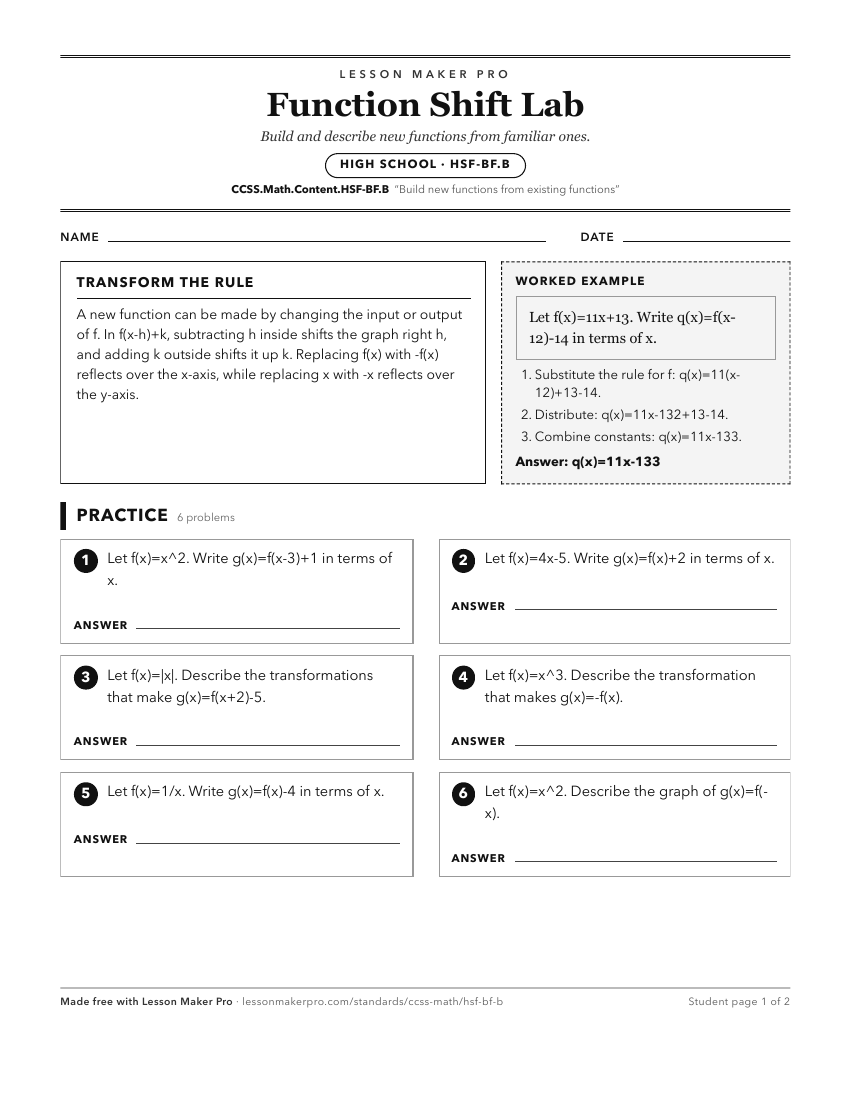
A ready-to-print activity worksheet aligned to CCSS.Math.Content.HSF-BF.B, with an answer key for the teacher on its own page. No account needed.
PDF, US Letter, prints cleanly in black and white.
Download the worksheetKeep exploring
Related Standards
- CCSS.Math.Content.HSF-BF.A.1b
Combine standard function types using arithmetic operations.
- CCSS.Math.Content.HSF-IF.C.8
Write a function defined by an expression in different but equivalent forms to reveal and explain different properties of the function.
- CCSS.Math.Content.8.F.A
Define, evaluate, and compare functions.
- CCSS.Math.Content.HSF-IF.C
Analyze functions using different representations
Turn this cluster into a lesson
Grade, subject, topic, and the complete cluster are prefilled. Create one free, no account needed.
Also for this cluster:Make a WorksheetMake a QuizMake a Sub Lesson