CCSS.
The Standard
Multiply a whole number of up to four digits by a one-digit whole number, and multiply two two-digit numbers, using strategies based on place value and the properties of operations. Illustrate and explain the calculation by using equations, rectangular arrays, and/or area models.
Common Core State Standards for Mathematics · Number and Operations in Base Ten
Teacher's field guide
What This Standard Means
What Students Need to Do
- Students break factors apart by place value and multiply the parts. They combine partial products and show how an equation, array, or area model matches their calculation.
What Mastery Looks Like
- Students accurately solve both types of multiplication problems using partial products. They label place values, connect each model section to an equation, and explain their steps.
Common Misconceptions
- Students may treat a ten as one, writing 3 × 20 as 6 instead of 60. They may omit a partial product or add partial products incorrectly.
How to Assess It
- Give an exit ticket with 2,306 × 4 and 27 × 34. Require an equation for one problem and a labeled area model for the other.
Lesson moves
Ways to Teach It
Use base-ten blocks to build 23 × 14, separate tens and ones, then record each partial product on an area model.
Students explain why 36 × 24 has four partial products, using an equation and a labeled area model.
Play Partial Product Match by pairing multiplication cards, expanded-form cards, and product cards, such as 42 × 6, 40 × 6, and 252.
Plan the cost of 24 class notebooks at $13 each, using an area model to find the total.
Free download
Printable 4.NBT.B.5 Worksheet
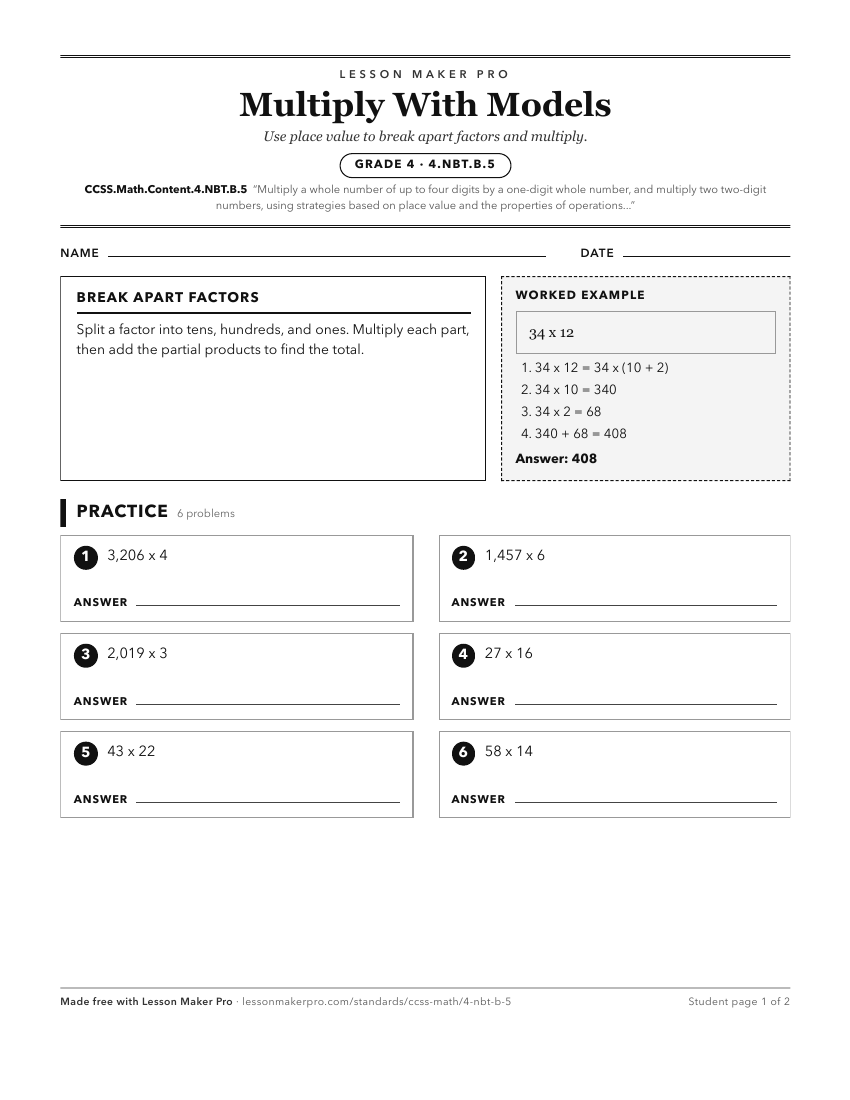
A ready-to-print activity worksheet aligned to CCSS.Math.Content.4.NBT.B.5, with an answer key for the teacher on its own page. No account needed.
PDF, US Letter, prints cleanly in black and white.
Download the worksheetLearning progression
Where This Standard Sits
See the whole path on the Number & Operations in Base Ten progression map.
Before This Standard
If students are struggling here, check these first.
- CCSS.Math.Content.3.OA.C.7
Multi-digit multiplication relies on accurate one-digit products when forming and adding partial products in arrays and place-value strategies.
- CCSS.Math.Content.4.NBT.A.1
Multi-digit multiplication by place value requires knowing each digit’s value and how moving left changes units by a factor of ten.
- CCSS.Math.Content.3.NBT.A.3
Multi-digit multiplication depends on decomposing numbers and finding partial products like 6 × 70 using place value and properties.
What This Unlocks
Mastery here sets students up for these next.
- CCSS.Math.Content.5.NBT.B.5
Standard algorithm fluency relies on place-value multiplication and partial products first practiced with one-digit and two-digit factors.
- CCSS.Math.Content.5.NBT.B.6
Students need place-value multiplication and area models to choose, compute, and justify partial quotients with two-digit divisors.
- CCSS.Math.Content.5.MD.C.5b
Multi-digit multiplication and area models support calculating prism volumes and seeing volume as repeated layers of rectangular area.
- CCSS.Math.Content.4.MD.A.3
Rectangle area uses multiplication of side lengths, and prior array or area models support understanding and computing length times width.
- CCSS.Math.Content.4.NBT.B.6
Division with remainders relies on place-value multiplication and the multiplication-division relationship to choose and justify quotient parts.
Keep exploring
Related Standards
Turn this exact standard into a lesson
Grade, subject, topic, and the complete standard are prefilled. Create one free, no account needed.
Also for this standard:Make a WorksheetMake a QuizMake a Sub Lesson