CCSS.
The Standard
Fluently multiply multi-digit whole numbers using the standard algorithm.
Common Core State Standards for Mathematics · Number and Operations in Base Ten
Teacher's field guide
What This Standard Means
What Students Need to Do
- Students multiply whole numbers with several digits accurately and efficiently. They record regrouping, keep place values aligned, and add partial products in the correct columns.
What Mastery Looks Like
- A student can correctly solve problems such as 347 × 26 and 4,508 × 73 with organized work. They handle regrouping and zero placeholders, then use an estimate to check the product.
Common Misconceptions
- Students may forget to shift the second partial product one place when multiplying by the tens digit. They may misrecord regrouped values or add partial products incorrectly. Zeros inside a factor can also cause skipped place values.
How to Assess It
- Give an exit ticket: Estimate, then solve 3,406 × 27 using the standard method. Show each step and explain whether the answer is reasonable.
Lesson moves
Ways to Teach It
Use digit cards and a place-value mat to build 243 × 12, then match each partial product to a line in the written method.
Show two solutions to 326 × 24, one missing a zero placeholder, and ask students to explain which answer is correct.
Pairs roll five dice, form a three-digit and two-digit factor, solve, and earn a point when both products match.
Calculate how many books arrive when a school orders 47 boxes with 236 books in each box, then check with estimation.
Free download
Printable 5.NBT.B.5 Worksheet
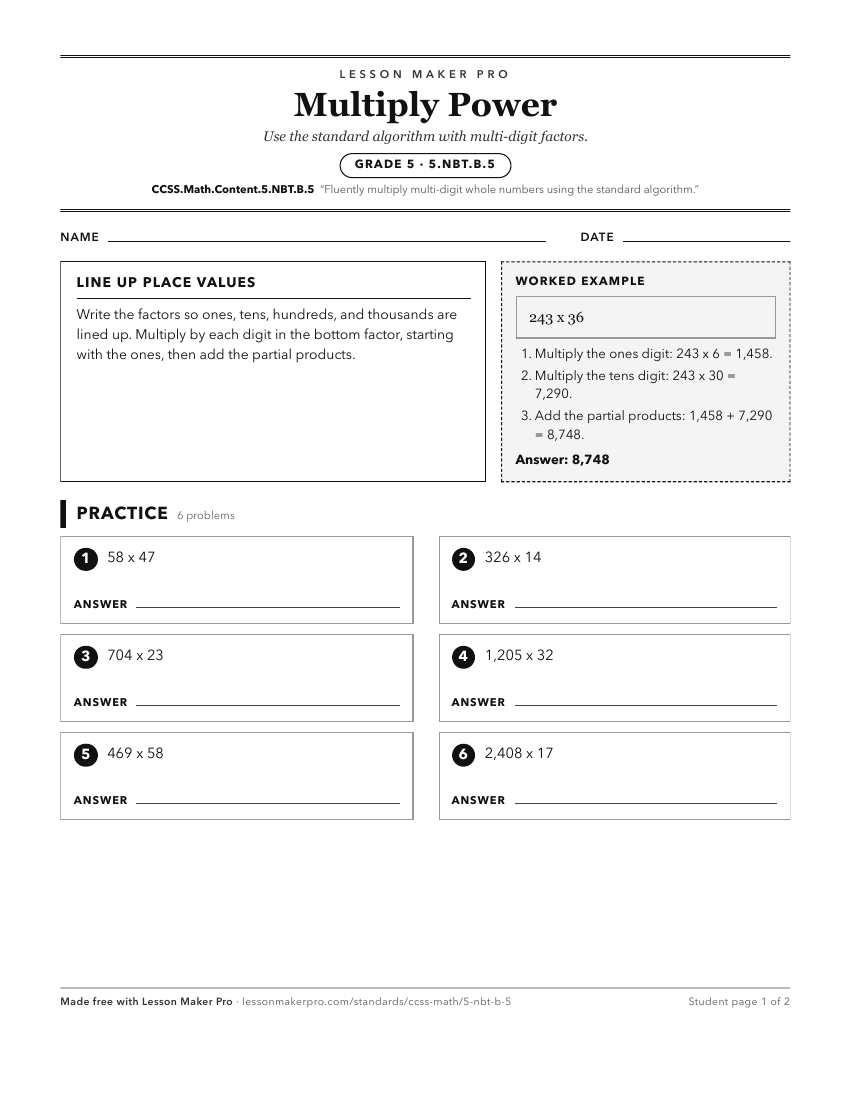
A ready-to-print activity worksheet aligned to CCSS.Math.Content.5.NBT.B.5, with an answer key for the teacher on its own page. No account needed.
PDF, US Letter, prints cleanly in black and white.
Download the worksheetLearning progression
Where This Standard Sits
See the whole path on the Number & Operations in Base Ten progression map.
Before This Standard
If students are struggling here, check these first.
- CCSS.Math.Content.3.OA.C.7
Multi-digit multiplication fluency depends on knowing one-digit products and using place-value partial products accurately.
- CCSS.Math.Content.4.NBT.B.5
Standard algorithm fluency relies on place-value multiplication and partial products first practiced with one-digit and two-digit factors.
- CCSS.Math.Content.4.NBT.A.1
Understanding each place as ten times the next supports regrouping and place shifts in the multi-digit multiplication algorithm.
What This Unlocks
Mastery here sets students up for these next.
- CCSS.Math.Content.6.NS.B.2
Division algorithm steps require choosing quotient digits and multiplying the divisor to check each place-value step.
- CCSS.Math.Content.6.EE.A.1
Evaluating powers uses repeated multiplication, so fluency with whole-number products helps students compute exponent expressions accurately.
Keep exploring
Related Standards
- CCSS.Math.Content.6.NS.B.3
Fluently add, subtract, multiply, and divide multi-digit decimals using the standard algorithm for each operation.
- CCSS.Math.Content.6.NS.B
Compute fluently with multi-digit numbers and find common factors and multiples.
- CCSS.Math.Content.4.NBT.B.4
Fluently add and subtract multi-digit whole numbers using the standard algorithm.
Turn this exact standard into a lesson
Grade, subject, topic, and the complete standard are prefilled. Create one free, no account needed.
Also for this standard:Make a WorksheetMake a QuizMake a Sub Lesson