CCSS.
The Standard
Determine the unknown whole number in an addition or subtraction equation relating three whole numbers.
Common Core State Standards for Mathematics · Operations and Algebraic Thinking
Teacher's field guide
What This Standard Means
What Students Need to Do
- Students find a missing whole number in an addition or subtraction equation. They solve when the unknown appears in any position and check that both sides are equal.
What Mastery Looks Like
- Students find the missing number whether it appears at the beginning, middle, or end of an equation. They check the result by replacing the blank and showing that both sides have the same value.
Common Misconceptions
- Students may treat the blank as a signal to calculate the numbers beside it, rather than as a missing value. They may also assume the answer always belongs after the equals sign or confuse which operation will find the unknown.
How to Assess It
- Give students this exit ticket: “Fill in each blank and draw a picture to prove one answer: 7 + □ = 12, 9 = □ - 4, 6 + 3 = □.”
Lesson moves
Ways to Teach It
Build 8 + □ = 13 with linking cubes, then add cubes until the train has 13 and record the missing number.
Ask students to explain in writing how they know the missing number in 10 = □ + 4.
Play Missing Number Match with cards showing equations such as 12 - □ = 7 and separate cards showing possible unknown values.
Use a covered snack bag: show 5 crackers, say there were 9, and have students find how many remain hidden.
Free download
Printable 1.OA.D.8 Worksheet
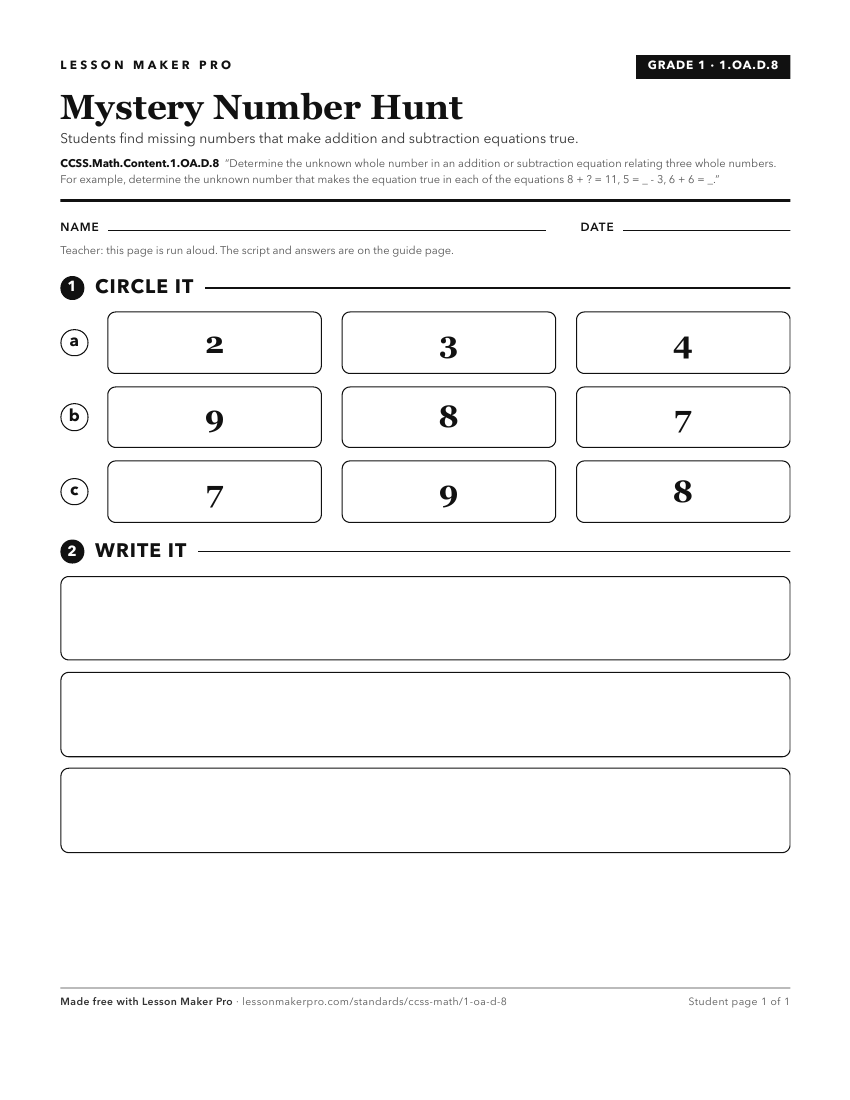
A ready-to-print activity worksheet aligned to CCSS.Math.Content.1.OA.D.8, with an answer key for the teacher on its own page. No account needed.
PDF, US Letter, prints cleanly in black and white.
Download the worksheetLearning progression
Where This Standard Sits
See the whole path on the Operations & Algebraic Thinking progression map.
Before This Standard
If students are struggling here, check these first.
- CCSS.Math.Content.K.OA.A.1
Representing addition and subtraction situations supports making sense of unknowns in equations, but students can solve simple missing-number equations by other counting strategies.
- CCSS.Math.Content.1.OA.D.7
Students must read the equal sign as showing equal values before finding a missing number that makes an equation true.
- CCSS.Math.Content.1.OA.B.4
Thinking of subtraction as a missing addend helps students solve subtraction equations with unknowns in any position.
What This Unlocks
Mastery here sets students up for these next.
- CCSS.Math.Content.2.OA.A.1
Finding missing numbers in addition and subtraction equations supports representing word problems with an unknown in any position.
- CCSS.Math.Content.2.MD.B.5
Students use the same missing-number addition and subtraction equations when representing unknown lengths in measurement word problems.
- CCSS.Math.Content.3.OA.A.3
Finding unknowns in addition or subtraction equations supports using symbols for unknowns in multiplication and division word-problem equations.
Keep exploring
Related Standards
- CCSS.Math.Content.1.OA.A.1
Use addition and subtraction within 20 to solve word problems involving situations of adding to, taking from, putting together, taking apart, and comparing, wit...
- CCSS.Math.Content.3.OA.A.4
Determine the unknown whole number in a multiplication or division equation relating three whole numbers.
- CCSS.Math.Content.4.OA.A.3
Solve multistep word problems posed with whole numbers and having whole-number answers using the four operations, including problems in which remainders must be...
- CCSS.Math.Content.1.OA.A.2
Solve word problems that call for addition of three whole numbers whose sum is less than or equal to 20, e.g., by using objects, drawings, and equations with a ...
Turn this exact standard into a lesson
Grade, subject, topic, and the complete standard are prefilled. Create one free, no account needed.
Also for this standard:Make a WorksheetMake a QuizMake a Sub Lesson