Alabama Social Studies SS24.WH.7b
The Standard
- SS24.WH.7
- Explain causes and consequences of World War I, including imperialism, militarism, nationalism, and the alliance system.
Describe the rise of the Bolsheviks and Soviet ideology in Russia during and after World War I.
2024 Alabama Course of Study: Social Studies
Teacher's field guide
What This Standard Means
What Students Need to Do
- Students trace how war losses, hunger, and the Provisional Government's choice to keep fighting helped Lenin's Bolsheviks gain support. They explain the Bolshevik takeover in 1917 and Russia's exit from the war. They describe the push for public ownership and the growth of one-party rule.
What Mastery Looks Like
- A student can put the tsar's fall, the Bolshevik takeover, and Russia's exit from the war in order. They can explain why “Peace, Land, Bread” appealed to Russians and how Bolshevik rule differed from its promise of power for workers.
Common Misconceptions
- Students may think Lenin took power directly from the tsar, rather than from the Provisional Government. Some assume Russia stayed in the war after the Bolshevik takeover, or that public ownership meant every worker had a say in government.
How to Assess It
- On an exit ticket, ask: “Why did the Bolsheviks gain support in 1917? Name one wartime problem, one Bolshevik promise, and one change they made after taking power.”
Lesson moves
Ways to Teach It
Give pairs dated event cards, from wartime food shortages to the Soviet Union's founding, and have them build a timeline with cause arrows.
Ask students to write two sentences explaining why “Peace, Land, Bread” might appeal to a Russian soldier or farmer in 1917.
Play a matching game with cards naming wartime problems, Bolshevik promises, and actions such as leaving the war.
Hand out a sample election flyer beside “Peace, Land, Bread”; have students highlight each promise and the problem it addresses.
Free download
Printable SS24.WH.7b Worksheet
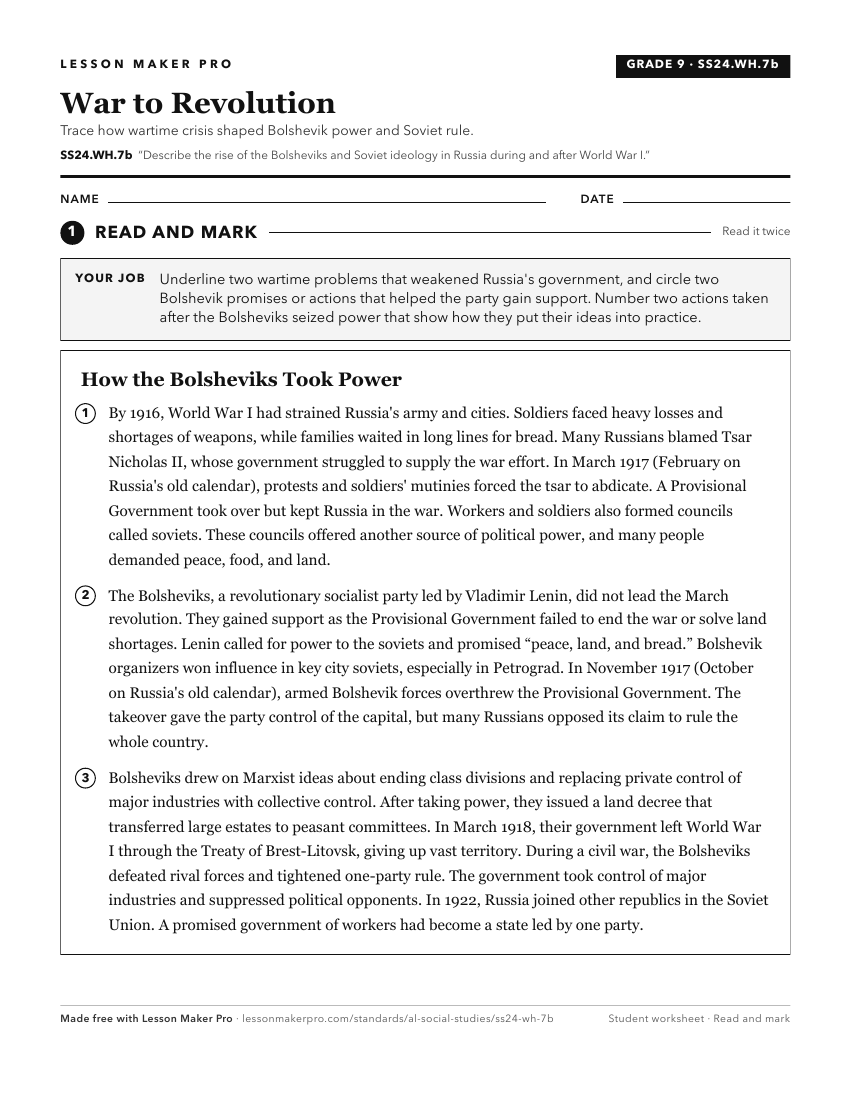
A ready-to-print activity worksheet aligned to SS24.WH.7b, with an answer key for the teacher on its own page. No account needed.
PDF, US Letter, prints cleanly in black and white.
Download the worksheetKeep exploring
Related Standards
- SS24.WH.8a
Compare and contrast political ideologies that emerged in Europe following World War I, including communism, fascism, and social democracy.
- SS24.WH.7
Explain causes and consequences of World War I, including imperialism, militarism, nationalism, and the alliance system.
- SS24.WH.8
Analyze the global cultural, economic, and political developments immediately following World War I.
- SS24.WH.13b
Compare political ideologies that existed within the United States, the Soviet Union, and People’s Republic of China after World War II.
Turn this exact standard into a lesson
Grade, subject, topic, and the complete standard are prefilled. Create one free, no account needed.
Also for this standard:Make a WorksheetMake a QuizMake a Sub Lesson