Alabama Social Studies SS24.WH.7
Standard Cluster
Explain causes and consequences of World War I, including imperialism, militarism, nationalism, and the alliance system. 7a Assess the effects of trench warfare and new military technologies on combat during World War I. 7b Describe the rise of the Bolsheviks and Soviet ideology in Russia during and after World War I. 7c Explain the consequences of the Treaty of Versailles of 1919, including political and boundary changes.
2024 Alabama Course of Study: Social Studies
Cluster contents
Standards in This Cluster
SS24.WH.7 is a cluster heading. These are the individual standards under it.
- SS24.WH.7a
Assess the effects of trench warfare and new military technologies on combat during World War I.
- SS24.WH.7b
Describe the rise of the Bolsheviks and Soviet ideology in Russia during and after World War I.
- SS24.WH.7c
Explain the consequences of the Treaty of Versailles of 1919, including political and boundary changes.
Teacher's field guide
What This Cluster Means
What Students Need to Do
- Explain how empire building, military buildup, nationalism, and alliances led to war. Describe how trenches and new weapons changed fighting and how wartime hardship helped the Bolsheviks gain power. Explain Soviet ideas about state ownership and how the peace treaty changed borders and politics.
What Mastery Looks Like
- Given an alliance map, students can explain how a conflict between Austria-Hungary and Serbia drew in other countries. They can link machine guns to trench deadlock and food shortages to support for the Bolsheviks. On two maps, they can identify German territorial losses and new European states after the war.
Common Misconceptions
- Students may think the assassination alone caused the war, or that every ally entered at once. They may assume trenches kept soldiers safe from new weapons or that the Bolsheviks wanted Russia to keep fighting. They may think the peace treaty changed only Germany, not other European borders and governments.
How to Assess It
- Hand out 1914 and 1919 Europe maps as an exit ticket. Ask students to name one cause of the war, one effect of machine guns on trench fighting, one reason Bolsheviks gained support, and one border change.
Lesson moves
Ways to Teach It
Give groups country cards and string to build 1914 alliances, then trace what happened when Austria-Hungary declared war on Serbia.
Ask students to write a soldier's letter using a trench diagram and a weapon fact sheet to explain why attacks stalled.
Give pairs cards labeled food shortages, Bolshevik promises of peace and land, state ownership, and withdrawal from war; sort them into causes and outcomes.
Find Poland on a current map, then compare 1914 and 1919 maps to see how its return changed Europe's political borders.
Free download
Printable SS24.WH.7 Worksheet
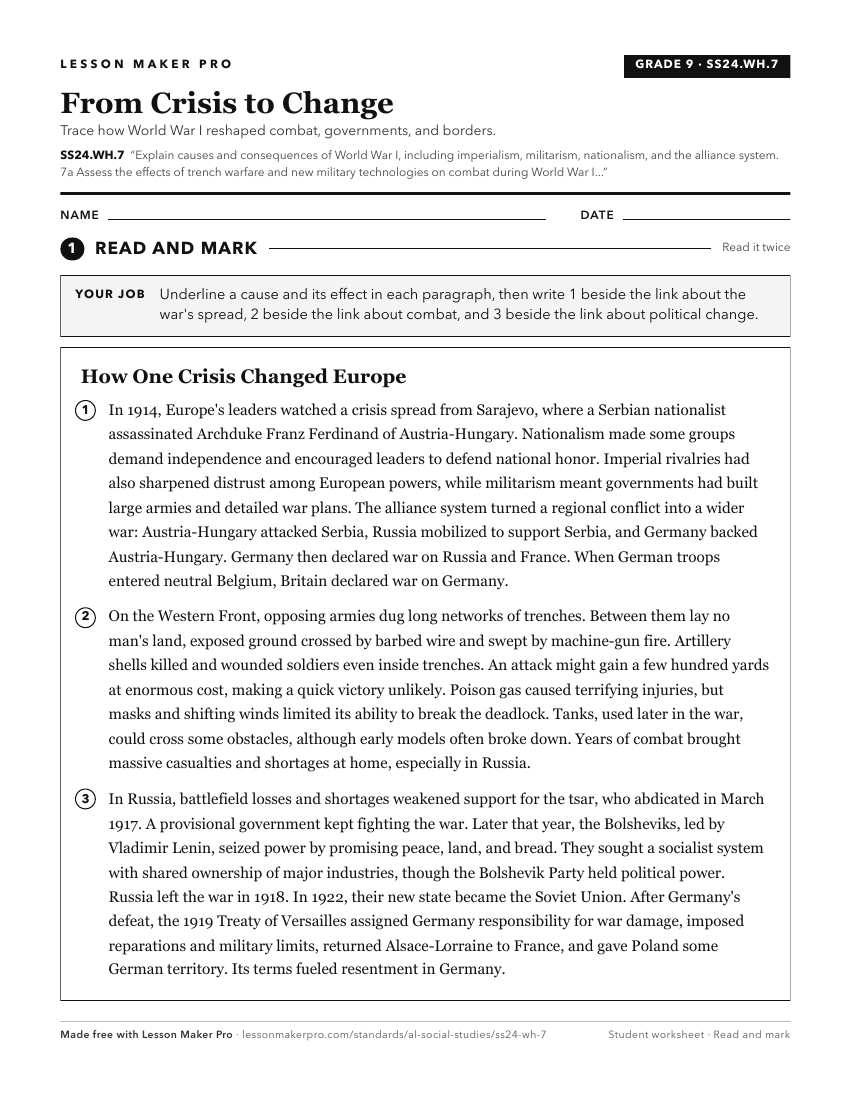
A ready-to-print activity worksheet aligned to SS24.WH.7, with an answer key for the teacher on its own page. No account needed.
PDF, US Letter, prints cleanly in black and white.
Download the worksheetKeep exploring
Related Standards
- SS24.5.5
Summarize the primary causes and consequences of World War I.
- SS24.US2.1e
Summarize the events and factors that led to the United States entry into World War I.
- SS24.WH.8
Analyze the global cultural, economic, and political developments immediately following World War I.
- SS24.5.5a
Identify and explain international events that led to the United States’ entry into World War I.
Turn this cluster into a lesson
Grade, subject, topic, and the complete cluster are prefilled. Create one free, no account needed.
Also for this cluster:Make a WorksheetMake a QuizMake a Sub Lesson