Alabama Social Studies SS24.WH.8
Standard Cluster
Analyze the global cultural, economic, and political developments immediately following World War I. 8a Compare and contrast political ideologies that emerged in Europe following World War I, including communism, fascism, and social democracy. 8b Summarize the effects of the dissolution of the Ottoman Empire, including the rise of Arab nationalism and the European Mandate System.
2024 Alabama Course of Study: Social Studies
Cluster contents
Standards in This Cluster
SS24.WH.8 is a cluster heading. These are the individual standards under it.
Teacher's field guide
What This Cluster Means
What Students Need to Do
- Students explain how World War I changed economies, politics, and culture, using war debts, antiwar art, and new borders as examples. They compare communism, fascism, and social democracy. They explain why Arab nationalists opposed European rule over former Ottoman lands.
What Mastery Looks Like
- A student can explain how inflation hurt families and how antiwar art reflected disillusionment. They can tell the three ideologies apart by elections, government power, and control of the economy. They can name a British or French mandate and explain why Arab nationalists rejected foreign control.
Common Misconceptions
- Students may group all three ideologies together because each criticized the old order. They may think Ottoman lands became one independent Arab country, or that mandates meant immediate independence. Some confuse inflation with falling prices.
How to Assess It
- On an exit ticket, ask: “How did fascism and social democracy differ on elections? Why might a Syrian nationalist oppose a French mandate? Name one postwar economic or cultural change.”
Lesson moves
Ways to Teach It
Give pairs a blank Middle East map and colored pencils; have them shade British and French mandates and label one Arab nationalist demand.
Show a German inflation photo and an antiwar painting; ask students to write how each shows a different postwar change.
Hand out nine short policy cards; teams sort them under communism, fascism, or social democracy and defend two choices.
Place a current map beside a 1920s mandate map; have students circle Syria and Iraq and identify which European power governed each.
Free download
Printable SS24.WH.8 Worksheet
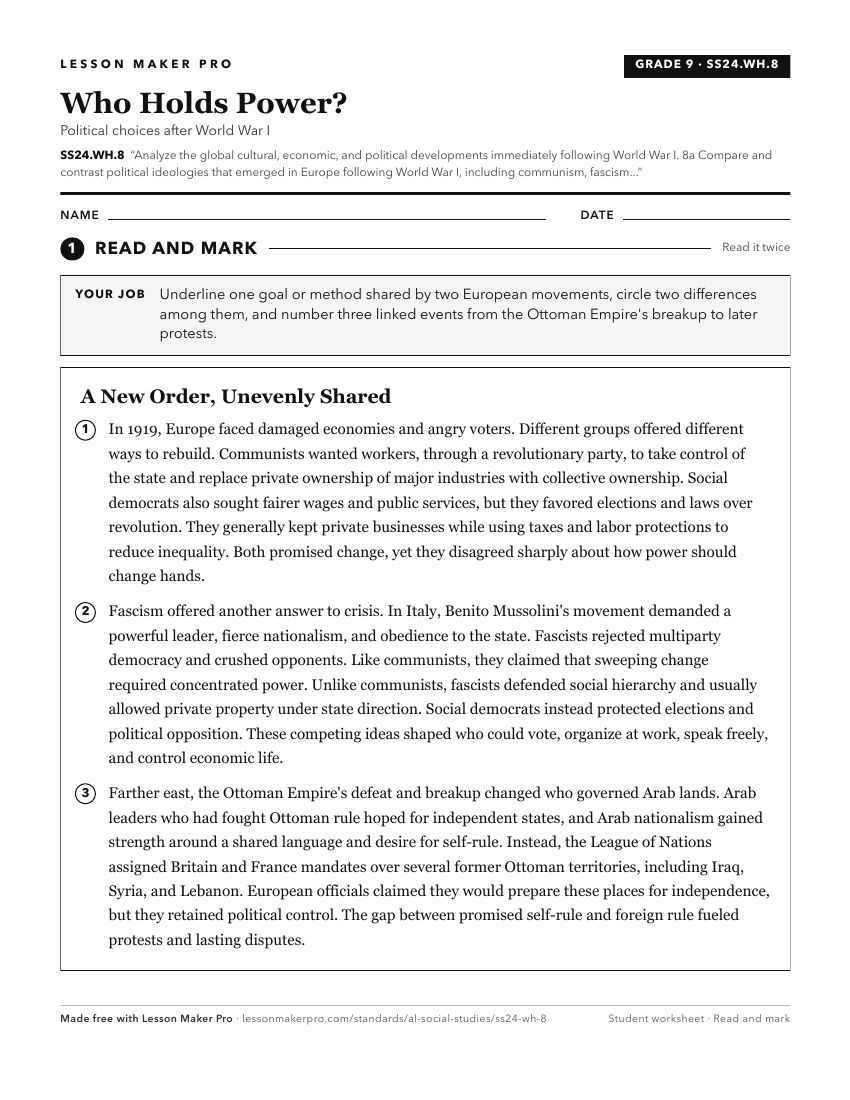
A ready-to-print activity worksheet aligned to SS24.WH.8, with an answer key for the teacher on its own page. No account needed.
PDF, US Letter, prints cleanly in black and white.
Download the worksheetKeep exploring
Related Standards
- SS24.WH.10
Evaluate the economic, global, political, and social consequences of World War II.
- SS24.WH.5b
Analyze how the international balance of power shifted as a result of the unification of Germany, the decline of the Ottoman Empire, and the emergence of intern...
- SS24.US2.2c
Analyze how government actions in the United States during World War I produced both economic growth and social division.
- SS24.US2.3
Evaluate how key figures, events, and trends shaped United States society and culture from the conclusion of World War I through the 1920s.
Turn this cluster into a lesson
Grade, subject, topic, and the complete cluster are prefilled. Create one free, no account needed.
Also for this cluster:Make a WorksheetMake a QuizMake a Sub Lesson