Alabama Social Studies SS24.WH.10
Standard Cluster
Evaluate the economic, global, political, and social consequences of World War II. 10a Analyze the role of major Axis and Allied leaders during World War II, including both political and military leaders. 10b Describe major turning points of World War II in the European, North Africa, and Pacific theaters and identify the locations of these events. 10c Compare the experiences of civilians in different countries involved in conflict during World War II.
2024 Alabama Course of Study: Social Studies
Cluster contents
Standards in This Cluster
SS24.WH.10 is a cluster heading. These are the individual standards under it.
- SS24.WH.10a
Analyze the role of major Axis and Allied leaders during World War II, including both political and military leaders.
- SS24.WH.10b
Describe major turning points of World War II in the European, North Africa, and Pacific theaters and identify the locations of these events.
- SS24.WH.10c
Compare the experiences of civilians in different countries involved in conflict during World War II.
Teacher's field guide
What This Cluster Means
What Students Need to Do
- Students explain how the war changed economies, governments, borders, and daily life. They locate major turning points in Europe, North Africa, and the Pacific and explain decisions by Axis and Allied leaders. They compare civilians’ experiences in different countries using evidence.
What Mastery Looks Like
- Students locate Stalingrad, El Alamein, and Midway and explain why each mattered. They connect decisions by an Axis leader and an Allied leader to wartime outcomes. They compare civilian accounts and explain postwar changes such as rebuilding, the United Nations, and the Cold War.
Common Misconceptions
- Students may treat D-Day as the war’s only turning point and overlook North Africa and the Pacific. They may mix up Axis and Allied leaders or assume civilians in every country faced the same conditions. Some think the war’s effects ended in 1945.
How to Assess It
- Exit ticket: Label Stalingrad, El Alamein, and Midway on a map, then explain why one mattered. Name an action by one Axis and one Allied leader, compare civilians in two countries, and give one postwar change.
Lesson moves
Ways to Teach It
Give pairs a blank map and battle cards; have them place Stalingrad, El Alamein, and Midway and write what changed after each.
Read short accounts from the London Blitz and Japanese American incarceration, then write how each government’s actions shaped civilian life.
Play a card match pairing Churchill, Hitler, Eisenhower, Rommel, Nimitz, and Tojo with a wartime decision and its effect.
Compare the opening of the 1945 United Nations Charter with a current UN peacekeeping mission description; identify the postwar goal still visible today.
Free download
Printable SS24.WH.10 Worksheet
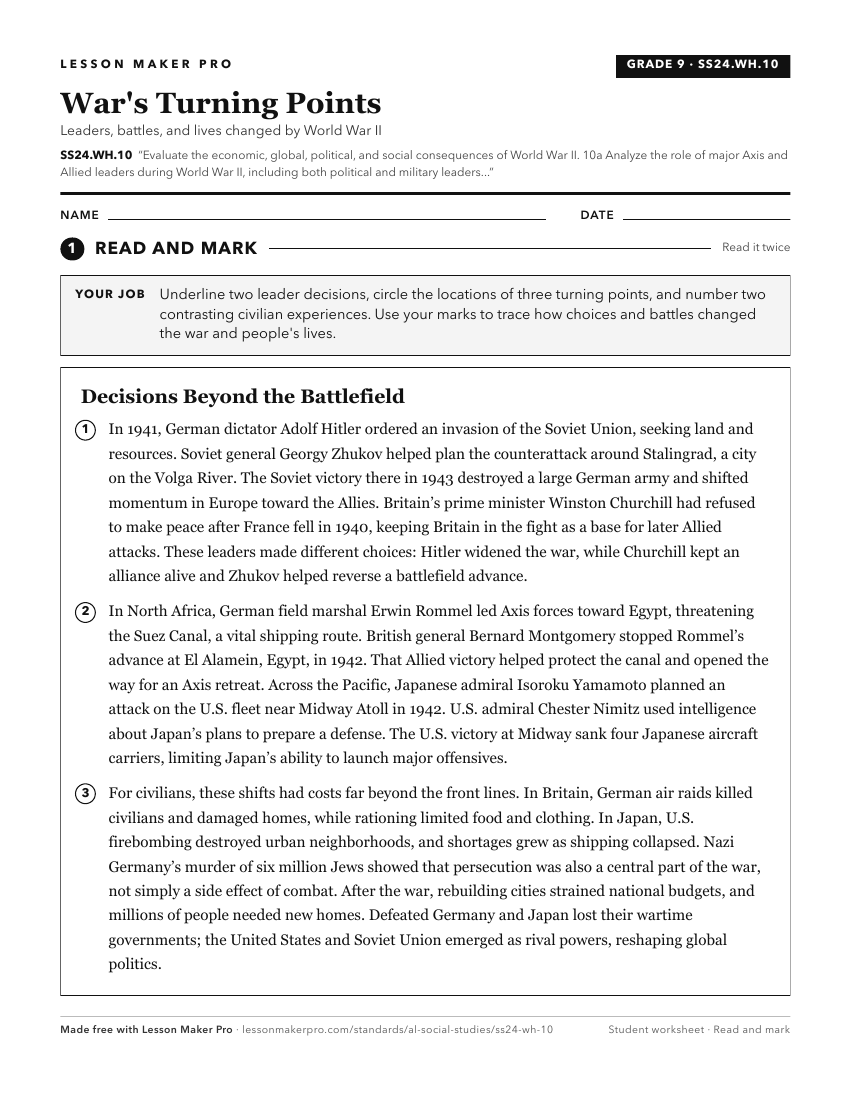
A ready-to-print activity worksheet aligned to SS24.WH.10, with an answer key for the teacher on its own page. No account needed.
PDF, US Letter, prints cleanly in black and white.
Download the worksheetKeep exploring
Related Standards
- SS24.WH.8
Analyze the global cultural, economic, and political developments immediately following World War I.
- SS24.US2.8
Analyze the domestic, economic, and civil rights impact of World War II on United States society.
- SS24.WH.13
Explain the origins of the Cold War as they relate to the economic, global, political, and social consequences of World War II.
- SS24.US2.6
Trace the progression of events and policies leading to World War II and the United States’ entry into the war.
Turn this cluster into a lesson
Grade, subject, topic, and the complete cluster are prefilled. Create one free, no account needed.
Also for this cluster:Make a WorksheetMake a QuizMake a Sub Lesson