Alabama Social Studies SS24.US2.6
Standard Cluster
Trace the progression of events and policies leading to World War II and the United States’ entry into the war. 6a Summarize the United States’ foreign policies of isolationism and internationalism as World War II began and explain how the bombing of Pearl Harbor affected this approach. 6b Critique the evolving United States policy and public attitudes toward Nazi Germany and the growing refugee crisis as the Holocaust began.
2024 Alabama Course of Study: Social Studies
Cluster contents
Standards in This Cluster
SS24.US2.6 is a cluster heading. These are the individual standards under it.
- SS24.US2.6a
Summarize the United States’ foreign policies of isolationism and internationalism as World War II began and explain how the bombing of Pearl Harbor affected th...
- SS24.US2.6b
Critique the evolving United States policy and public attitudes toward Nazi Germany and the growing refugee crisis as the Holocaust began.
Teacher's field guide
What This Cluster Means
What Students Need to Do
- Students put the steps toward war in order and explain why U.S. policy shifted from neutrality to aid for the Allies, then to war. They explain how Pearl Harbor changed public and government support for entering the war. They also examine how U.S. immigration rules and public opinion affected people fleeing Nazi persecution.
What Mastery Looks Like
- A student can connect the Neutrality Acts, Lend-Lease, Pearl Harbor, and Germany’s declaration of war in a clear timeline. They can use a source about refugees to explain and judge a U.S. policy choice, while recognizing that Americans did not all agree.
Common Misconceptions
- Students may think the United States offered no help to the Allies before Pearl Harbor. Some assume Pearl Harbor was an attack by Germany or that the United States entered the war against Germany that same day. Others think people fleeing Nazi persecution could enter the United States freely.
How to Assess It
- On an exit ticket, ask: Put the Neutrality Acts, Lend-Lease, Pearl Harbor, and Germany’s declaration of war in order. Explain one change in U.S. policy and one way immigration quotas affected refugees.
Lesson moves
Ways to Teach It
Give pairs event cards for the Neutrality Acts, Kristallnacht, the St. Louis, Lend-Lease, and Pearl Harbor; have them build an annotated timeline.
Show a 1939 article about the St. Louis and an immigration quota chart; ask students to write who could act and what limited them.
Play policy sort: read short scenarios about arms sales, loans, and military attacks; students hold up neutrality, aid, or war cards.
Give students a current U.S. refugee admissions fact sheet and a 1939 quota chart; have them compare who sets admission limits.
Free download
Printable SS24.US2.6 Worksheet
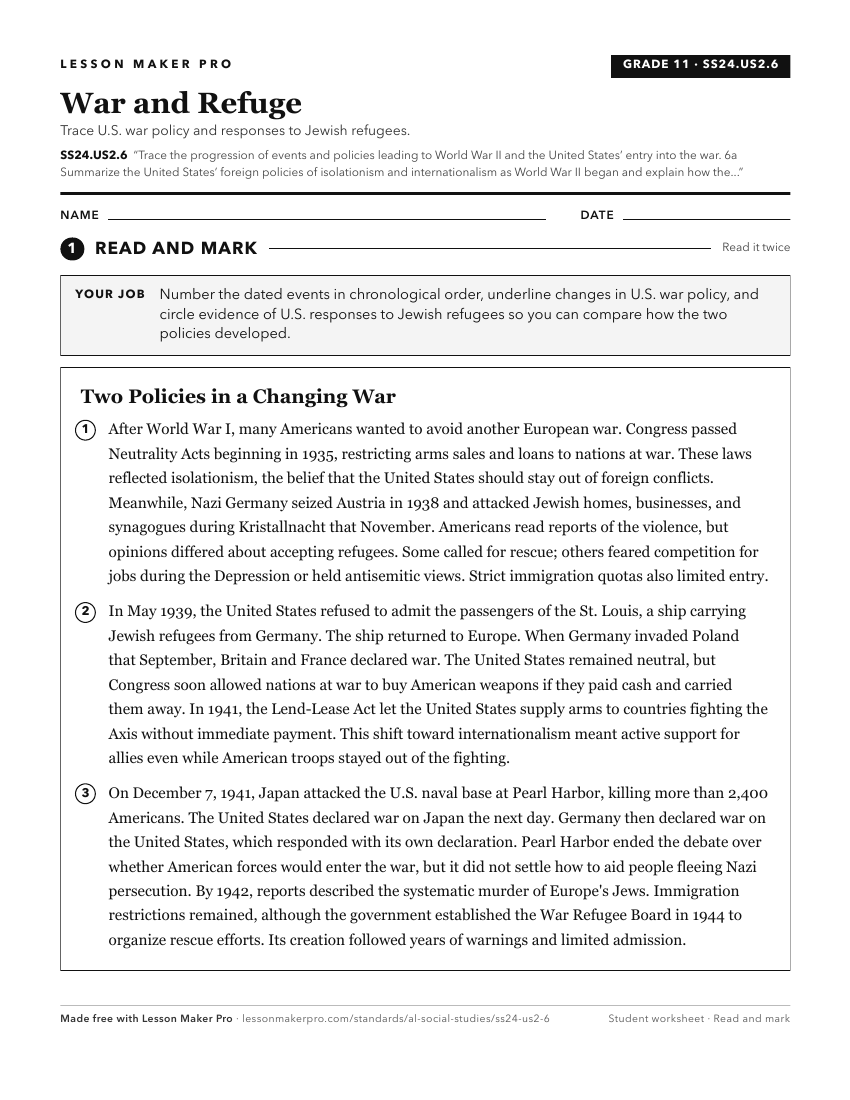
A ready-to-print activity worksheet aligned to SS24.US2.6, with an answer key for the teacher on its own page. No account needed.
PDF, US Letter, prints cleanly in black and white.
Download the worksheetKeep exploring
Related Standards
- SS24.US2.1e
Summarize the events and factors that led to the United States entry into World War I.
- SS24.5.9
Describe the reasons for the United States’ entry into World War II and identify its contributions toward the defeat of the Axis powers.
- SS24.US2.7
Analyze how United States military involvement shaped major events of World War II.
- SS24.5.5a
Identify and explain international events that led to the United States’ entry into World War I.
Turn this cluster into a lesson
Grade, subject, topic, and the complete cluster are prefilled. Create one free, no account needed.
Also for this cluster:Make a WorksheetMake a QuizMake a Sub Lesson