Alabama Social Studies SS24.US2.7
Standard Cluster
Analyze how United States military involvement shaped major events of World War II. 7a Develop an argument supporting the thesis that major battles of World War II in which the United States was involved were turning points of the war and outline the impact of these battles on territorial occupation by the Allied and Axis powers. 7b Compare and contrast the roles and leadership of United States leaders in securing victory for the Allied powers during World War II. 7c Evaluate the effectiveness of United States strategies in the war, including the decision to utilize atomic weapons on Japan. 7d Describe the role of the United States military in helping end the Holocaust, including the liberation of concentration camps and participation in the Nuremberg Trials. 7e Explain how key consequences of World War II shaped United States foreign policy after the war.
2024 Alabama Course of Study: Social Studies
Cluster contents
Standards in This Cluster
SS24.US2.7 is a cluster heading. These are the individual standards under it.
- SS24.US2.7a
Develop an argument supporting the thesis that major battles of World War II in which the United States was involved were turning points of the war and outline ...
- SS24.US2.7b
Compare and contrast the roles and leadership of United States leaders in securing victory for the Allied powers during World War II.
- SS24.US2.7c
Evaluate the effectiveness of United States strategies in the war, including the decision to utilize atomic weapons on Japan.
- SS24.US2.7d
Describe the role of the United States military in helping end the Holocaust, including the liberation of concentration camps and participation in the Nuremberg...
- SS24.US2.7e
Explain how key consequences of World War II shaped United States foreign policy after the war.
Teacher's field guide
What This Cluster Means
What Students Need to Do
- Students argue why battles such as Midway and D-Day changed the war and control of territory. They compare U.S. leaders and judge wartime choices, including the atomic bombings. They explain camp liberation, the later Nuremberg trials, and the U.S. role abroad after the war.
What Mastery Looks Like
- Students use maps to show how D-Day helped the Allies retake France and Midway checked Japanese expansion. They distinguish Eisenhower's command in Europe from MacArthur's campaign in the Pacific and weigh Truman's atomic bomb decision using evidence. They explain how U.S. forces helped liberate camps, how the U.S. took part in the Nuremberg trials, and why the U.S. joined NATO.
Common Misconceptions
- Some students say Midway freed occupied islands, though it stopped a Japanese advance without retaking territory. Others credit Roosevelt with the atomic bomb decision, which Truman made. Some think U.S. troops liberated every Nazi camp or that the Nuremberg trials ended the Holocaust.
How to Assess It
- Show maps of German-held France before D-Day and Allied positions in August 1944. Ask students to explain how control changed and why D-Day was a turning point.
Lesson moves
Ways to Teach It
Give pairs blank France maps and June and August 1944 front lines; have them shade German-held land and mark Allied gains.
Ask students to weigh the atomic bomb decision using Truman's statement, Japan's surrender timeline, and the Soviet entry into the war.
Have pairs sort four source cards into U.S. camp liberation reports and Nuremberg trial excerpts, then explain what happened first.
Compare a 1949 NATO membership map with a 1945 Europe map; ask why U.S. leaders committed to defending Western Europe.
Free download
Printable SS24.US2.7 Worksheet
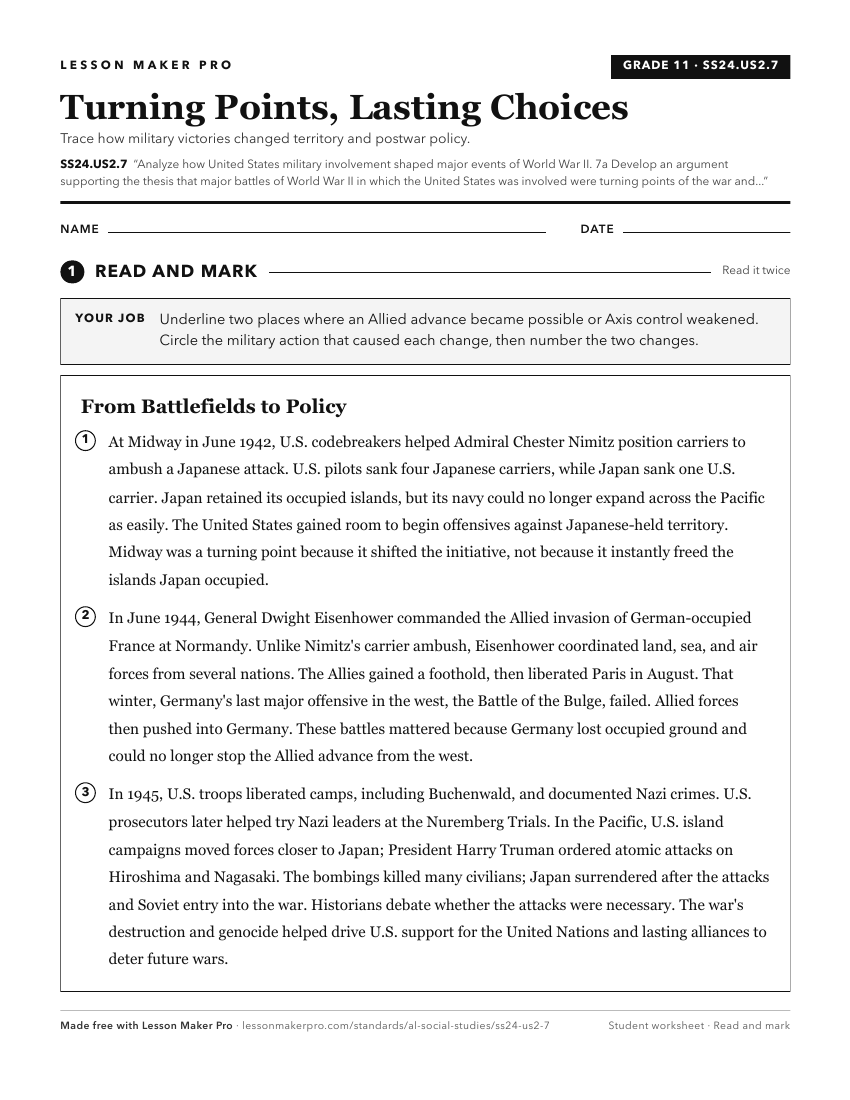
A ready-to-print activity worksheet aligned to SS24.US2.7, with an answer key for the teacher on its own page. No account needed.
PDF, US Letter, prints cleanly in black and white.
Download the worksheetKeep exploring
Related Standards
- SS24.WH.10a
Analyze the role of major Axis and Allied leaders during World War II, including both political and military leaders.
- SS24.US2.8
Analyze the domestic, economic, and civil rights impact of World War II on United States society.
- SS24.US2.6
Trace the progression of events and policies leading to World War II and the United States’ entry into the war.
Turn this cluster into a lesson
Grade, subject, topic, and the complete cluster are prefilled. Create one free, no account needed.
Also for this cluster:Make a WorksheetMake a QuizMake a Sub Lesson