Alabama Social Studies SS24.5.9
Standard Cluster
Describe the reasons for the United States’ entry into World War II and identify its contributions toward the defeat of the Axis powers. 9a Compare totalitarianism and democracy as represented in the Axis and Allied powers prior to war in Europe. 9b Explain the military contributions of Americans during World War II, including the achievements of the Tuskegee Airmen and Alabama Medal of Honor recipients. 9c Explain the significance of major events in the war, including Pearl Harbor, internment of Japanese-Americans, D-Day, the Holocaust, Victory in Europe (VE) Day, the development and use of the atomic bomb, and Victory over Japan (VJ) Day.
2024 Alabama Course of Study: Social Studies
Cluster contents
Standards in This Cluster
SS24.5.9 is a cluster heading. These are the individual standards under it.
- SS24.5.9a
Compare totalitarianism and democracy as represented in the Axis and Allied powers prior to war in Europe.
- SS24.5.9b
Explain the military contributions of Americans during World War II, including the achievements of the Tuskegee Airmen and Alabama Medal of Honor recipients.
- SS24.5.9c
Explain the significance of major events in the war, including Pearl Harbor, internment of Japanese-Americans, D-Day, the Holocaust, Victory in Europe (VE) Day,...
Teacher's field guide
What This Cluster Means
What Students Need to Do
- Students explain why the attack on Pearl Harbor brought the United States into the war. They compare elected governments in Britain and France with dictatorships in Germany and Italy. They describe U.S. military contributions and explain why major wartime events mattered.
What Mastery Looks Like
- A student links Pearl Harbor to U.S. entry, D-Day to freeing France, VE Day to Germany’s surrender, and VJ Day to Japan’s surrender after the atomic bombings. They explain that the Holocaust was Nazi mass murder and that Japanese American incarceration violated civil rights. They compare free elections with dictatorship and describe how the Tuskegee Airmen escorted bombers and Alabama’s Henry Erwin saved his crew.
Common Misconceptions
- Students may think the United States entered the war when Germany invaded Poland, rather than after Japan attacked Pearl Harbor. They may think all Allied governments were democracies or that Japanese American families chose to leave their homes. They may confuse VE Day with VJ Day or think the atomic bombs were used in Europe.
How to Assess It
- On an exit ticket, ask: “Why did Pearl Harbor bring the United States into the war? How did the Tuskegee Airmen or D-Day help defeat Germany? Name one difference between democratic Britain and Nazi Germany.”
Lesson moves
Ways to Teach It
Place cards for Pearl Harbor, Japanese American incarceration, D-Day, VE Day, Hiroshima, and VJ Day on a floor timeline; mark the Holocaust as a span.
Ask: How did prewar Britain and Germany choose leaders, and what does Japanese American incarceration show about protecting rights during war?
Use biography cards for the Tuskegee Airmen and Henry Erwin; have pairs match each to a mission and explain its impact.
Give pairs mock ration coupons and a grocery list; have them plan one dinner and explain how saving supplies helped U.S. troops.
Free download
Printable SS24.5.9 Worksheet
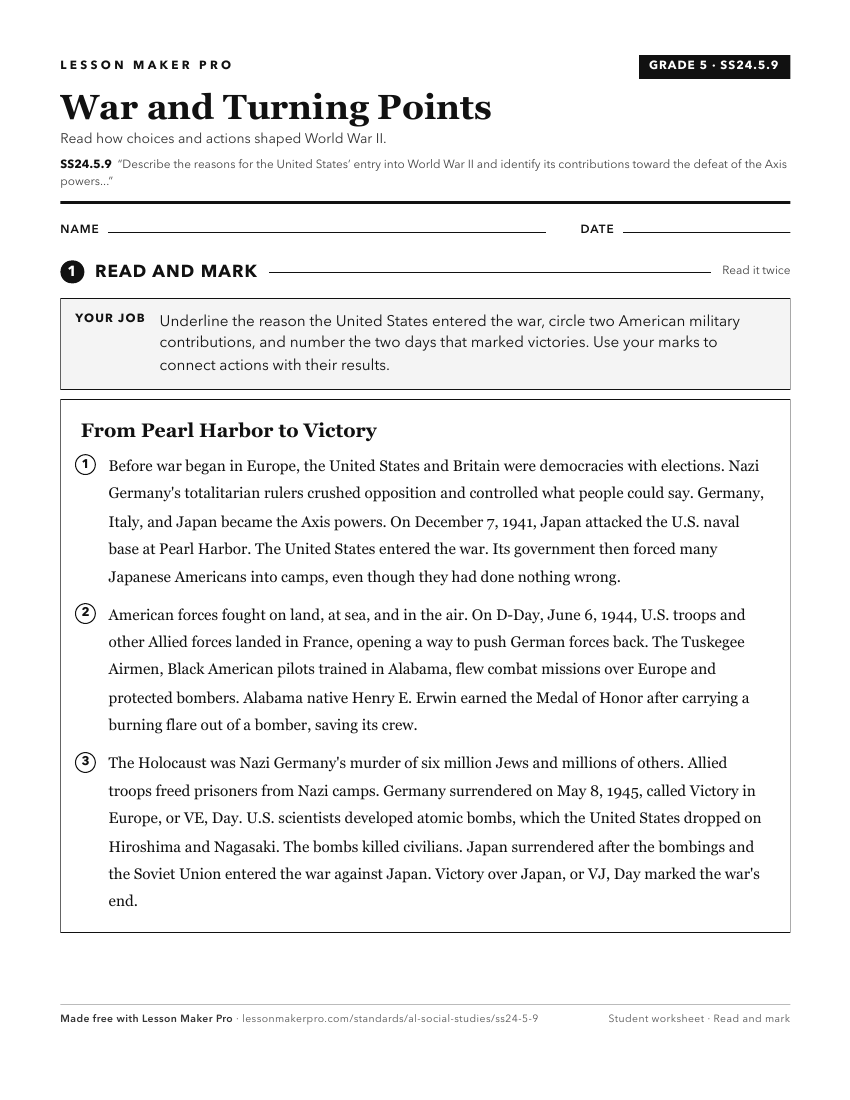
A ready-to-print activity worksheet aligned to SS24.5.9, with an answer key for the teacher on its own page. No account needed.
PDF, US Letter, prints cleanly in black and white.
Download the worksheetKeep exploring
Related Standards
- SS24.US2.7
Analyze how United States military involvement shaped major events of World War II.
- SS24.5.5a
Identify and explain international events that led to the United States’ entry into World War I.
- SS24.US2.6
Trace the progression of events and policies leading to World War II and the United States’ entry into the war.
Turn this cluster into a lesson
Grade, subject, topic, and the complete cluster are prefilled. Create one free, no account needed.
Also for this cluster:Make a WorksheetMake a QuizMake a Sub Lesson