Alabama Social Studies SS24.US2.3
Standard Cluster
Evaluate how key figures, events, and trends shaped United States society and culture from the conclusion of World War I through the 1920s. 3a Describe how the automobile, cinema, print media, and radio contributed to the rise in mass culture, economic growth, and expansion of the middle class during the 1920s. 3b Explain how art, literature, and music, including that produced by Alabamians, influenced both the Harlem Renaissance and the broader culture of the 1920s. 3c Explain why the 1920s comprised a period of significant social conflict as manifested by the Scopes trial, growth of the Ku Klux Klan, rise of nativist thinking, the Red Scare, and antisemitism. 3d Summarize the debate over prohibition and describe how prohibition contributed to social and cultural changes of the 1920s. 3e Trace the causes and course of Red Summer and subsequent violence into the 1920s, including the Tulsa Race Massacre.
2024 Alabama Course of Study: Social Studies
Cluster contents
Standards in This Cluster
SS24.US2.3 is a cluster heading. These are the individual standards under it.
- SS24.US2.3a
Describe how the automobile, cinema, print media, and radio contributed to the rise in mass culture, economic growth, and expansion of the middle class during t...
- SS24.US2.3b
Explain how art, literature, and music, including that produced by Alabamians, influenced both the Harlem Renaissance and the broader culture of the 1920s.
- SS24.US2.3c
Explain why the 1920s comprised a period of significant social conflict as manifested by the Scopes trial, growth of the Ku Klux Klan, rise of nativist thinking...
- SS24.US2.3d
Summarize the debate over prohibition and describe how prohibition contributed to social and cultural changes of the 1920s.
- SS24.US2.3e
Trace the causes and course of Red Summer and subsequent violence into the 1920s, including the Tulsa Race Massacre.
Teacher's field guide
What This Cluster Means
What Students Need to Do
- Students show how cars, movies, print media, and radio spread shared tastes and created jobs. They explain how Alabama artists shaped the Harlem Renaissance and why prohibition, the Scopes trial, and prejudice divided Americans. They trace racial violence from Red Summer in 1919 to the Tulsa Race Massacre in 1921.
What Mastery Looks Like
- A student can use a car ad and radio listing to explain how businesses reached more buyers and helped expand the middle class. They can name Alabama-born Zora Neale Hurston and explain how her writing reached readers beyond Harlem. They can place Red Summer and Tulsa on a timeline and use evidence to explain conflicts over race, immigration, religion, and alcohol.
Common Misconceptions
- Students may assume every family could afford a car or radio, or that prohibition stopped drinking. They may think all Harlem Renaissance artists came from New York. Some mistake Red Summer for a single riot or confuse the 1919 violence with Tulsa in 1921.
How to Assess It
- Exit ticket: Explain how radio helped create a shared audience, name one Alabama-born Harlem Renaissance writer, and explain why a white mob attacked Tulsa’s Greenwood district.
Lesson moves
Ways to Teach It
Give groups a 1920s car ad, radio schedule, movie poster, and magazine page; have them chart shared trends, new jobs, and buyers.
Compare a Zora Neale Hurston excerpt with a Langston Hughes poem, then write how each challenged stereotypes.
Match event cards for Red Summer, Tulsa, Scopes, Klan recruitment, immigration quotas, antisemitism, the Red Scare, and prohibition to cause and effect cards.
Put a 1920s radio set ad next to a streaming subscription ad; have students mark prices and how each reaches large audiences.
Free download
Printable SS24.US2.3 Worksheet
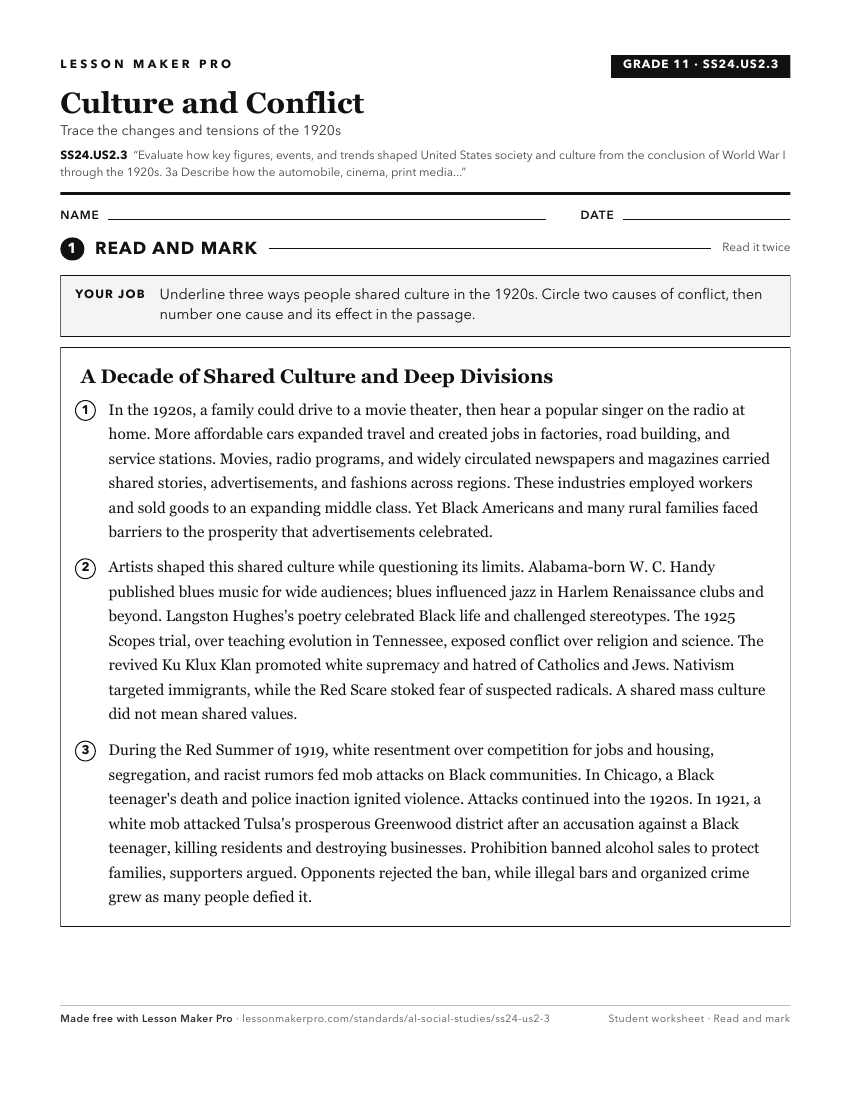
A ready-to-print activity worksheet aligned to SS24.US2.3, with an answer key for the teacher on its own page. No account needed.
PDF, US Letter, prints cleanly in black and white.
Download the worksheetKeep exploring
Related Standards
- SS24.US2.2c
Analyze how government actions in the United States during World War I produced both economic growth and social division.
- SS24.US1.6
Evaluate the influence of American social and political reform on the emergence of a national identity from the early to mid-nineteenth century.
- SS24.WH.8
Analyze the global cultural, economic, and political developments immediately following World War I.
- SS24.US2.8
Analyze the domestic, economic, and civil rights impact of World War II on United States society.
Turn this cluster into a lesson
Grade, subject, topic, and the complete cluster are prefilled. Create one free, no account needed.
Also for this cluster:Make a WorksheetMake a QuizMake a Sub Lesson