Alabama Social Studies SS24.US1.6
Standard Cluster
Evaluate the influence of American social and political reform on the emergence of a national identity from the early to mid-nineteenth century. 6a Describe the changes in political culture during the Age of Reform, including the concept of Jacksonian democracy. 6b Investigate and share information on the influence of individuals and movements of art, religion, education, and literature on the emergence of a national identity.
2024 Alabama Course of Study: Social Studies
Cluster contents
Standards in This Cluster
SS24.US1.6 is a cluster heading. These are the individual standards under it.
Teacher's field guide
What This Cluster Means
What Students Need to Do
- Students explain how voting and party politics changed during Jackson’s presidency. They examine how reformers, artists, writers, preachers, and educators shaped ideas about being American. They ask whose voices counted and whose were left out.
What Mastery Looks Like
- A student can explain that voting expanded for white men but not for everyone. They can connect Horace Mann’s schools and Hudson River School paintings to different ideas of a shared American culture. They can name a group excluded from voting.
Common Misconceptions
- Students may assume Jacksonian democracy gave everyone the vote. They may miss that abolitionists and supporters of Indian removal had sharply different ideas about who belonged in the nation. They may see paintings and books as decoration rather than evidence of those ideas.
How to Assess It
- Exit ticket: Explain how wider voting for white men and common schools shaped national identity. Name one group excluded from voting.
Lesson moves
Ways to Teach It
Give groups index cards labeled white male suffrage, Indian removal, abolition, and common schools; sort them by whose belonging each expanded or denied.
Ask: Could Jacksonian democracy claim to represent all Americans? Write three sentences using white male suffrage and Indian removal as evidence.
Match Horace Mann, Frederick Douglass, Hudson River painters, and revival preachers to school reform, abolition writing, national landscapes, and religious reform.
Show New York’s current voter registration form; compare its eligibility rules with the state’s 1821 rules for white and Black men.
Free download
Printable SS24.US1.6 Worksheet
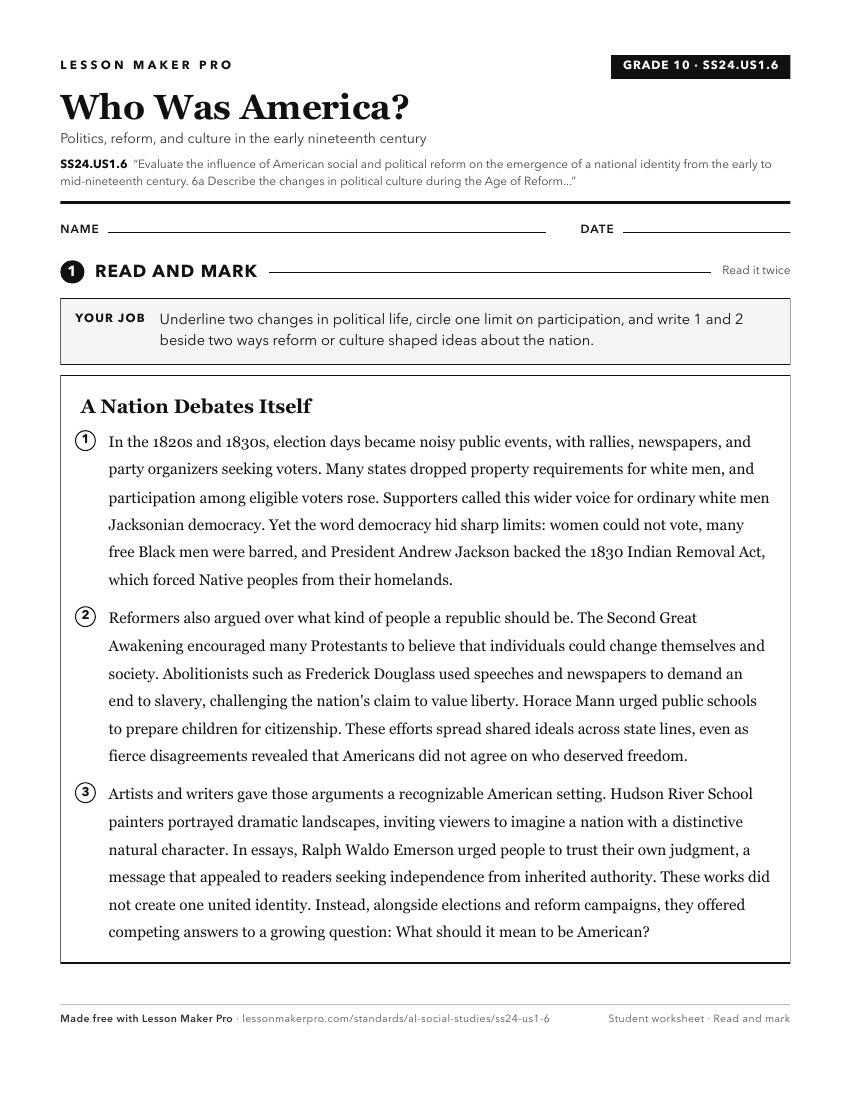
A ready-to-print activity worksheet aligned to SS24.US1.6, with an answer key for the teacher on its own page. No account needed.
PDF, US Letter, prints cleanly in black and white.
Download the worksheetKeep exploring
Related Standards
- SS24.US1.16
Describe the transformation of American society and politics during the late nineteenth and early twentieth centuries.
- SS24.US1.16a
Analyze how the growing awareness of economic and political corruption during the Gilded Age led to reform efforts on both state and national levels.
- SS24.6.11c
Assess the arguments made by groups and individuals seeking greater inclusion and advancement of fundamental values in the late 1700s, including women and Black...
Turn this cluster into a lesson
Grade, subject, topic, and the complete cluster are prefilled. Create one free, no account needed.
Also for this cluster:Make a WorksheetMake a QuizMake a Sub Lesson