Alabama Social Studies SS24.US2.3b
The Standard
- SS24.US2.3
- Evaluate how key figures, events, and trends shaped United States society and culture from the conclusion of World War I through the 1920s.
Explain how art, literature, and music, including that produced by Alabamians, influenced both the Harlem Renaissance and the broader culture of the 1920s.
2024 Alabama Course of Study: Social Studies
Teacher's field guide
What This Standard Means
What Students Need to Do
- Students study 1920s art, writing, and music, including work by Alabama-born Zora Neale Hurston and W. C. Handy. They explain how these works shaped the Harlem Renaissance and reached people beyond Harlem through books, magazines, and records.
What Mastery Looks Like
- A student can point to a detail in Hurston's writing or Aaron Douglas's art and explain how it portrayed Black life. They can explain how a recording of Handy's blues brought Black music to listeners beyond Harlem.
Common Misconceptions
- Students may think every Harlem Renaissance artist lived in Harlem, or that the movement was only about music. They may also confuse Handy's original song with Bessie Smith's later recording of it.
How to Assess It
- Exit ticket: Choose Hurston's essay, a Douglas illustration, or the 1925 recording of Handy's “St. Louis Blues.” Name one feature and explain its link to Harlem and audiences elsewhere.
Lesson moves
Ways to Teach It
Give pairs printouts of Hurston's 1928 essay and Douglas's 1927 illustrations; have them mark details that show Black identity, history, or pride.
Ask, “How did Hurston's writing and Handy's blues challenge older portrayals of Black life?” Require one detail from each work.
Run a card match: connect Hurston, Douglas, and Handy to a work, its medium, and how audiences outside Harlem encountered it.
Compare a 1925 record ad with a streaming app screen; students mark how each carries music beyond its starting community.
Free download
Printable SS24.US2.3b Worksheet
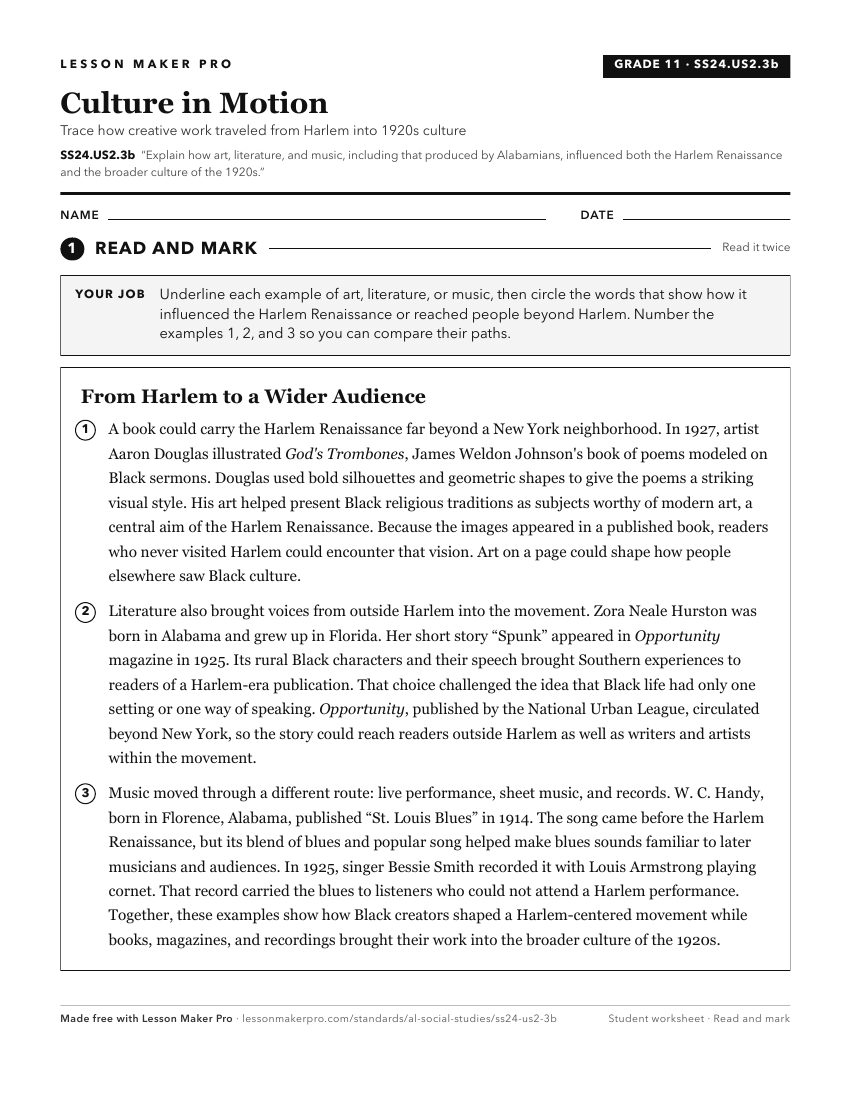
A ready-to-print activity worksheet aligned to SS24.US2.3b, with an answer key for the teacher on its own page. No account needed.
PDF, US Letter, prints cleanly in black and white.
Download the worksheetKeep exploring
Related Standards
- SS24.4.16a
Describe how industry, trade, farming, and the rise of Populism changed Alabama after the Civil War and shaped its economy and communities in the late 1800s.
- SS24.5.6
Identify the contributions of Alabamians to sports, film, and the arts during the early twentieth century, the Harlem Renaissance, and the Jazz Age.
- SS24.AS.15b
Explain the role of individuals and communities in helping to expand educational and entrepreneurial opportunities for Black Alabamians at the turn of the twent...
- SS24.5.11a
Identify Alabamians who contributed to the growth of American culture post-World War II into the 1970s.
Turn this exact standard into a lesson
Grade, subject, topic, and the complete standard are prefilled. Create one free, no account needed.
Also for this standard:Make a WorksheetMake a QuizMake a Sub Lesson