Alabama Social Studies SS24.5.6
Standard Cluster
Identify the contributions of Alabamians to sports, film, and the arts during the early twentieth century, the Harlem Renaissance, and the Jazz Age. 6a Explain how overcropping, the boll weevil, and low cotton prices affected farmers in Alabama.
2024 Alabama Course of Study: Social Studies
Cluster contents
Standards in This Cluster
SS24.5.6 is a cluster heading. These are the individual standards under it.
Teacher's field guide
What This Cluster Means
What Students Need to Do
- Students name Alabamians in sports, film, and music and tell what each did in the early 1900s. They connect blues to the Jazz Age and the Harlem Renaissance. They explain how worn-out soil, boll weevils, and low cotton prices hurt Alabama farmers.
What Mastery Looks Like
- A student identifies Jesse Owens as an Olympic runner, Tallulah Bankhead as a film actor, and W. C. Handy as a blues composer whose music influenced jazz. The student explains that repeated cotton planting weakened soil, boll weevils damaged crops, and low prices cut farmers' earnings.
Common Misconceptions
- Students may think boll weevils damaged cotton after harvest, rather than while it grew. They may think a large harvest always meant good pay, even when cotton prices were low. Some confuse the Harlem Renaissance with a place in Alabama.
How to Assess It
- On an exit ticket, have students match Owens, Bankhead, and Handy to their fields. Then ask them to explain how worn soil, boll weevils, and low prices each hurt a cotton farmer.
Lesson moves
Ways to Teach It
Give groups paper cotton bolls and farm income cards; remove bolls for worn soil and weevils, then lower the sale price.
Play a clip of W. C. Handy's "St. Louis Blues" and ask: What might Jazz Age musicians have borrowed from it?
Have pairs race to match Jesse Owens, Tallulah Bankhead, and W. C. Handy cards to a photo and a contribution.
Show a $20 grocery receipt and compare it with cotton earnings of $30 and $15; ask which farmer can pay the bill.
Free download
Printable SS24.5.6 Worksheet
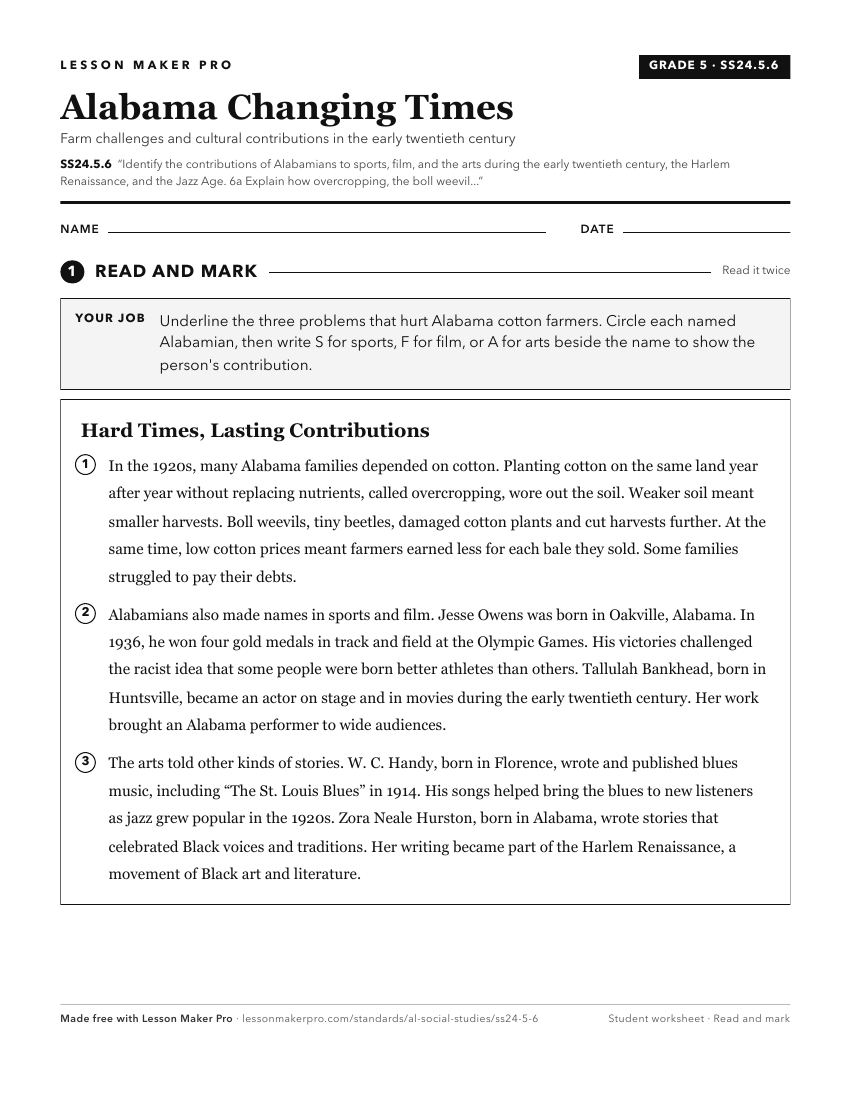
A ready-to-print activity worksheet aligned to SS24.5.6, with an answer key for the teacher on its own page. No account needed.
PDF, US Letter, prints cleanly in black and white.
Download the worksheetKeep exploring
Related Standards
- SS24.US2.3b
Explain how art, literature, and music, including that produced by Alabamians, influenced both the Harlem Renaissance and the broader culture of the 1920s.
- SS24.5.12e
Identify Alabamians who contributed to concurrent civil rights movements in the United States during the decades following World War II.
- SS24.4.15d
Recount the contributions of Alabamians who helped shape their state during Reconstruction.
- SS24.5.11a
Identify Alabamians who contributed to the growth of American culture post-World War II into the 1970s.
Turn this cluster into a lesson
Grade, subject, topic, and the complete cluster are prefilled. Create one free, no account needed.
Also for this cluster:Make a WorksheetMake a QuizMake a Sub Lesson